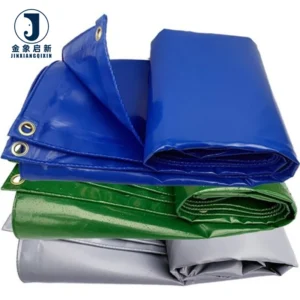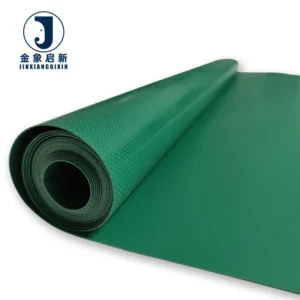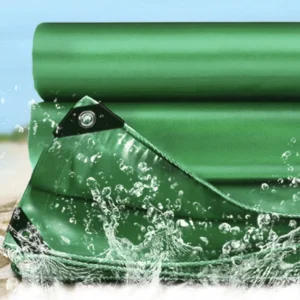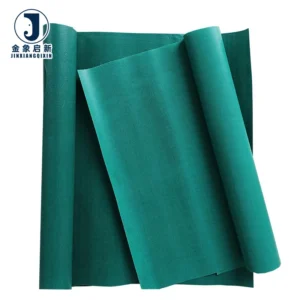
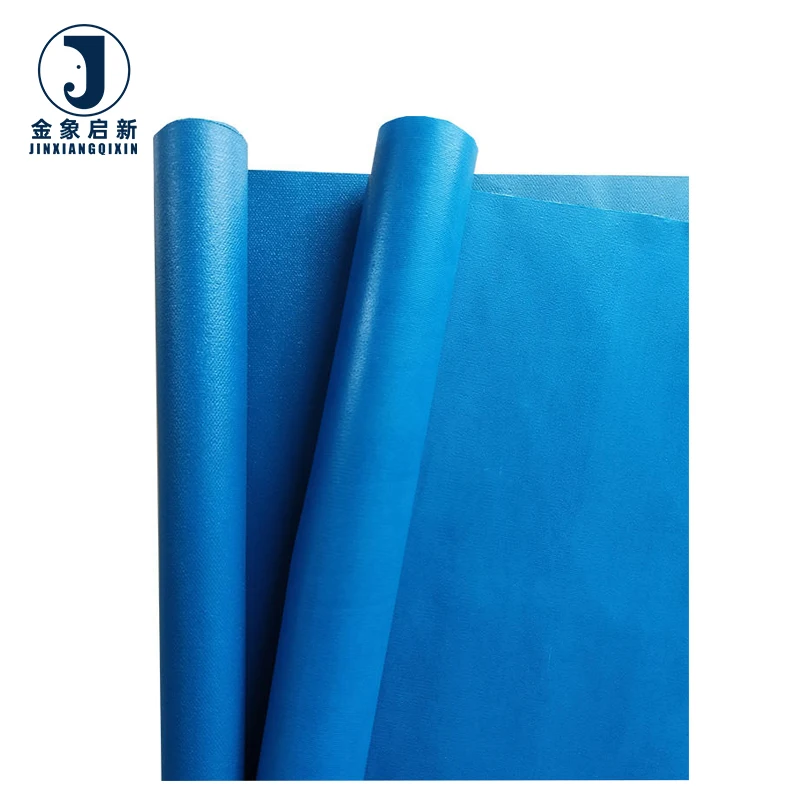
Coating Weight Transparency — every roll of PVC Coated Tarpaulin Roll ships with a specification sheet stating base fabric denier, coating method, and measured GSM, backed by dedicated QA at every production stage.
Technical Specifications
| Parameter | Value |
|---|---|
| Product Type | PVC Coated Tarpaulin Roll |
| Material | PVC + High-strength polyester mesh fabric |
| Coating Technology | Laminated technology & Hot-melt coating technology |
| Weight (GSM) | 350gsm / 420gsm / 500gsm / 550gsm / 600gsm / 750gsm |
| Total Thickness | 0.32mm / 0.35mm / 0.40mm / 0.45mm / 0.50mm / 0.65mm |
| Roll Width | 2m, 2.1m |
| Roll Length | 75m (2m width), 50m (2.1m width) |
| Color Options | Blue, Red, Yellow, Light Blue, Grey (customized colors available) |
| Key Features | Cold crack resistance, anti-mildew, anti-static treatment¹, waterproof, UV resistance² |
| Special Treatments Available | Flame retardant³, anti-static³, anti-cold, anti-mildew, 3P |
| Finish Product Size | Custom cut sizes available or sold by inventory roll |
¹ Anti-static grade not stated in source — confirm the standard required for your application.
² UV resistance test basis not stated — test report available on request, specifying grade.
³ Flame retardant and anti-static grades not stated — confirm the certification your market requires.
Application Suitability
| Application | Exposure & Requirement |
|---|---|
| Tent and awning fabric | Roll stock for fabrication — consistent GSM and colour match across rolls, weld seam integrity at panel joints |
| Inflatable and membrane structure fabric | Air-holding seams under positive pressure — adhesion strength between PVC coating and polyester mesh is critical |
| Truck awning and cargo cover | Road vibration, UV, and flex fatigue at tie-down points — tear propagation resistance at cut edges |
| Scaffolding and building enclosure | Wind load, scaffold contact abrasion — flame retardant grade may be required by local building code |
| Construction and equipment covers | Outdoor weathering, dirt and chemical splash — surface cleanability and coating adhesion at hem welds |
| Pond liner and fish tank | Continuous water immersion — hydrostatic resistance and anti-mildew treatment for long-term submersion |
| Plant and refinery maintenance | Chemical environment, hot work proximity — flame retardant and anti-static grades may be site-mandated |
| Marine and offshore maintenance | Salt spray, high humidity, deck abrasion — cold crack resistance for operations in northern climates |
Why a GSM Number Without Coating Method Is Not a Specification
A fabric’s weight tells you how much material is on the roll, but only the coating method and base fabric construction tell you how that material will perform at the weld line and under load.
Technical buyers often receive quotations stating a GSM figure with no reference to whether the PVC was laminated or hot-melt coated, and no denier or mesh count for the polyester base. The result is that two rolls of PVC coated tarpaulin base fabric denier GSM coating technology can carry the same weight label yet behave completely differently during fabrication — one holds a heat-welded seam under tension while the other delaminates at the first flex cycle. [NEED_CITE: adhesion strength test methods for coated fabrics per ISO 1421]
When the coating method is unspecified, fabricators set heat-weld parameters by trial and error, wasting material on test seams. When base fabric denier and weave are unknown, specifiers cannot predict tear propagation behaviour at cut edges and eyelet zones. The mapping between GSM and total thickness on this product family — from 350gsm at 0.32mm to 750gsm at 0.65mm — gives you a baseline for independent verification when rolls arrive at your facility.
Coating Technology and What It Controls
This PVC coated tarpaulin roll family is produced using both laminated technology and hot-melt coating technology. Laminated construction bonds a pre-formed PVC film to the polyester mesh under heat and pressure, yielding a smooth, uniform surface suited to printing and applications where visual consistency matters. Hot-melt coating applies*ve structure to create a mechanical lock that favours high-peel strength and weld seam durability.
For fabricators building welded assemblies — truck side curtains, inflatable structures, or architectural membranes — the coating method governs the heat-weld window. Hot-melt coated grades typically tolerate a wider temperature band before the base fabric is thermally damaged, while laminated grades offer a cleaner surface for high-frequency welding. Specifying the coating method on the purchase order removes a variable from your fabrication setup.
Reading the GSM-to-Thickness Map
Six weight grades are available across this product family, each with a corresponding total thickness: 350gsm at 0.32mm, 420gsm at 0.35mm, 500gsm at 0.40mm, 550gsm at 0.45mm, 600gsm at 0.50mm, and 750gsm at 0.65mm. This mapping lets specifiers cross-reference caliper measurements against stated weight. [NEED_CITE: tensile and tear test methods for coated fabrics per ISO 1421]
When a roll arrives on your dock, a micrometer check of total thickness against this table provides a rapid, non-destructive proxy for whether the PVC coating weight matches the quotation. A 500gsm roll measuring 0.33mm instead of the expected 0.40mm signals that coating weight was reduced — the base fabric may be carrying more of the total GSM than the specification intended, altering hand feel and weld behaviour.
How Base Fabric and Coating Weight Interact
Total GSM is the sum of base fabric weight and PVC coating weight. Two rolls can both be labelled 550gsm, yet one carries a heavier denier mesh with a thinner coating while the other uses a lighter mesh buried under more PVC. The first will show higher tensile and tear values; the second will offer better surface abrasion resistance and a thicker weld zone. Without a material specification sheet that breaks out base fabric denier and weave count from coating weight, a technical buyer cannot predict which roll will survive at a flex point and which will crack.
Coating adhesion — the bond strength between PVC and polyester — determines whether a welded seam fails cohesively within the coating or adhesively at the interface. Hot-melt coating, by penetrating the mesh, typically produces higher peel strength values than laminated construction. Roll width and length — available at 2m × 75m or 2.1m × 50m — influence how many transverse welds a fabricator must introduce on wide panels, each weld representing a potential failure origin if adhesion is marginal. [NEED_CITE: peel strength testing for PVC-coated polyester fabrics]
What Specification Gaps Cost in the Field
When flame retardant treatment is claimed on a purchase order but no grade is referenced, the fabric may arrive with a formulation that does not satisfy the building inspector or mine safety officer on site. The roll must then be replaced at project expense, and the fabricator absorbs the labour already invested in cutting and welding. Similarly, when anti-static properties are required for aviation fuel handling or grain elevator environments but the test standard is not documented, the site operator cannot produce the compliance paperwork that auditors demand.
Batch colour variation between rolls installed side by side on a large awning or building wrap forces a costly re-order. Cold crack resistance that is claimed without a test temperature means the fabric may stiffen and fracture during winter installation in northern climates. Each of these outcomes traces back to a missing data point on the original specification sheet. [NEED_CITE: DIN 4102 fire classification for building materials]
Process Control Backing This Roll Stock
The coating lines producing this PVC coated tarpaulin base fabric denier GSM coating technology maintain in-process checks on coating weight at intervals during each run, not only at the end. This means GSM drift is caught before an entire roll is wound, reducing the likelihood of out-of-spec material reaching your cutting table.
A 10-person R&D team handles material selection and sample development, so when a fabricator needs a specific peel strength or a membrane contractor needs a confirmed flame retardant grade, the formulation is developed and sampled before the production order is placed. Pre-shipment inspection covers every roll, with GSM and thickness spot-check data recorded and available as part of the dispatch documentation. ISO and CE certificates accompany the shipment, alongside certificates of origin and customs paperwork.
Documentation & Verification
- Material specification sheet stating GSM, base fabric denier and weave, and coating method for each roll
- GSM and thickness spot-check data recorded during pre-shipment inspection
- Test reports for UV and flame retardant grades where applicable, referencing exact standard achieved
- ISO and CE certificates provided with shipment, with scope relevant to coated fabric production
- Certificate of origin and customs documentation for international roll stock dispatch
- Roll packing list identifying each roll by weight, colour, and batch reference
Fabrication, Handling & Storage
- Hot-melt coated grades tolerate a wider heat-weld temperature band — confirm parameters per GSM grade before production runs
- Laminated grades suit high-frequency welding; test peel strength on scrap from the same 2m or 2.1m roll before full panel assembly
- Store rolls upright on cores to prevent flat-spot creasing, especially on 750gsm / 0.65mm grades which resist re-flattening
- Unroll and allow 500gsm and heavier grades to relax at workshop temperature before cutting to reduce tension-related distortion at weld lines
- Clean welded seams with PVC-compatible solvent only — aggressive cleaners may attack the coating-to-mesh bond on laminated constructions
- Plan cutting layouts around 2m × 75m or 2.1m × 50m roll dimensions to minimize transverse welds on large panels
Before You Send the Inquiry
Specify the GSM grade, coating method preference, and roll width you need, along with the end-use environment — indoor membrane, outdoor awning, or industrial enclosure — so that the correct special treatment can be confirmed. If your market requires a particular flame retardant or anti-static standard, state the regulation name and grade on the inquiry. Indicate whether you need stock rolls for your own fabrication or whether cut-to-size finished panels are required.
Frequently Asked Questions
Q: How is GSM verified before shipment and can I get a test report with my rolls?
A: Every roll undergoes GSM and thickness spot-checking during pre-shipment inspection. The recorded data is included in the dispatch documentation package, allowing you to compare measured values against the specification sheet. If you require an independent laboratory test report for a specific roll or batch, this can be arranged — state the test standard on your inquiry.
Q: What is the difference between laminated and hot-melt coating, and which suits welding-based fabrication?
A: Laminated coating bonds a PVC film to the mesh under heat and pressure, producing a smooth surface suited to printing and high-frequency welding. Hot-melt coating penetrates the mesh weave, creating a mechanical lock with higher peel strength that favours hot-air and wedge welding on structural seams. For load-bearing welded assemblies, hot-melt coated grades are typically specified.
Q: How does base fabric denier and mesh count relate to tensile and tear strength at each GSM grade?
A: Base fabric denier and weave density determine the mechanical backbone of the fabric. A higher denier mesh at a given GSM leaves less room for coating weight, favouring tensile and tear values over surface abrasion resistance. Request the material specification sheet for the GSM grade you are evaluating — it breaks out base fabric construction from coating weight so you can assess the balance.
Q: What flame retardant grades and test standards are available, and which markets do they cover?
A: Flame retardant treatment is available across this product family, but the specific grade must be confirmed against your local regulation — DIN 4102, NFPA 701, or other standards depending on your market. State the required standard and grade on your inquiry so the correct formulation is matched and a supporting test report can be provided.
Q: Can anti-UV and anti-static treatments be confirmed with independent test reports per roll?
A: Anti-UV and anti-static treatments are available as options, each tied to a specific test standard. The grade and test basis must be stated on the purchase order so the correct formulation is applied and documented. Test reports referencing the exact standard achieved can be supplied — confirm which standard your site or market requires when placing the inquiry.