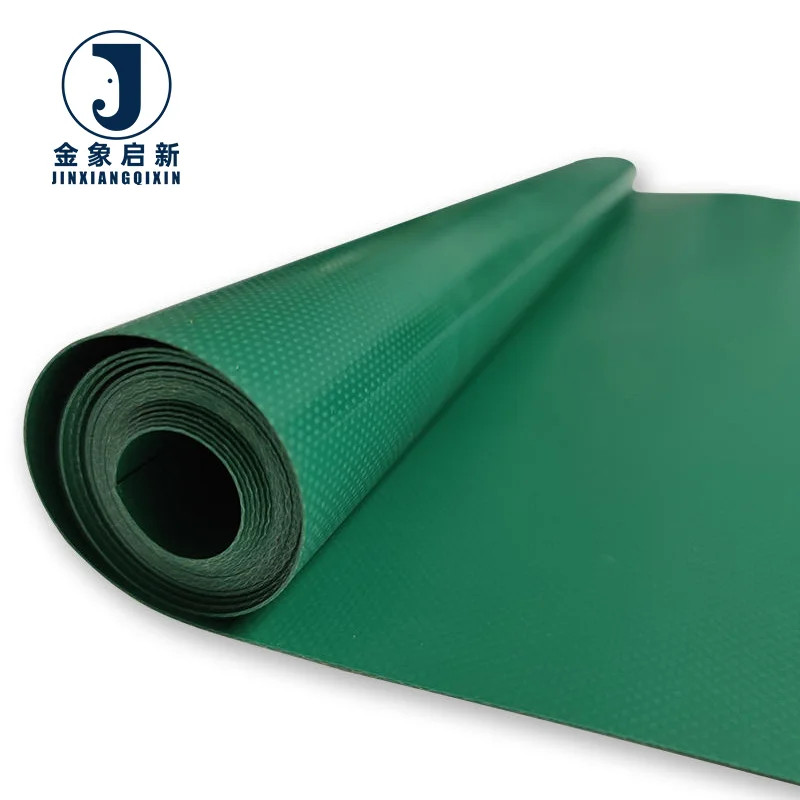
Deep Coating Process Control — Nearly three decades of PVC coating refinement ensures every roll from 350 to 900 GSM carries verified base fabric denier, mesh count and tensile data, so technical buyers can match the specification sheet to the material on the dock.
Technical Specifications
| Parameter | Value |
|---|---|
| Product Type | PVC Coated Tarpaulin Roll |
| Specification | 350 / 400 / 420 / 500 / 600 / 650 / 750 / 900 |
| Base Fabric Denier | 500D×840D (350–420); 500D×1000D (500); 1000D×1000D (600); 1000D×1300D (650); 1300D×1300D (750); 1000D×2000D (900) |
| Mesh Count (Warp × Weft) | 30×19 (350–500); 20×20 (600–750); 30×15 (900) |
| Coating Material | PVC, double-sided on polyester base |
| Total Thickness | 0.29 mm (400); 0.32 mm (420); 0.38 mm (500); 0.44 mm (600); 0.46 mm (650); 0.55 mm (750); 0.65 mm (900); not stated (350) |
| Weight (GSM) | 350 / 400 / 420 / 500 / 600 / 650 / 750 / 900 g/m² |
| Tensile Strength — Warp | 1650 N (350); 1800 N (400); 1850 N (420); 2050 N (500); 2500 N (600); 2550 N (650); 2750 N (750); 3900 N (900) |
| Tensile Strength — Weft | 1600 N (350); 1700 N (400); 1750 N (420); 1900 N (500); 2200 N (600); 2250 N (650); 2850 N (750); 3500 N (900) |
| Brittle Temperature | ≤ −50 °C to −60 °C |
| Softening Temperature | ≥ 80 °C |
| Key Features | Water resistant, flame retardant (grade not stated — confirm requirement), anti-UV (test basis not stated — confirm requirement) |
Application Suitability
| Application | Exposure & Requirement |
|---|---|
| Truck and trailer side curtains | Constant flex at load points, road spray, UV exposure, abrasion against cargo |
| Tent and awning fabrication by roll | Cut-and-weld production, consistent colour across rolls, dimensional stability under tension |
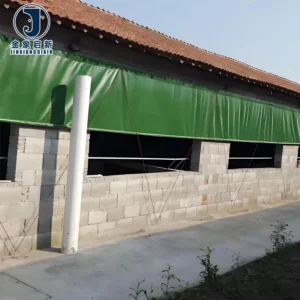
| Machine and equipment covers | Outdoor storage, dust and moisture ingress, repeated handling and folding |
| Membrane and inflatable structures | Known tensile and coating weight for structural calculation, heat-weld seam integrity |
| Balcony and window rain screens | Permanent weather exposure, wind loading, flexibility at low temperatures |
Why PVC Coated Tarpaulin Roll Material Properties Decide Fabrication Yield
The specification sheet must match the roll you cut — every grade, every time.
When a technical buyer orders a 600 GSM PVC coated polyester, they expect a 1000D×1000D base fabric at 20×20 mesh with 2500 N warp tensile. What arrives instead is sometimes a lighter construction with inflated GSM from excess filler, producing a fabric that welds poorly and tears at the hem. The gap between quoted PVC coated tarpaulin roll material properties and actual roll performance is where fabricators lose money — wasted material on the cutting table, failed seams during assembly and rejected loads at the end customer [NEED_CITE: tensile and tear test methods for coated fabrics per ISO 1421]. Without verified denier and density data per grade, the only way to confirm what is on the roll is to test it after the container has already been unpacked.
Base Fabric Denier as the Structural Backbone
PVC coated tarpaulin roll material properties begin with the polyester yarn. Across this product family, base fabric denier progresses from 500D×840D at the 350–420 GSM grades through 1300D×1300D at 750 GSM and 1000D×2000D at 900 GSM. Higher denier yarns carry greater individual filament strength, translating directly into the warp and weft tensile values listed in the specification table. For fabricators welding panels for inflatable structures or tensioned awnings, denier selection determines how much load the base fabric absorbs before the coating matrix transfers stress to the seam.
Double-Sided Coating and Heat-Sealed Edge Wrapping
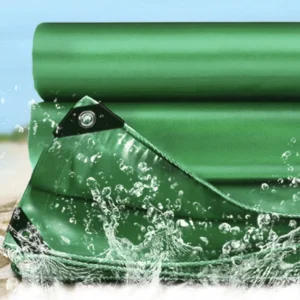
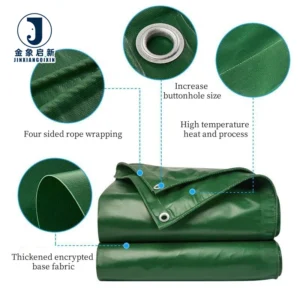
The polyester base receives PVC coating on both faces, locking the yarns in place and providing the waterproof barrier. At the roll edge, high-temperature heat-sealed seamless edge wrapping replaces traditional stitched hems, preventing delamination where the coating meets cut lines. For fabricators running automated welding lines, consistent coating thickness across the roll width — from 0.29 mm at 400 GSM to 0.65 mm at 900 GSM — determines the heat and pressure window needed for reliable seam formation [NEED_CITE: DIN 4102 fire classification for building materials].
Decoding GSM, Denier and Mesh Count Together
A 650 GSM roll with 1000D×1300D yarns at 20×20 mesh behaves very differently from a 650 GSM roll built on a lighter base with added coating weight. The first relies on high-denier yarns for tensile strength; the second depends on coating mass, which adds stiffness without proportional tear resistance. Mesh count reveals how tightly the yarns are woven — a 30×19 density at 500 GSM provides more interlocking points per square inch than a 20×20 at 600 GSM, distributing local puncture loads across a wider yarn network. Reading PVC coated tarpaulin roll material properties as a three-variable system — GSM, denier and mesh — prevents the common mistake of selecting a grade based on weight alone and discovering insufficient tear propagation resistance during fabrication.
The Hidden Cost of Selecting on GSM Alone
Choosing a PVC coated tarpaulin roll material properties grade by weight without verifying denier and mesh leads to predictable field failures. A truck cover made from a coating-heavy but low-denier roll flexes at tie-down points and the base fabric tears before the PVC surface shows wear. A tent panel cut from a roll whose colour drifted between batches shows a visible shade line once erected alongside panels from a previous delivery. Flame retardant claims unsupported by a stated test grade result in rejected inspections on construction sites that require documented compliance [NEED_CITE: DIN 4102 fire classification for building materials]. Each of these failures traces back to incomplete specification at the point of purchase rather than a manufacturing defect.
Procurement Verification at Every Production Stage
The material specification sheet issued with each roll states GSM, base fabric denier, coating method and colour reference, verified against a pre-shipment inspection record. Dedicated quality control operates at every production stage — from yarn tension during weaving through coating weight measurement to final roll inspection — with 100 percent inspection before dispatch. UV and flame retardant test reports accompany applicable grades, referencing the test standard used. Roll packing lists state net weight and roll count, supporting container loading plans. ISO and CE certificates, certificate of origin and customs documentation ship with every order.
Documentation & Verification
- Material specification sheet stating GSM, base fabric denier, coating method and colour reference per roll
- UV and flame retardant test reports with stated standard for applicable grades
- Pre-shipment inspection record with weight verification against stated GSM before dispatch
- ISO and CE certificates, certificate of origin and customs support documentation
- Roll packing list with net weight and roll count for container loading verification
Fabrication, Handling & Storage
- Heat-sealed edge wrapping requires matching temperature and pressure settings to the specific thickness grade — 0.38 mm at 500 GSM needs less dwell time than 0.65 mm at 900 GSM
- Double-sided PVC coating supports hot air welding; confirm airflow temperature against coating softening point (≥ 80 °C) before production runs
- Store rolls upright on pallets in a covered area to prevent flattening and permanent creasing across the coating surface
- At brittle temperatures (≤ −50 °C to −60 °C), allow rolls to acclimate before unrolling to avoid coating micro-cracking along the fold line
- Clean coated surfaces with mild detergent; solvent-based cleaners may affect the PVC plasticiser balance and surface finish
Requesting a Technical Quotation
Provide the target GSM grade, required roll width and annual volume to receive a specification sheet matched to your fabrication method. State any flame retardant grade or UV treatment standard your end market requires so the correct test report accompanies the shipment. Indicate whether you need stock colour or a custom colour reference with batch consistency across the full order, and whether finished cut sizes or roll stock only is required.
Frequently Asked Questions
Q: How is GSM verified per roll before shipment?
A: Each roll is weighed and measured against the stated GSM on the material specification sheet. The pre-shipment inspection record documents the actual weight per square metre, and dedicated quality control checks coating adhesion and surface consistency at every production stage before the roll is packed for dispatch.
Q: What flame retardant grades are available and how are they documented?
A: Flame retardant treatment is available across the range — confirm the grade required for your market (e.g., B1, M2, NFPA 701) and the applicable test report will be included with the shipment. Without a stated grade, a generic flame retardant claim cannot satisfy site inspection requirements.
Q: How do denier and mesh count affect tensile and tear performance?
A: Base fabric denier determines individual yarn strength, while mesh count defines how many yarns share a local load. A higher denier at a given GSM provides better tear propagation resistance, whereas a higher mesh count distributes puncture forces more evenly. Both must be read alongside GSM to assess PVC coated tarpaulin roll material properties accurately.
Q: What coating method is used and how does it affect welding?
A: The polyester base receives double-sided PVC coating, producing a uniform layer on both faces. Heat-sealed seamless edge wrapping at the roll edges prevents delamination. For fabricators, the consistent coating thickness per GSM grade allows stable heat and pressure settings during hot air or high-frequency welding.
Q: How are rolls packed and what documentation ships with them?
A: Rolls are packed in roll packing, bale packing or carton configuration as required. Each shipment includes a roll packing list with net weight and roll count, material specification sheets, applicable test reports, ISO and CE certificates, pre-shipment inspection records and certificate of origin for customs clearance.