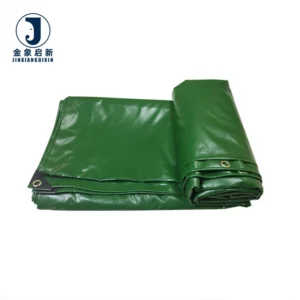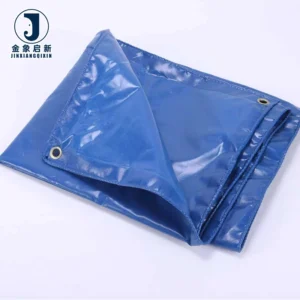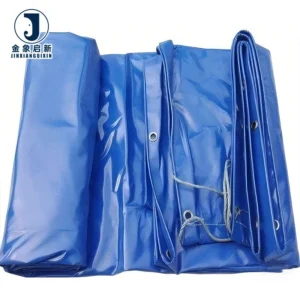
Material Specification Transparency — every roll of PVC coated tarpaulin ships with a documented GSM, base fabric denier and coating construction that you can verify at receiving, backed by dedicated QA at every production stage.
Technical Specifications
| Parameter | Value |
|---|---|
| Product Type | PVC Coated Tarpaulin |
| Base Fabric Denier | 200D×300D, 500D×500D, 840D×840D, 1000D×1000D |
| Weight Range | 250gsm–1500gsm (confirm the grade for this item) |
| Surface Finish | Available in glossy or matte finish |
| Temperature Range | -15°C to 70°C |
| Treatment | Waterproof, UV, flame retardant and anti-fungal treated |
| Flame Retardant | FR treated (grade not stated — confirm the grade required for your market) |
| UV Treatment | Customized (test basis not stated — request test report for your climate zone) |
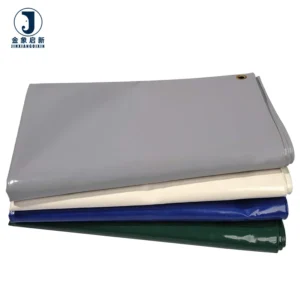
| Color Options | Blue, yellow, black, green, white, custom colors available |
| Size | 3×4m, 6×8m, 8×10m, 10×12m or custom made |
| Environment | Eco-friendly formulation |
| Standards | ISO, CE |
Application Suitability
| Application | Exposure & Requirement |
|---|---|
| Truck and trailer load covers | Constant flexing at tie-down points, road debris abrasion, prolonged UV exposure, rain and wind loading at highway speed |
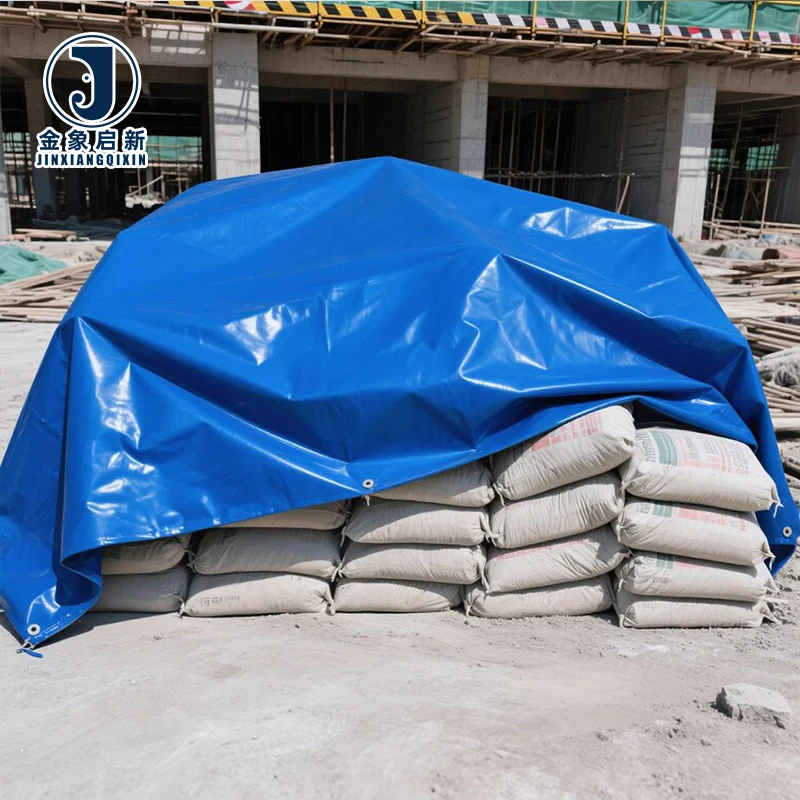
| Construction site and equipment covers | Puncture from sharp edges, dust and chemical splash, daily handling and folding, long-term outdoor storage |
| Agricultural and aquaculture pond lining | Permanent water immersion, soil chemistry contact, UV exposure on exposed edges, puncture from substrate |
| Tent and awning fabric manufacturing | Repeated folding and deployment, weld seam integrity at structural joints, color consistency across production batches |
Why the Denier and GSM Relationship Matters More Than Weight Alone
The base fabric construction determines how the coating weight translates into real-world tensile and tear performance.
When a quotation states a PVC coated tarpaulin at a given GSM, that number alone tells you nothing about the yarn density or weave pattern underneath. A 650gsm fabric built on a 200D×300D base with heavy coating fill will behave very differently under load than a 650gsm fabric built on a 1000D×1000D high-tenacity base with a thinner coating layer. Technical buyers who specify only by weight frequently receive material that meets the scale test but fails at the weld line or tears from a small puncture under field stress. [NEED_CITE: tensile and tear test methods for coated fabrics per ISO 1421]
How Base Fabric Denier Drives Tensile and Tear Behavior
The denier options available — from 200D×300D through to 1000D×1000D — define the yarn thickness in the warp and weft directions of the PVC coated tarpaulin base cloth. Higher denier yarns carry more load per thread, which directly raises the force required to initiate and propagate a tear. For applications involving mechanical stress at fold lines or tie-down points, specifying a higher denier base ensures the fabric fails gracefully rather than splitting suddenly from a nick or abrasion mark.
Coating Weight, Adhesion and the Weld Line
The coating weight range of 250gsm–1500gsm determines not only the overall material thickness but also how much PVC compound penetrates and bonds with the base fabric. Deep process control over coating weight and adhesion means the coating does not delaminate at the weld seam under flex stress. Glossy and matte surface finishes are available, and each interacts differently with hot air and wedge welding parameters — matte surfaces generally accept heat more evenly, while glossy finishes may require adjusted temperature profiles to achieve full seam fusion. [NEED_CITE: coating adhesion and peel strength testing for PVC coated fabrics]
Reading the Specification Sheet Against Your Application
Selecting the right PVC coated tarpaulin requires matching three variables simultaneously: denier, GSM and surface treatment. A construction equipment cover exposed to sharp edges benefits from a high-denier base with a mid-range coating that maintains flexibility in cold conditions. A pond liner that sees constant water contact and minimal mechanical stress may perform better with a lower denier but heavier coating that maximizes waterproof integrity. Temperature performance across the -15°C to 70°C range depends on the coating formulation maintaining adhesion without becoming brittle at the low end or softening at the high end, which is why coating chemistry matters as much as weight.
What Happens When the Specification Does Not Match the Field
Receiving PVC coated tarpaulin rolls that are lighter than the agreed GSM is one of the most common complaints from importers, and it is rarely caught until the material is cut and deployed. Beyond weight discrepancy, flame retardant grades claimed without a supporting test report can lead to failed site inspections, particularly in construction and mining ventilation where compliance documentation is checked before installation. Color variation between rolls in the same order becomes visible once panels are welded side by side, forcing fabricators to reject entire batches. Welded seams that fail before the fabric itself — typically at the point of maximum flex — trace back to coating adhesion that was insufficient for the welding method used. [NEED_CITE: common failure modes in coated fabric field installations]
Why Source This PVC Coated Tarpaulin Here
Three full production lines with 36 sets of professional equipment support consistent output across the 250gsm–1500gsm range, with batch-to-batch GSM control verified at every production stage. The 10-person R&D team handles material selection and sample development, so custom denier, color and finish requirements are developed and confirmed before full production begins. A dedicated QA/QC process with 100% pre-shipment inspection catches weight deviation, color drift and surface defects before rolls are packed. Nearly 30 years of focused coated fabric production means the coating formulation and adhesion parameters have been refined across diverse application conditions. Samples are developed within days for custom requirements, allowing you to verify weld behavior and color match before committing to a production run.
Documentation & Verification
- Material specification sheet stating GSM, base fabric denier and coating type for every roll
- Test report for UV and flame retardant grades provided where applicable to the order
- Pre-shipment inspection record with verified GSM per roll included in the dispatch package
- Roll packing list with net weight and roll count for receiving verification
- Certificate of origin and customs documentation for international shipment
- ISO and CE certificates available as part of the documentation set
Fabrication, Handling & Storage
- Hot air welding temperature must be calibrated to the specific glossy or matte finish on each roll
- Heavier GSM grades in the 1000D×1000D denier range require wider weld overlap to distribute peel stress
- Store rolls horizontally on pallets to prevent permanent creasing through the PVC coating layer
- Allow cold-stored rolls to reach ambient temperature before unrolling to avoid coating micro-cracking
- Reinforce eyelet zones with additional PVC patches when working with lighter 250gsm grades
- Use compatible PVC-based adhesives for field repairs to maintain coating chemistry consistency
Before You Request a Quotation
Provide the specific application environment and the mechanical or chemical exposure the fabric will face, along with the denier and GSM range you are evaluating. Confirm whether your target market requires a particular flame retardant grade or UV test standard, so the correct treatment can be applied and documented. Specify whether you need rolls in stock widths or custom sizes, the color reference if batch consistency across multiple rolls is critical, and whether you require finished cut panels or raw roll stock for your own fabrication.
Frequently Asked Questions
Q: How do I verify the GSM matches the quotation when rolls arrive?
A: Every order ships with a pre-shipment inspection record documenting the measured GSM per roll. On receipt, you can cross-check by cutting a measured sample and weighing it against the stated specification. Any discrepancy between the documented and actual weight is flagged during our 100% inspection before dispatch, so the issue is resolved before the rolls leave the facility.
Q: Can I get test reports for UV and flame retardant treatment with my shipment?
A: Test reports for UV and flame retardant grades are provided where applicable to your specific order. Because requirements vary by market — some regions require DIN classifications, others NFPA or local building codes — confirm the standard your project demands at the inquiry stage so the correct treatment is applied and independently tested before production.
Q: Will the color be consistent if I order multiple rolls for a single project?
A: Color consistency across rolls in the same production run is controlled through in-process QA checks at the coating stage. If your project involves welding panels side by side where any variation would be visible, request a roll-to-roll color verification as part of the pre-shipment inspection. Custom color references are matched during sample development before bulk production.
Q: What denier should I choose for a truck cover that flexes under tie-down straps?
A: Higher denier base fabrics such as 840D×840D or 1000D×1000D provide greater resistance to tear propagation at flex and tie-down points. The coating weight should be selected to balance flexibility with abrasion resistance — too heavy a coating on a high-denier base can stiffen the panel and increase stress at the fold line during daily use.
Q: How are welded seams tested before the material ships?
A: Seam integrity is verified during the 100% pre-shipment inspection, where welded joints are checked for adhesion and peel resistance. The welding parameters used must match the specific surface finish and GSM of the material; glossy and matte finishes respond differently to heat, and the QA team adjusts test conditions accordingly for each production batch.