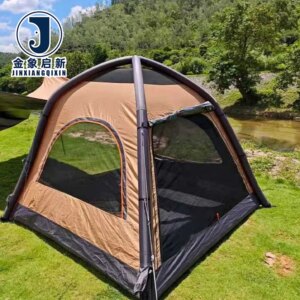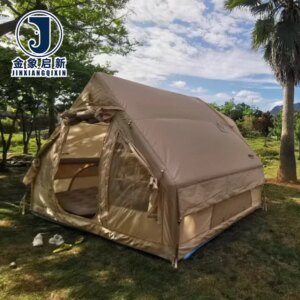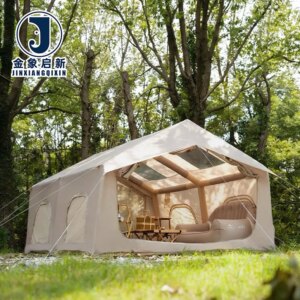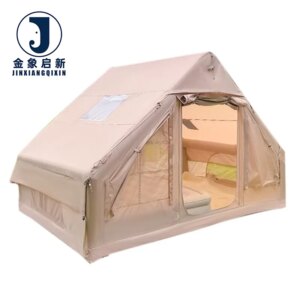
Precision-controlled coating adhesion — Our three full production lines maintain strict GSM and coating weight tolerances across every roll, ensuring the Inflatable Tent Fabric manufacturer custom orders you place match the material specification sheet exactly, from the first sample to the final shipment.
Technical Specifications
| Parameter | Value |
|---|---|
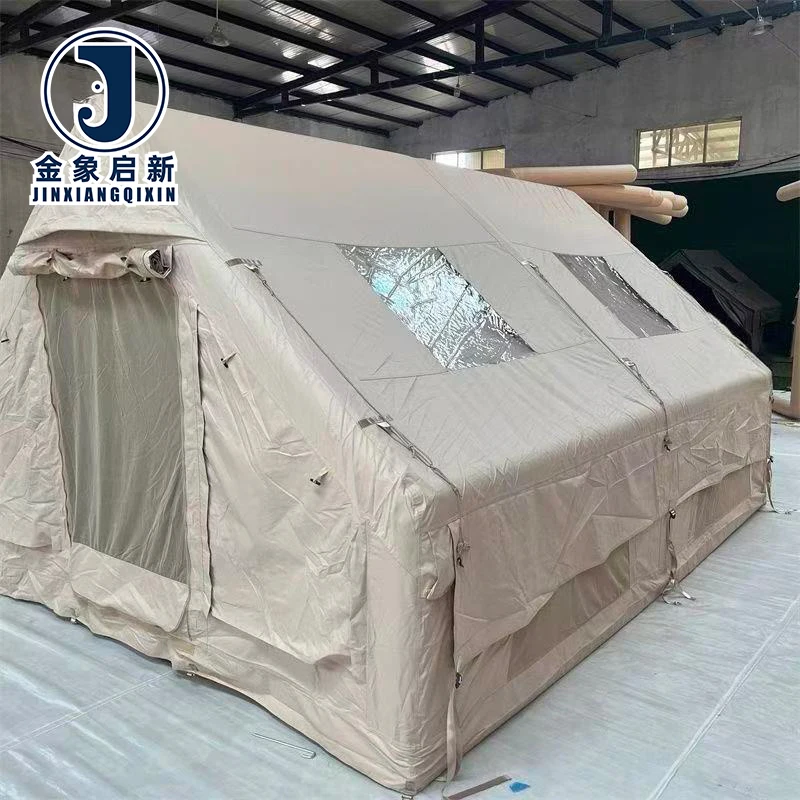
| Product Type | Inflatable Tent |
| Core Material | PVC Tarpaulin |
| Key Performance | Waterproof, UV-resistant (test basis not stated), Tear-resistant |
| Capacity | 6-8 Person |
| Season Rating | 4 Season |
| Opening Mechanism | Automatic Opening (Inflatable) |
| Customization Service | OEM & ODM (sample customization, pattern printing) |
| Quality Control System | Strict full-process quality inspection with dedicated QA&QC staff |
| Certifications | ISO9001, ISO14001, ISO45001, CE |
Application Suitability
| Application | Exposure & Requirement |
|---|---|
| Outdoor gear manufacturing | High-frequency inflation cycles, internal air beam pressure, external UV exposure |
| Commercial outdoor events | Rapid deployment, wind load resistance, waterproof integrity over multi-day use |
| Construction site temporary housing | Abrasion from ground contact, dust and debris exposure, flame retardant compliance |
| Industrial camping operations | Repeated packing and unpacking, temperature fluctuation, mechanical stress at seams |
Why Coating Adhesion Determines Air Beam Integrity More Than Base Fabric Weight
A heavy base fabric with poor coating adhesion will fail at the heat-welded seam long before the fabric itself tears.
Inflatable tent manufacturers often specify a high GSM expecting better structural performance, only to find the PVC coating delaminates at the welded joint when the air beam is pressurized. The coating must bond completely to the base yarn; without this bond, the heat welding process creates a weak seam that splits under internal pressure. We have seen coated rolls fail at the weld line because the coating weight was high but the adhesion process was not controlled [NEED_CITE: heat welding parameters for PVC coated fabric adhesion]. The Inflatable Tent Fabric manufacturer custom production process requires precise temperature and dwell time control during coating to ensure the PVC penetrates the base weave.
Coating Method and Heat Weld Compatibility
The PVC tarpaulin core material used in inflatable tent production must be coated using a method that allows consistent heat welding. Knife-over-edge coating produces a uniform layer that fuses predictably when high-frequency or hot-air welding is applied to air beam seams. The coating weight must be controlled so that the welding energy melts through the PVC layer and bonds to the base fabric without burning through or leaving uncured sections. Manufacturers sourcing Inflatable Tent Fabric must verify that the coating method specified is compatible with their welding equipment parameters.
UV-Resistant Treatment and Four-Season Exposure Claims
UV-resistant treatment is listed as a key performance feature for four-season inflatable camping tents, but the test basis is not stated in the source specification. Buyers specifying this fabric for prolonged outdoor shelter applications should request the test standard and exposure hours that support the UV claim before committing to a production run. Available in UV-resistant grades — confirm the test standard required for your target market’s outdoor exposure conditions. The treatment must be integrated into the PVC coating compound rather than applied as a surface finish to maintain effectiveness across repeated inflation cycles [NEED_CITE: UV degradation test methods for PVC coated textiles].
Base Fabric Construction and Tear Propagation
The tear resistance of PVC tarpaulin for inflatable tents depends on the base fabric denier and weave density, not solely on the total GSM. A tightly woven base with lower denier yarns can outperform a heavier, loosely woven construction when an air beam develops a puncture. The weave pattern determines how a tear propagates through the fabric; ripstop weaves limit tear spread while plain weaves allow it to continue. Technical buyers should request the base fabric specification alongside the total coated weight to evaluate structural performance for four-season rated inflatable shelter applications.
The Cost of Specifying GSM Without Verifying Coating Weight
Quoted GSM values that are not verified upon arrival result in air beams that cannot hold pressure or fabric that tears during deployment. When the coating weight is lighter than agreed, the heat-welded seams lack sufficient PVC material to form a complete bond, and the air beam fails at the joint under minimal internal pressure. Batch-to-batch inconsistency in coating weight also causes colour variation across rolls in the same inflatable tent fabric order, visible once panels are welded side by side. Buyers who do not verify GSM per roll before production absorb the cost of seam failures, colour mismatches, and rejected finished units [NEED_CITE: coating weight tolerance standards for PVC tarpaulin].
Why Source Inflatable Tent PVC Tarpaulin Here
Three full production lines and 36 sets of professional processing equipment support bulk capacity for inflatable tent fabric orders with reliable on-time delivery across commercial production schedules. The 10-person R&D team handles material selection, pattern printing, and custom sizing, developing samples within days so you can verify weld compatibility before committing to full production. Dedicated QA and QC staff inspect every production stage, with 100% pre-shipment inspection including roll-by-roll GSM verification and waterproof testing specific to inflatable tent applications. Nearly 30 years of focused coated fabric production provides deep process control over coating weight and adhesion quality. Sample customization is available to confirm colour accuracy, print registration, and heat weld performance before bulk dispatch.
Documentation & Verification
- Material specification sheet stating exact GSM, base fabric construction, coating type, and colour reference for each batch
- Quality inspection report with performance test results for waterproof integrity and structural load accompanying every shipment
- ISO9001, ISO14001, ISO45001, and CE certification documentation supporting import compliance in target markets
- Pre-shipment inspection record with roll-by-roll GSM verification before dispatch
- Test reports for UV-resistant and flame-retardant grades where applicable to the specification ordered
Fabrication, Handling & Storage
- Heat weld parameters must be adjusted to the specific PVC coating weight to ensure complete fusion at air beam seams
- Store rolls horizontally on pallets to prevent creasing that compromises the PVC coating layer before cutting
- Use compatible PVC adhesive for field repair of punctures on the waterproof tarpaulin surface
- Avoid dragging rolls across abrasive surfaces to protect the coated finish during warehouse handling
- Allow cold-stored rolls to reach ambient temperature before unrolling to prevent coating crack damage
Requesting a Fabric Specification for Your Inflatable Tent Line
Provide your air beam diameter, operating pressure range, and the deployment temperature range for your target market so we can recommend the appropriate base fabric denier and coating weight. Specify whether you require rolls in standard widths or custom widths to minimize waste in your panel cutting layout. Confirm any flame retardant grade or UV-resistance test standard required by your destination market’s regulatory framework. State whether you need pattern printing, custom colour matching, or sample development before placing the full production order.
Frequently Asked Questions
Q: How is GSM verified upon delivery, and what documentation supports the quoted weight?
A: Every roll is weighed and measured before dispatch, and a pre-shipment inspection record is provided showing the actual GSM per roll against the quoted specification. This inspection record accompanies the shipment alongside the material specification sheet, giving you documented proof that the Inflatable Tent Fabric manufacturer custom order matches what was agreed before production began.
Q: What is the test basis for UV-resistant claims, and how does it relate to outdoor service life?
A: UV-resistant treatment is available for prolonged sun exposure in four-season operating conditions, though the specific test basis is not stated in the current specification sheet. We recommend requesting the test standard and exposure hours relevant to your target market so you can verify that the treatment level is appropriate for the expected outdoor deployment duration of your inflatable camping tents.
Q: How is colour consistency maintained across multiple rolls in the same inflatable tent fabric order?
A: Dedicated QA and QC staff monitor the coating and colouring process at every production stage, with 100% inspection before shipment to verify batch-to-batch consistency. Rolls within the same order are produced from the same coating compound batch where possible, and colour reference checks are performed to ensure that panels welded side by side show no visible variation once the inflatable tent is assembled.
Q: What OEM and ODM customization options are available for pattern printing and sizing?
A: The 10-person R&D team supports full OEM and ODM customization including sample development, pattern printing, custom width and length, and material grade selection. Samples are developed within days so you can verify print accuracy, colour match, and heat weld compatibility before approving the bulk production run for your Inflatable Tent Fabric manufacturer custom order.
Q: What certifications accompany the product for import and regulatory compliance?
A: Each shipment is accompanied by ISO9001, ISO14001, ISO45001, and CE certification documentation, along with a certificate of origin and customs support documentation. Where flame retardant or specific UV-resistance grades are specified, the corresponding test reports are included to support compliance verification in your target market.