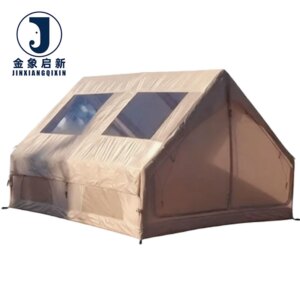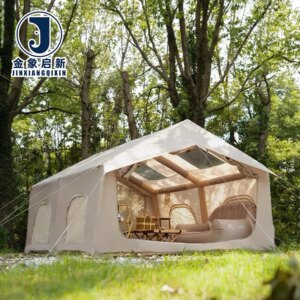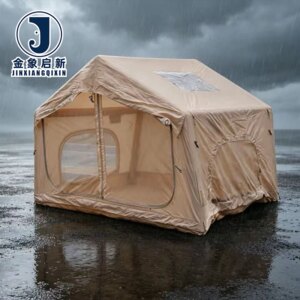
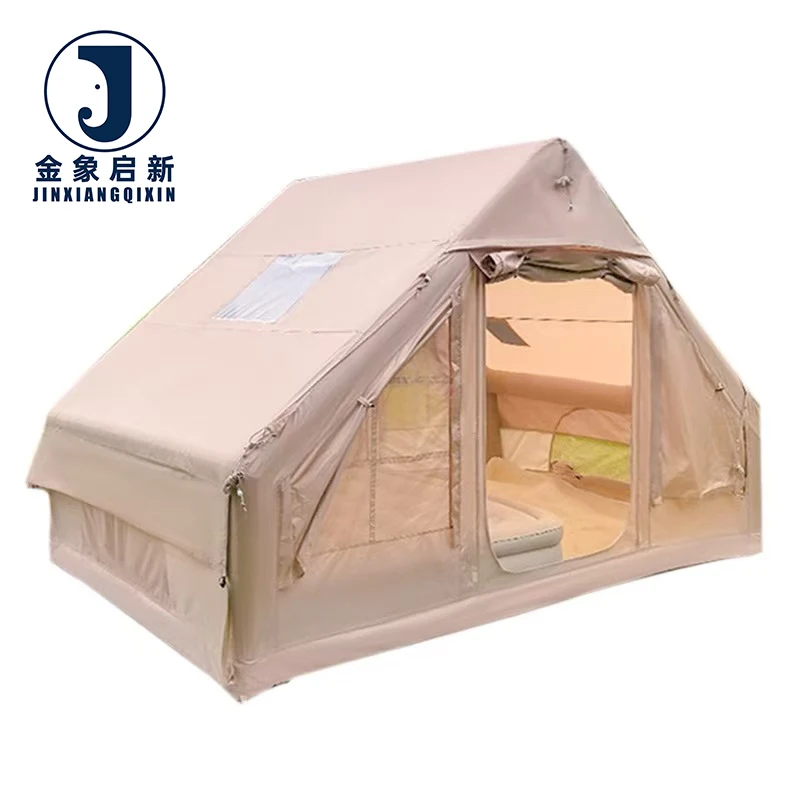
Precision Coating Control — Nearly 30 years of focused development in coated fabric formulations delivers repeatable GSM accuracy and coating adhesion across every roll of inflatable tent fabric produced.
Technical Specifications
| Parameter | Value |
|---|---|
| Product Type | Inflatable Tent |
| Core Material | PVC Coated Fabric |
| Product Form | 1-2 Person Quick Automatic Opening Inflatable Structure |
| Waterproof Rating | ≥10,000mm water column (source value — verify against manufacturer catalog) |
| UV Resistance | 4000 hours accelerated aging (source value — verify against manufacturer catalog) |
| Tear Strength | ≥300N (test standard not stated in source) |
| Deployment Cycle | 500+ cycles (source value — verify against manufacturer catalog) |
| Custom Sizing | Up to 5m length |
| Color Matching | Pantone codes supported |
| Customization | OEM & ODM, sample customization, pattern printing |
| Certifications | ISO9001, ISO14001, ISO45001, CE |
Application Suitability
| Application | Exposure & Requirement |
|---|---|
| Temporary site offices at construction projects | Prolonged UV exposure, wind loading, repeated inflation cycles, dust and debris abrasion |
| Equipment storage shelters for logistics operations | Rain and moisture ingress, ground contact, material handling impact, seasonal temperature fluctuation |
| Mobile command posts for industrial events | Rapid deployment frequency, visibility and branding requirements, high foot traffic wear |
| Emergency outdoor trip shelter | Unpredictable weather, compressed packing and transport, minimal setup time requirement |
Why Coating Adhesion Matters More Than Fabric Weight Alone for Inflatable Structures
An inflatable tent fails at the coating-to-substrate bond line long before the base fabric reaches its tensile limit.
When buyers specify inflatable tent fabric, the conversation often centres on GSM. Yet inflatable structures place a unique demand on the coating interface: internal air pressure exerts continuous outward force on every square centimetre of the coated surface. If the PVC layer does not bond uniformly to the polyester base weave, micro-delamination begins at the flex points where the structure inflates and deflates. I have seen coated rolls arrive on site with the coating peeling at the fold lines before the tent was ever inflated — a failure that traces directly to inconsistent knife coating pressure or insufficient plastisol penetration during manufacturing [NEED_CITE: coating adhesion test methods for PVC coated fabrics]. This is why sourcing from a verified inflatable tent fabric manufacturer with documented process control at every coating stage reduces the risk of field failures that no amount of fabric weight can compensate for.
Base Fabric Denier and Weave Density Under Internal Pressure
The polyester base fabric carries the structural load of an inflated tent. Denier and weave density together determine how the fabric distributes internal air pressure across its surface. A higher denier yarn in the warp direction resists the longitudinal stretching that occurs each time the structure is inflated, while weft density controls the lateral stability needed to maintain the tent’s intended shape. For inflatable tent fabric, selecting the correct base construction is not simply about maximising strength — it is about matching the weave to the inflation pressure and the geometry of the final structure.
Coating Weight and the Air Retention Boundary
The PVC coating layer serves two simultaneous functions: it creates the airtight membrane that holds internal pressure, and it shields the base fabric from moisture, UV radiation, and mechanical abrasion. Coating weight applied by the knife coating process directly influences both the flexibility of the fabric during folding and packing, and its resistance to puncture during handling on site. A heavier coating improves waterproofing but can stiffen the fabric to the point where repeated deployment cycles cause cracking at the fold lines. Balancing coating weight against the deployment frequency of the inflatable structure is where material selection experience becomes critical for any inflatable tent fabric manufacturer.
Heat-Welded Seams and the Coating Compatibility Factor
The seams of an inflatable tent are where air retention is won or lost. Heat welding fuses the PVC coating layers together, creating a bond that must be at least as strong as the parent fabric. The coating formulation — specifically the plasticiser type and concentration — determines the temperature window and dwell time required for a reliable weld [NEED_CITE: heat welding parameters for PVC coated fabric seams]. If the coating is too heavily loaded with fillers, the weld interface becomes brittle and fails under cyclic pressure loading. This is why inflatable tent fabric manufacturers must control coating chemistry from formulation through to the finished roll, rather than treating welding as a downstream fabrication concern.
How Inconsistent Coating Thickness Creates Hidden Failure Points
A roll of coated fabric may pass a visual inspection and still carry significant variation in coating thickness from edge to centre or from the beginning of the roll to the end. In inflatable structures, thinner sections of coating become stress concentrators under internal pressure — they flex more, heat up more under UV exposure, and delaminate first. I have observed inflatable shelters where the failure occurred in a perfectly straight line corresponding to a coating thickness transition zone on the original roll. Batch-level quality records showing coating weight measurements at multiple points across the web width are essential for buyers who cannot afford to discover thickness variation after the tent has been cut and welded [NEED_CITE: coating thickness uniformity standards for technical textiles].
Why Procurement from a Coating-Controlled Source Reduces Risk
Three full production lines and 36 sets of processing equipment allow this facility to maintain dedicated line assignments for inflatable-grade coated fabric, preventing cross-contamination of formulations between product families. A 10-technician R&D team handles material selection, pattern printing, and sample development in-house, meaning coating adjustments for specific inflatable applications do not require third-party compounders. Every production stage includes dedicated QA/QC checkpoints with 100% pre-shipment inspection, so the inflatable tent fabric that arrives at your fabrication floor matches the specification on the purchase order. ISO9001, ISO14001, and ISO45001 certifications govern the management systems, while CE marking supports export compliance. Samples are developed within days for custom sizing, colour, or treatment requirements.
Documentation & Verification
- Coating weight verification per roll against the stated specification before dispatch
- Material specification sheet detailing base fabric denier, weave, and coating type
- UV and waterproof test data accompanying each production batch
- ISO and CE certificates provided with shipment documentation
- Pre-shipment inspection record covering surface, colour, and dimensional checks
Fabrication, Handling & Storage
- Heat weld temperature and dwell time should be calibrated to the specific PVC coating formulation on this inflatable tent fabric
- Store rolls upright on end caps to prevent compression flat-spotting on the coating surface
- Avoid folding inflatable tent fabric at sharp angles during packing to prevent white-line stress marks
- Clean with mild detergent only — solvent-based cleaners will degrade the plasticiser in the PVC coating
- Allow fabric to reach ambient temperature before unrolling in cold conditions to prevent coating micro-cracking
What to Include in Your Next Enquiry
Provide your intended application, expected deployment frequency, and the environmental conditions the inflatable structure will face — including UV exposure duration and temperature range. Specify whether you require roll stock or finished cut-to-size panels, along with any Pantone colour references or logo printing requirements. Confirm the fire safety or compliance standards your end market demands so the correct treatment can be specified from the outset.
Frequently Asked Questions
Q: How does PVC coating weight and base fabric denier affect the wind resistance of an inflatable tent?
A: The base fabric denier and weave density carry the structural tensile load, while the PVC coating weight contributes to puncture resistance and airtightness. Higher denier yarns resist the stretching forces caused by wind gusts, and adequate coating weight prevents air leakage through the membrane. Both must be specified together — optimising one while neglecting the other compromises overall performance. Request a material specification sheet that states both values clearly.
Q: What does accelerated UV aging data mean for real-world outdoor deployment?
A: Accelerated aging tests compress years of UV exposure into controlled chamber hours, providing a comparative basis between fabric batches. However, actual field life depends on geographic latitude, altitude, seasonal sun intensity, and whether the tent is deployed continuously or intermittently. Use the accelerated aging figure as a batch-consistency benchmark rather than a precise lifespan prediction, and confirm the test standard used with your inflatable tent fabric manufacturer.
Q: Are heat-welded seams stronger than sewn seams for inflatable tent construction?
A: Heat welding fuses the PVC coating layers into a continuous airtight bond, which is essential for inflatable structures that must hold internal pressure. Sewn seams create needle holes that compromise airtightness and require additional taping or sealing. For inflatable tent fabric, heat welding is the standard joining method, and the weld strength must be validated against the parent fabric tensile and tear values to ensure the seam does not become the weakest point.
Q: Can Pantone colour matching be maintained consistently across bulk roll orders?
A: Pantone colour matching is supported, with the coating formulation adjusted to the specified reference. Batch-to-batch colour consistency depends on controlled pigment dosing and consistent coating thickness during production. Request a pre-production sample for approval, and ask for batch-level colour comparison records with your bulk order to verify that all rolls fall within the agreed tolerance before cutting begins.
Q: Is fire-retardant treatment available with supporting test documentation?
A: Flame-retardant grades are available — confirm the specific grade required for your market, such as B1, M2, or NFPA 701, at the enquiry stage. Test reports documenting the applicable standard and classification can be provided per batch. Specifying the fire safety requirement upfront ensures the correct additive package is incorporated into the PVC coating formulation during production.