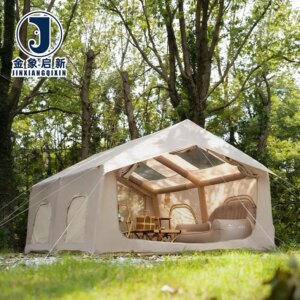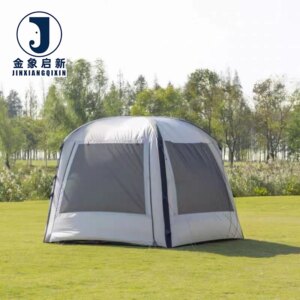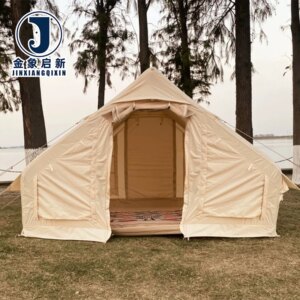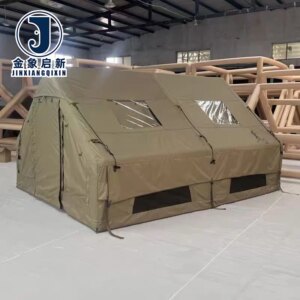
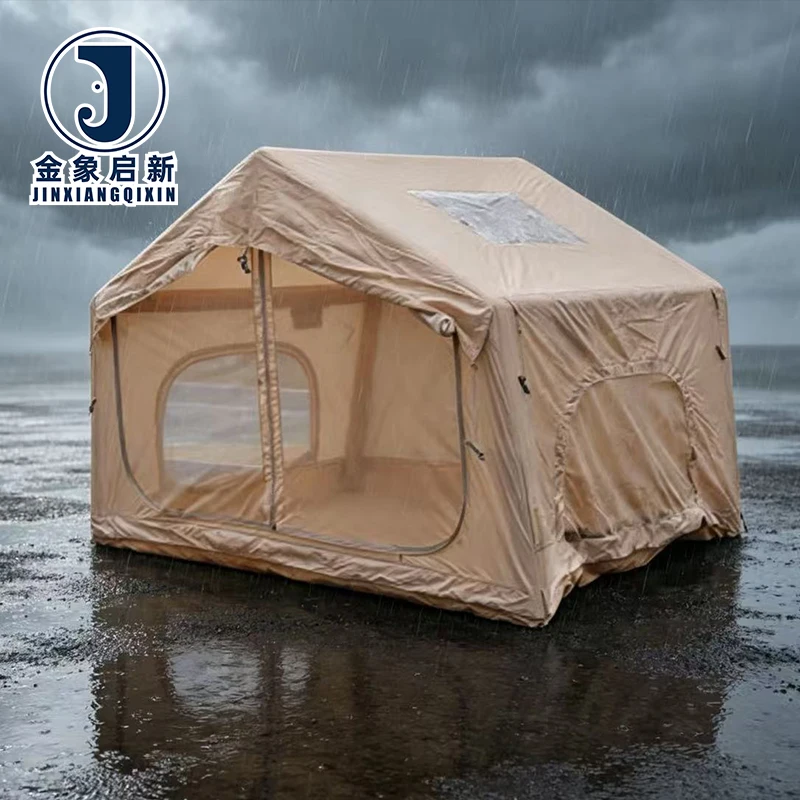
Deep coating control — every roll of inflatable tent fabric is weighed and measured at the coating head, ensuring the PVC layer matches the quoted specification before it reaches the slitter.
Technical Specifications
| Parameter | Value |
|---|---|
| Product Type | Inflatable Tent |
| Capacity | 5-8 Person |
| Core Material | PVC tarpaulin |
| Season Rating | 4-Season |
| Opening Mechanism | Quick Automatic Opening (Inflatable) |
| Waterproof | Fully waterproof coated construction |
| UV Resistance | Available in UV-resistant grades — confirm the grade required for your market |
| Fire Retardancy | Available in flame retardant grades — confirm the grade required for your market |
| Anti-Static | Available in anti-static grades — confirm the standard required for your site |
| Tear Resistance | Tear-resistant PVC-coated structure |
| Customization | OEM & ODM (sample customization, pattern printing, material selection, product design) |
| Standards | ISO9001, ISO14001, ISO45001, CE |
Application Suitability
| Application | Exposure & Requirement |
|---|---|
| Construction site temporary facilities | Daily inflation cycles, abrasive ground contact, dust ingress, site safety compliance for fire and static |
| Outdoor event rapid deployment structures | Frequent transport and re-erection, UV exposure across multi-day events, crowd-adjacent wear and soiling |
| Agricultural mobile storage in remote locations | Prolonged sun exposure, wind-driven rain, chemical contact from fertiliser or feed dust, uneven terrain puncture risk |
Why "Flame Retardant" on a Data Sheet Is Not Enough Without a Grade
A fire classification only matters when the test standard matches the regulation your site must satisfy.
Inflatable tents used on construction sites or at public events face scrutiny from fire marshals who ask for a specific test result, not a generic claim. We have seen fabric labelled as fire-resistant fail a site audit because the certificate referenced a standard the local authority does not recognise. An Inflatable Tent Fabric manufacturer must be able to state the exact grade and the test method behind it, so you can cross-reference with your compliance requirement before the order is placed [NEED_CITE: fire classification standards for temporary structures and tents].
Coated Fabric Engineered for Repeated Inflation Cycles
An inflatable tent places demands on its shell material that a static structure does not. Each inflation cycle stretches the PVC tarpaulin at the seam lines and around valve ports, and the coating must flex without cracking or delaminating from the base fabric. Our Inflatable Tent Fabric manufacturer process controls coating adhesion at the point of application, so the bond between PVC layer and woven substrate holds through repeated pressurisation and deflation sequences.
Rapid Deployment Without Specialist Labour
The quick automatic opening mechanism depends on the air beams holding their profile under pressure. Fabric stiffness, weld integrity and valve seat geometry all contribute to a structure that stands up in minutes rather than hours. We develop material samples for inflatable tent prototypes so you can validate beam behaviour before committing to a production run [NEED_CITE: inflatable structure engineering and air-beam pressure design].
Reading the Specification Sheet Beyond the Weight Number
GSM tells you how much material is in each square metre, but it does not tell you how that weight is distributed between base fabric and coating. A heavy coating on a light base fabric will feel substantial on the roll yet tear easily along the warp when an inflatable beam flexes under wind load. Conversely, a dense base fabric with a lean coating delivers high tensile strength but may show pinholes after repeated folding. For inflatable tent applications, the ratio of coating weight to base fabric denier determines both the puncture resistance of the air beams and the long-term flexibility of the weld lines. Requesting a material specification sheet that breaks down base fabric denier, weave count and coating weight separately gives you a far clearer picture than a single GSM figure.
The Hidden Cost of Specifying on Price per Kilogram Alone
When inflatable tent fabric is sourced on cost per kilogram, suppliers may reduce coating thickness to hit a target price while maintaining the quoted GSM by using a heavier, lower-grade base yarn. The result arrives on time and weighs the same, but the weld lines fail at lower peel strength and the surface shows uneven gloss under sunlight. Batch colour variation becomes visible when two rolls are inflated side by side at an event [NEED_CITE: coating weight and adhesion test methods for PVC tarpaulin per ISO 1421].
Why Source Inflatable Tent Fabric Here
Three full production lines and 36 sets of processing equipment allow us to hold tight tolerances on coating weight across the entire run, which matters when air-beam welds must perform identically on every panel.
A 10-person R&D team works with you on material selection, pattern printing and product design, developing samples within days so you can test inflation behaviour before bulk commitment.
Dedicated QA and QC staff inspect every roll before shipment, recording GSM, coating thickness and colour against the reference standard so your inflatable tent order arrives with full traceability.
Full OEM and ODM capability covers everything from custom width slitting to printed branding, letting you consolidate fabric sourcing for multiple inflatable tent models under one supply agreement.
Documentation & Verification
- Material specification sheet listing GSM, base fabric denier and coating weight for each inflatable tent roll
- UV and flame-retardant test reports matching the grade you specified at order confirmation
- Pre-shipment inspection record covering weight, colour and coating adhesion per roll
- Certificate of origin and customs documentation aligned with your import market requirements
Fabrication, Handling & Storage
- Hot-air weld temperature must match the PVC coating formulation used on the inflatable beam panels to avoid weak seams
- Store rolls upright on pallets to prevent flat-spotting that can cause crease marks on the inflatable tent surface
- Allow cold-stored rolls to reach ambient temperature before unrolling to avoid coating crack on inflation
- Use PVC-compatible cleaners only; solvent-based products can degrade the coating surface and affect weld adhesion
- Plan cutting layout to minimise transverse welds across air-beam sections where flex stress concentrates
What We Need to Quote Your Inflatable Tent Fabric
Tell us the inflation pressure your beam design operates at, the climate range the tent will be deployed in and the fire or anti-static standard your market requires. Share the roll width you run on your welding equipment and whether you need printed branding or solid colour. If you have an existing inflatable tent prototype, we can match the current material or propose an alternative for sample testing.
Frequently Asked Questions
Q: How is the fabric weight verified on arrival and what proof is provided?
A: Every roll is weighed and measured at the coating line and again during pre-shipment inspection. The inspection record states the actual GSM per roll, and you can verify on arrival by cutting a measured sample and weighing it. We include this record with the packing list so your QC team has a baseline for comparison.
Q: What fire-retardant grades are available for inflatable tent fabric?
A: We supply inflatable tent fabric in multiple flame-retardant grades depending on your market regulation. State the standard your site or event authority requires at inquiry stage, and we will provide the matching test report with your sample so you can confirm compliance before placing the bulk order.
Q: How do you control colour consistency across multiple rolls in one order?
A: Colour is matched against a signed reference swatch at the coating head and again during pre-shipment inspection. Each roll in your inflatable tent order is checked side by side under controlled lighting. The inspection record documents the result, ensuring every roll in the shipment is visually uniform when deployed together.
Q: What customization options exist for width, printing and minimum order?
A: We offer custom roll widths, pattern printing and branding for inflatable tent fabric. OEM and ODM services cover sample development, material selection and product design. Share your required width and print artwork at inquiry stage and we will confirm the feasible minimum and sample lead time.
Q: Which certifications and documents ship with each order?
A: Each shipment includes ISO9001, ISO14001, ISO45001 and CE certification documentation relevant to the inflatable tent fabric, along with a certificate of origin, packing list and material specification sheet. Additional customs or compliance documents can be arranged based on your import country requirements.