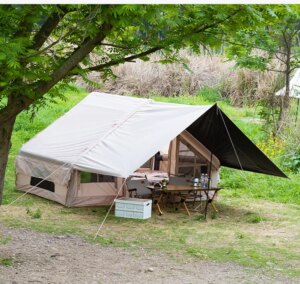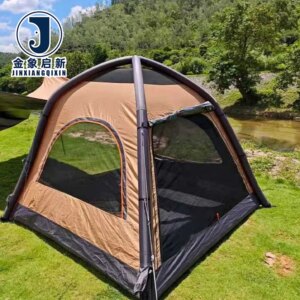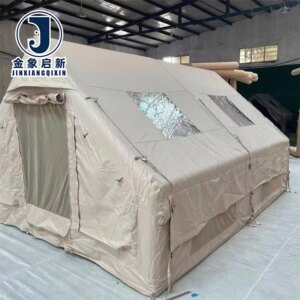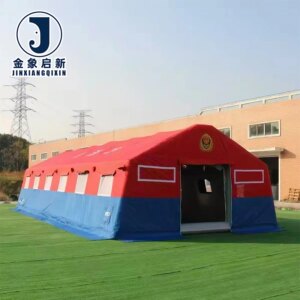

Coating formulation control — three production lines with in-process weight monitoring keep PVC layer thickness uniform across every roll of inflatable tent fabric.
Technical Specifications
| Parameter | Value |
|---|---|
| Product Type | Inflatable Tent |
| Core Material | PVC tarpaulin |
| Key Performance | Waterproof, UV-resistant (test basis not stated in source), tear-resistant, fire-retardant (grade not stated in source), anti-static (standard not stated in source) |
| Capacity | 6-8 Person |
| Construction | Single layer |
| Season Rating | Four-season |
| Opening Mechanism | Quick automatic opening (inflatable) |
| Customization | OEM & ODM, sample customization, pattern printing, material thickness adjustment, custom color matching |
| Standards | ISO 9001, ISO 14001, ISO 45001, CE |
Application Suitability
| Application | Exposure & Requirement |
|---|---|
| Commercial outdoor equipment manufacturing | Repeated inflation cycles, internal air pressure stress, weld seam integrity under flex |
| Wholesale distribution of branded tent lines | Batch-to-batch colour and GSM consistency across container loads |
| Rental and event operations | Frequent pack-and-unpack abrasion, UV exposure, public safety fire codes |
| Four-season outdoor structures | Temperature swings, snow load on inflated beams, moisture ingress prevention |
Why Inflatable Tent Fabric Fails at the Weld Before the Fabric Does
Weld strength must match the base fabric tear strength, or the seam becomes the weakest link under inflation pressure.
When PVC coated fabric is heat-welded into inflatable air beams, the coated surfaces melt and fuse. If the coating formulation or weight is inconsistent between batches, the welding temperature that worked on the last roll may over-melt or under-bond the current one. The result is a seam that peels apart while the surrounding fabric remains intact — a failure pattern I have encountered repeatedly when sourcing from suppliers who treat coating as a commodity step rather than a controlled process. [NEED_CITE: tensile and tear test methods for coated fabrics per ISO 1421]
For an Inflatable PVC Tent Manufacturer, this means every roll must arrive with documented coating weight and a consistent thermal response profile so your fabrication team can set weld parameters with confidence.
How Coating Weight Governs Air Beam Integrity
The PVC coating layer does more than block water — it is the structural matrix that transfers inflation pressure across the woven base fabric. An Inflatable PVC Tent Manufacturer selecting material for air beams needs a coating that bonds firmly to the yarns without penetrating so deeply that the weld zone starves of surface polymer. Our coating lines are calibrated to hold layer thickness within a controlled band, ensuring that the heat-activated surface remains available for reliable seam fusion during fabrication.
Fire-Retardant and Anti-Static Grades for Commercial Compliance
Inflatable tents deployed at public events or commercial campsites often must meet local fire safety codes. Fire-retardant treatment is available for this fabric — confirm the grade required for your market before ordering, as requirements differ between regions and application classes. Anti-static formulation is also available in options to reduce dust attraction during manufacturing and field use, particularly in arid environments where airborne particulates cling to charged surfaces. [NEED_CITE: fire classification standards for temporary outdoor structures]
Reading the Specification Sheet Beyond GSM
Buyers often anchor on grams per square metre as the sole indicator of fabric quality, but GSM alone tells an incomplete story. A PVC tarpaulin’s real-world performance depends on how that weight is distributed between the base fabric and the coating layer. A heavy coating over a loosely woven scrim may hit the target GSM while delivering poor tear resistance because the yarn density is too low to stop a rip from propagating. Conversely, a tightly woven high-denier base with a moderate coating weight can outperform a heavier, loosely constructed alternative in both tensile and tear tests. When evaluating inflatable tent fabric, request the base fabric denier, weave density and coating weight as separate line items rather than accepting a single composite number.
The Hidden Cost of Specifying on Price Per Kilogram Alone
When procurement decisions hinge on unit price without verifying what that price actually delivers, the downstream costs compound quickly. A roll that arrives lighter than the quoted GSM forces the fabricator to use more material per tent to achieve the same structural performance, erasing any upfront saving. Colour variation between rolls in the same shipment becomes visible once air beams are welded side by side on the production floor, triggering sorting, re-cutting and waste. Fire-retardant claims unsupported by batch-specific test reports can stall a product launch entirely when the target market’s safety authority requests documentation at the border. [NEED_CITE: batch consistency challenges in coated fabric procurement]
Why Buyers Source Inflatable Tent Fabric Here
Our three full production lines and 36 sets of professional equipment handle bulk roll output while maintaining coating uniformity — critical for inflatable structures where every metre must respond identically to heat welding.
The 10-person R&D team develops custom material thickness, colour matches and pattern prints specific to inflatable tent applications, with sample turnaround measured in days rather than weeks.
Dedicated QA and QC staff inspect every production stage, with 100% pre-shipment inspection confirming GSM, colour consistency and coating adhesion before any roll leaves the facility.
Nearly 30 years of focused PVC coating experience means the process parameters for inflatable-grade fabric are established and repeatable, not experimental.
Full OEM and ODM capability allows commercial buyers to specify material properties, dimensions and branding to match their product line requirements exactly.
ISO 9001, ISO 14001, ISO 45001 and CE certification provides the documentation framework that international wholesale and commercial buyers need for market entry.
Documentation & Verification
- Material specification sheet listing GSM, base fabric type and coating formulation per roll
- UV and fire-retardant test reports traceable to the specific production batch
- Pre-shipment inspection record confirming weight, colour and coating adhesion values
- ISO and CE certificate package supporting customs and market compliance
- Roll packing list with net weight and dimensions for container loading plans
Fabrication, Handling & Storage
- Set heat weld temperature based on the coating formulation data supplied with each PVC tarpaulin roll batch
- Store rolls upright on pallets to prevent flat-spot deformation of the PVC coating surface
- Allow cold-stored rolls to reach ambient temperature before unrolling to avoid coating micro-cracking
- Use PVC-compatible solvent cleaners that do not degrade the coating’s fire-retardant additives
- Plan cutting layout to minimise weld seams across high-stress inflation zones of the tent structure
- Match thread and tape materials to the PVC coating chemistry for lasting seam adhesion
What We Need to Quote Your Inflatable Tent Fabric Accurately
Share your target market’s fire safety code so we can confirm the correct retardant grade, along with the air beam diameter and inflation pressure your design operates at. Let us know the roll width and annual volume you require, and whether you need solid colour, custom colour matching or printed branding on the fabric surface. If you have an existing product that performs well, send us a sample or specification sheet so we can match the coating weight and base fabric construction precisely.
Frequently Asked Questions
Q: How is GSM verified on arrival and what documentation supports batch consistency?
A: Every roll ships with a pre-shipment inspection record showing measured GSM against the specification. Our QA team weighs and records each roll before packing, and the batch inspection report accompanies the shipment so your receiving team can cross-check values immediately on arrival without waiting for third-party lab results.
Q: What flame-retardant grades are available and how do they map to target market fire safety codes?
A: Fire-retardant treatment is available in multiple grades to suit different regional requirements. Because fire safety codes vary significantly between markets — from European classifications to North American standards — we recommend sharing your target market’s specific regulation so we can confirm the appropriate grade and provide the matching test report with your order.
Q: What customization options exist for thickness, color, width and pattern printing?
A: We offer custom material thickness adjustment, colour matching to your reference samples, roll width options and pattern printing for brand identification. Each custom parameter is developed through our sample process so you can approve the physical material before bulk production begins, ensuring the final rolls match your approved standard exactly.
Q: How does the base fabric denier affect inflatable air beam pressure resistance?
A: Higher denier yarns in the base fabric provide greater tensile strength to resist the outward force of inflation pressure. The weave density also plays a role — a tighter weave distributes stress across more yarns, reducing the risk of localized failure at weld points. We provide base fabric construction details on the specification sheet for each grade.
Q: How are samples developed and approved before bulk production commences?
A: Submit your requirements for GSM, colour, width and any treatment grades. Our R&D team produces a sample roll within days, which you test for weld performance, inflation behaviour and visual approval. Once signed off, bulk production follows the same formulation and process parameters locked during sampling.