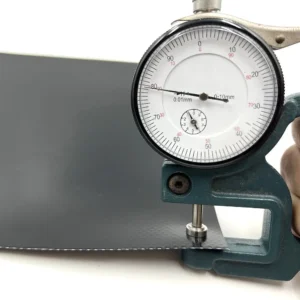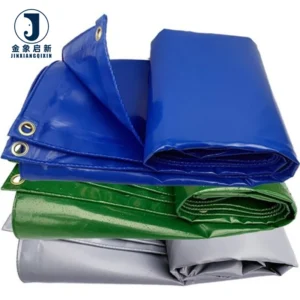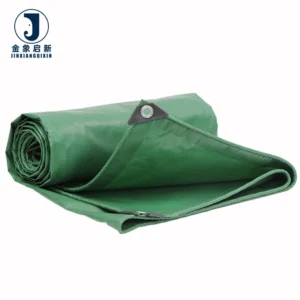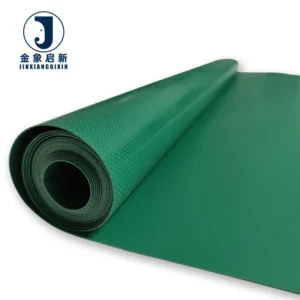
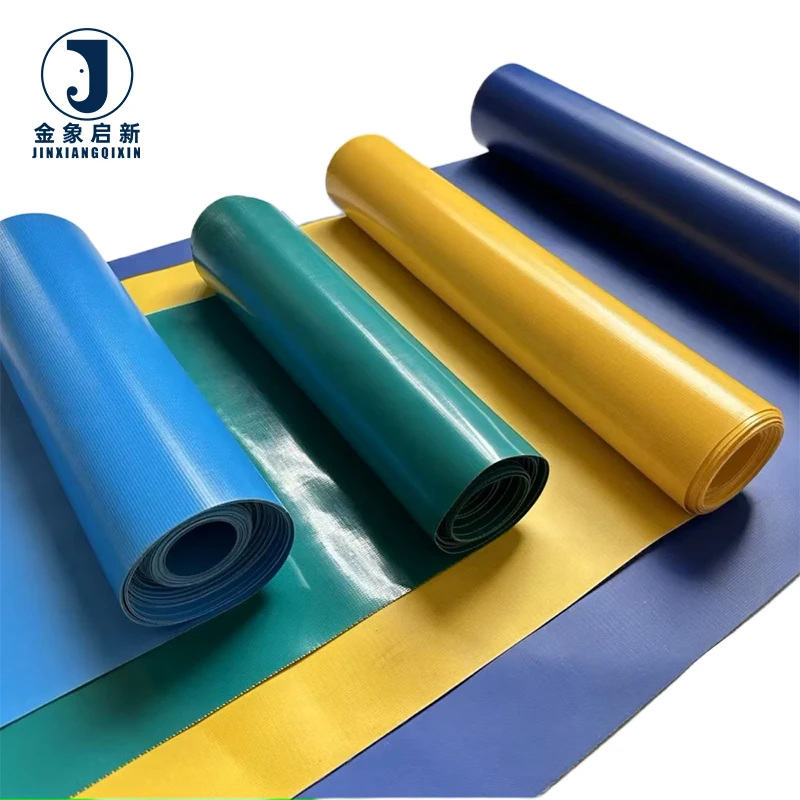
Material Process Control — coating weight verified at every stage across three production lines to match the quoted specification roll by roll.
Technical Specifications
| Parameter | Value |
|---|---|
| Product Type | PVC Coated Tarpaulin Roll |
| Specification | 200DX300D.500DX500D.840DX840D.1000DX1000D |
| Weight Range | 250gsm–1500gsm (confirm grade per order) |
| Base Fabric Denier | 200D×300D / 500D×500D / 840D×840D / 1000D×1000D |
| Coating Material | PVC |
| Surface Finish | Glossy or matte (available options) |
| Colour Options | Blue, yellow, black, green, white, custom |
| Treatment Options | Waterproof, UV, flame retardant, anti-fungal (grades to be confirmed per order) |
| Temperature Range | -15°C to 70°C |
| Size Options | 3×4m, 6×8m, 8×10m, 10×12m or custom made |
| Environment | Eco-friendly |
| Working Life | 3–10 years depending on usage environment |
| Key Features | Waterproof, rain-resistant, tear-resistant, good flexibility and adhesion strength, abrasion-resistant |
| Standards | ISO, CE (facility level) |
Application Suitability
| Application | Exposure & Requirement |
|---|---|
| Truck side curtains and transport covers | Constant flexing, road abrasion, UV exposure, wind load at tie-down points |
| Tent and awning panels | UV and rain exposure, repeated folding and tensioning at frame contact points |
| Construction site covers | Abrasion from scaffolding and debris, prolonged weather exposure, puncture risk |
| Inflatable and membrane structures | Sustained tensile load, internal pressure cycling, welded seam integrity |
| Equipment and agricultural covers | Moisture ingress, dust, fungal growth in humid storage conditions |
Why GSM Alone Does Not Tell You How Strong PVC Coated Tarpaulin Really Is
Coating weight and base fabric denier must be read together — GSM without denier context is incomplete.
A quotation listing 650gsm tells you nothing about whether the strength comes from a dense polyester base or simply from a thicker PVC layer. I have reviewed incoming material where the GSM matched the quote but the base fabric was a lighter denier than specified, leaving the fabric vulnerable to tearing under load [NEED_CITE: tensile and tear test methods for coated fabrics per ISO 1421]. When technical buyers specify PVC coated tarpaulin roll stock, the base fabric construction determines how the material behaves at stress points — seams, eyelets, and flex zones — while the coating provides waterproofing, UV shielding, and surface durability. Requesting both GSM and denier on the material spec sheet removes this ambiguity before production begins.
Base Fabric Denier and Its Role in Structural Performance
The denier options in this PVC coated tarpaulin range — from 200D×300D up to 1000D×1000D — define the tensile and tear baseline before any coating is applied. Higher denier yarns produce a base fabric with greater inherent resistance to tearing propagation, which matters when the finished product experiences point loads at welded seams or tie-down attachments. A 1000D×1000D base is specified where the end use involves sustained mechanical stress, while lighter deniers suit applications where weight savings and flexibility take priority.
Surface Finish and Its Effect on Fabrication Behaviour
Glossy and matte finishes are not purely cosmetic choices. A glossy surface sheds dirt and water more readily in outdoor service, while a matte surface typically offers better adhesion for printed graphics and certain adhesive bonding methods. For fabricators using hot-air welding, the surface finish influences the temperature window and dwell time needed to achieve consistent seam strength [NEED_CITE: hot-air welding parameters for PVC coated fabrics]. Specifying the correct finish at the inquiry stage avoids rework during conversion.
Reading GSM, Denier and Coating Weight Together
GSM is the sum of base fabric weight and coating weight. Two rolls with identical GSM can have very different performance profiles — one may carry a heavy base fabric with a thin coat, the other a light base buried under thick PVC. The coating method, whether knife-coated, laminated or calendered, further affects peel strength and weld behaviour. For technical buyers evaluating PVC coated tarpaulin, requesting a material specification sheet that breaks out base fabric weight and coating weight separately gives a far more reliable basis for comparison than GSM alone. The temperature range of -15°C to 70°C defines the service envelope, and performance outside this boundary should be validated with the supplier before committing to volume.
The Hidden Cost of Specifying on Price Per Kilogram Rather Than Material Construction
When purchasing decisions focus only on cost per kilogram, suppliers have an incentive to meet the target GSM by increasing coating thickness while reducing base fabric density. The roll arrives at the correct weight but tears more easily at stress points, and welded seams fail before the fabric body does. I have seen converters discover this mismatch only after their finished products were in the field [NEED_CITE: seam failure modes in coated technical textiles]. Colour variation between rolls in the same batch creates visible inconsistency once panels are installed side by side. These are preventable problems that trace back to incomplete specification at the inquiry stage.
Why Source This PVC Coated Tarpaulin Range From Jinxiang
Three full production lines and 36 sets of professional equipment support bulk roll output with consistent coating weight control across the run. A 10-person R&D team handles material selection, denier matching, and sample development, producing samples within days for custom requirements. Every roll passes dedicated QA/QC checks at each production stage, with 100% inspection before shipment. The facility holds ISO and CE certification, and material documentation — including GSM verification, denier confirmation, and treatment test reports where applicable — is issued per order. Custom widths, colours and treatment combinations are accommodated with defined minimums rather than open-ended commitments.
Documentation & Verification
- Material specification sheet stating GSM, base fabric denier and coating type per roll
- UV and flame retardant test reports issued where treatment grades are confirmed for the order
- Pre-shipment inspection record verifying weight against the quoted value before dispatch
- Roll packing list with batch identification for traceability across bulk orders
- Certificate of origin and customs documentation included with each shipment
- ISO and CE certificates available on file for the manufacturing facility
Fabrication, Handling & Storage
- Set hot-air welder temperature and speed according to glossy or matte finish before production runs begin
- Verify coating adhesion at seam areas, especially on higher GSM grades where thicker coats require adjusted dwell time
- Store rolls horizontally on pallets to prevent edge deformation that causes tracking issues during unrolling
- Allow rolls to acclimatise before unrolling in cold conditions, as PVC stiffens below the rated -15°C threshold
- Use compatible PVC-based repair patches for field fixes, matching the surface finish for adhesion consistency
- Plan cut patterns to minimise offcuts, accounting for roll width and the denier construction’s directional tear behaviour
What We Need to Quote Accurately
Provide the end-use application and the specific exposure conditions the fabric will face in service. Confirm the target market’s fire safety or compliance requirements so the correct treatment grade can be sourced. State the required roll width, colour reference, surface finish preference, and whether you need roll stock or cut-to-size panels. If batch colour consistency across multiple rolls is critical, flag this at inquiry stage so production sequencing can be planned accordingly.
Frequently Asked Questions
Q: How do GSM, denier and coating weight relate to tensile and tear strength?
A: GSM is the combined weight of base fabric and PVC coating. Tensile and tear strength depend primarily on the base fabric denier and weave density, while the coating adds waterproofing and surface protection. Two rolls at the same GSM can perform very differently if their base fabric constructions differ. Requesting a material spec sheet that itemises both components gives a reliable basis for comparison.
Q: What test reports are available for UV and flame retardant claims?
A: UV and flame retardant treatments are available in this PVC coated tarpaulin range, but the specific grade and test standard must be confirmed per order. We issue test reports matching the grade specified for your application. Request documentation at the inquiry stage to ensure the treatment meets your market’s compliance requirements before production begins.
Q: Can custom width, colour and GSM be produced, and what are the minimums?
A: Custom widths, colours and GSM grades are available within the production capability of three full coating lines. Minimum order quantities depend on the degree of customisation — standard widths and stock colours carry lower thresholds than fully bespoke specifications. Share your target dimensions and annual volume for a precise minimum and lead time quotation.
Q: How is roll-to-roll colour and weight consistency controlled across a bulk order?
A: In-process QA checks verify coating weight and colour at each production stage, with 100% pre-shipment inspection against the quoted specification. Batch identification on every roll enables traceability. If your installation places panels side by side where colour variation would be visible, flag this requirement at inquiry so production can be sequenced from matched coating batches.
Q: What is the difference between glossy and matte finish for welding and fabrication?
A: Glossy surfaces tend to require slightly different hot-air welding temperatures compared to matte finishes, and they respond differently to printed graphics and adhesive bonding. The choice affects weld parameter settings and the visual outcome of the finished product. Confirm the preferred finish at the sample stage to validate your fabrication process before committing to a full production run.