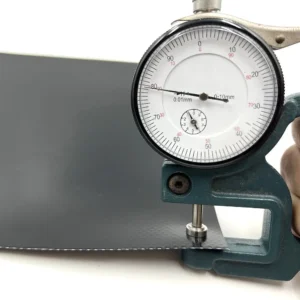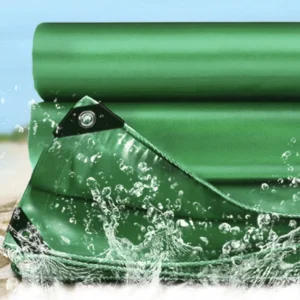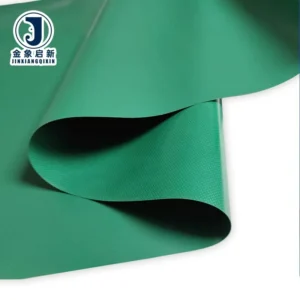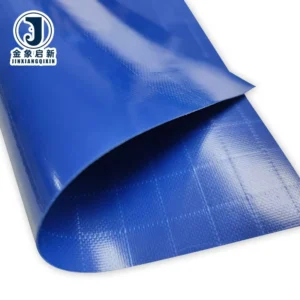
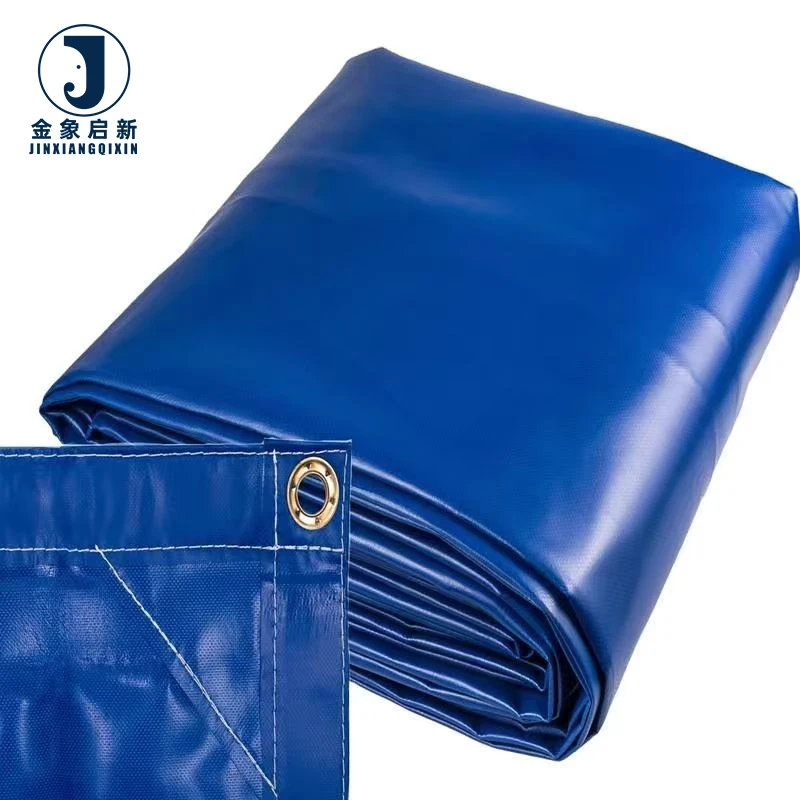
Deep process control over coating weight and adhesion — every roll of this PVC coated polyester tarpaulin is produced on lines where coating thickness is monitored continuously, ensuring the stated GSM matches what arrives at your facility.
Technical Specifications
| Parameter | Value |
|---|---|
| Product Type | PVC Coated Tarpaulin Roll |
| Base Fabric | Polyester |
| Coating Material | PVC (vinyl coated) |
| Weight (GSM) | 500 to 800 g/m² (confirm grade for your application) |
| Coating Method | Knife-over-roll with high-frequency heat welding compatibility |
| Waterproof Rating | Anti-permeable ≥20KPa |
| Flame Retardant | ≤10 seconds (grade not stated in source — confirm the grade required for your market) |
| Low-Temperature Flexibility | Will not fracture at -30°C |
| Chemical Resistance | Acid, alkali, and brine corrosion |
| Anti-Mildew | Mildew proofing properties claimed (test basis not stated in source) |
| Water Absorption | Near zero, fast drying |
| Seaming Method | High-frequency heat welding |
| Certification | ISO, CE |
Application Suitability
| Application | Exposure & Requirement |
|---|---|
| Truck and trailer side curtains | Constant flexing at load points, road spray, UV exposure, abrasion against cargo |
| Industrial equipment covers | Outdoor weathering, chemical splash contact, repeated removal and re-fitting |
| Construction site enclosures | Wind load, rain ingress, UV degradation, scaffold contact abrasion |
| Corrosive environment covers | Acid, alkali, or brine contact requiring chemical-resistant PVC coating |
| Cold-climate outdoor storage | Sub-zero temperatures demanding flexibility without brittle fracture |
Why GSM Alone Fails to Predict Real-World Tensile Performance
Coating weight tells you what was applied — base fabric denier and weave density tell you whether it holds together under tension.
Technical buyers often specify PVC Coated Tarpaulin GSM base fabric coating weight as a single acceptance criterion, then discover that two rolls with identical GSM behave differently on the fabrication table. The reason sits underneath the coating: a loosely woven base fabric absorbs more PVC to reach the target weight but delivers lower tensile and tear figures than a tightly woven alternative at the same GSM. Without a specification sheet that breaks down base fabric construction separately from coating mass, the number on the quotation becomes unreliable. [NEED_CITE: tensile and tear test methods for coated fabrics per ISO 1421]
Coating Adhesion and the Knife-Over-Roll Process
The knife-over-roll coating method used for this PVC coated polyester fabric deposits a controlled PVC layer onto the moving base fabric web. This approach produces a smooth surface finish and consistent coating weight across the full roll width. Adhesion between the PVC skin and the polyester substrate determines whether the coating delaminates at welded seams or fold lines. The high-frequency heat welding compatibility of this material means fabricators can produce water-tight joins without needle holes compromising the waterproof barrier.
Polyester Base Fabric and Dimensional Stability
Polyester was selected as the base fabric for this PVC coated tarpaulin roll because it maintains dimensional stability under sustained tension and temperature fluctuation. Unlike polyamide, polyester absorbs minimal moisture, so the fabric does not stretch or sag after rain exposure. The base weave structure contributes directly to tear propagation resistance — a tightly woven warp and weft configuration forces tear energy to dissipate across multiple yarn intersections rather than running along a single line. [NEED_CITE: base fabric denier and weave influence on coated fabric tear performance]
Reading the Specification Sheet Beyond the Weight Number
When evaluating PVC Coated Tarpaulin GSM base fabric coating weight, technical buyers should cross-reference four parameters simultaneously: base fabric denier, warp and weft density, total coated GSM, and the coating-to-substrate ratio. A 650 g/m² fabric built on 1000D × 1000D yarns at 18 × 18 picks will outperform a 650 g/m² fabric built on 500D yarns at lower pick density, because the heavier yarns and tighter weave carry the mechanical load while the PVC coating handles waterproofing and chemical resistance. The waterproof rating of ≥20KPa confirms that the coating layer is continuous and anti-permeable. Low-temperature flexibility to -30°C indicates that the PVC formulation retains plasticiser stability in cold service, preventing the brittle fracture that causes cracking in standard grades during winter deployment. Chemical resistance to acid, alkali, and brine environments extends the service envelope beyond general-purpose tarpaulin applications into industrial and marine-adjacent use.
What Specification Errors Cost on the Fabrication Floor
Selecting the wrong coating weight or base fabric grade produces consequences that surface after fabrication, not at the inspection bench. Rolls that arrive below the quoted GSM may still pass a visual check but fail at the weld line when the fabric flexes under load. Flame retardant grades that lack a documented test standard can result in rejected installations when the site inspector requests certification. Colour variation between rolls in the same order becomes visible only after panels are installed side by side on a truck curtain or site enclosure. [NEED_CITE: common causes of coated fabric seam failure under cyclic loading]
Why Fabricators Source This Roll Stock Here
Three full production lines and 36 sets of professional equipment support bulk roll output with consistent coating weight control across long production runs. A dedicated 10-person R&D team handles material selection and sample development, so custom width, colour, and treatment requirements are resolved at the sample stage before bulk commitment. QA/QC inspection runs at every production stage, with 100% pre-shipment inspection confirming roll-to-roll weight and colour consistency. Samples are developed within days for custom requirements, shortening the evaluation cycle. Decades of focused production on coated fabric provide the process knowledge needed to maintain adhesion performance across different GSM grades and coating formulations.
Documentation & Verification
- Material specification sheet stating GSM, base fabric denier, coating type, and weight per roll
- Test reports for flame retardant grades matched to the production lot on request
- Pre-shipment inspection record with measured weight samples and visual colour consistency check
- ISO and CE certificates traceable to the manufacturing facility
- Roll packing list detailing width, length, and gross weight per roll for container planning
- Certificate of origin and customs documentation included with shipment
Fabrication, Handling & Storage
- High-frequency heat welding suits this PVC coated polyester — set dwell time to achieve full coating fusion without base fabric scorching
- Store rolls upright on end cores to prevent flat-spot creasing across the coated surface
- Allow cold-stored rolls to reach ambient temperature before unrolling to avoid coating crack at low-temp stiffness
- Cut panels with a clean blade to prevent fraying the polyester base fabric at raw edges before welding
- Use compatible PVC-based adhesives for patch repairs to maintain chemical resistance continuity
- Plan panel layout to minimise transverse welds across the roll width, reducing seam count per cover
What We Need to Quote Your Roll Requirement
Provide the target GSM range and base fabric denier preference if your application has a known tensile requirement. Confirm whether flame retardant certification is needed for your market and which test standard applies. Specify roll width, colour reference, and estimated annual volume so we can align production scheduling and confirm lead times.
Frequently Asked Questions
Q: How is the GSM verified on each roll before dispatch?
A: Every roll undergoes weight sampling at multiple points along its length during pre-shipment inspection. Measured values are recorded on the inspection report and compared against the specification sheet. Rolls falling outside the accepted tolerance are held before packing. You receive the inspection record with your shipment documentation so you can cross-check on arrival.
Q: Which flame retardant test standard applies to this material?
A: The material is available in flame retardant grades with performance at ≤10 seconds, but the specific test standard is not stated in the current source documentation. Request the applicable test certificate matched to your production lot when placing your order. Different markets require different classifications, so confirm the standard your installation demands before committing.
Q: How do you ensure colour consistency across multiple rolls in one order?
A: All rolls in a single production batch use the same PVC compound mix and colour masterbatch. The pre-shipment inspection includes a side-by-side visual colour check across sampled rolls. If your order spans multiple production batches, we flag this in advance and provide batch-grouped packing so you can plan panel installation accordingly.
Q: What base fabric denier options are available and how do they affect performance?
A: The base fabric is polyester, available in multiple denier and weave density configurations within the 500 to 800 g/m² range. Higher denier yarns and tighter weave density increase tensile and tear strength but add weight. Provide your application load and flex requirements so the correct base fabric grade can be matched to your target GSM.
Q: What is the difference between knife-over-roll and dip coating for this tarpaulin type?
A: Knife-over-roll deposits a controlled PVC layer onto one side of the moving base fabric, producing precise coating weight and a smooth finish suited to welding and printing. Dip coating saturates the fabric from both sides. For truck curtain and industrial cover fabrication where one-side appearance and weld integrity matter, knife-over-roll is the standard production method.