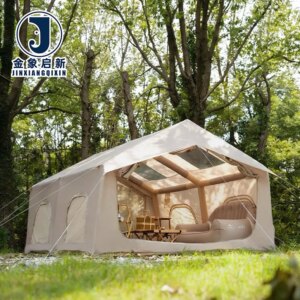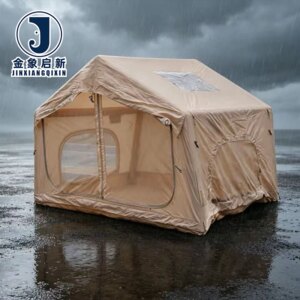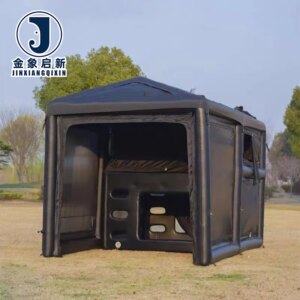
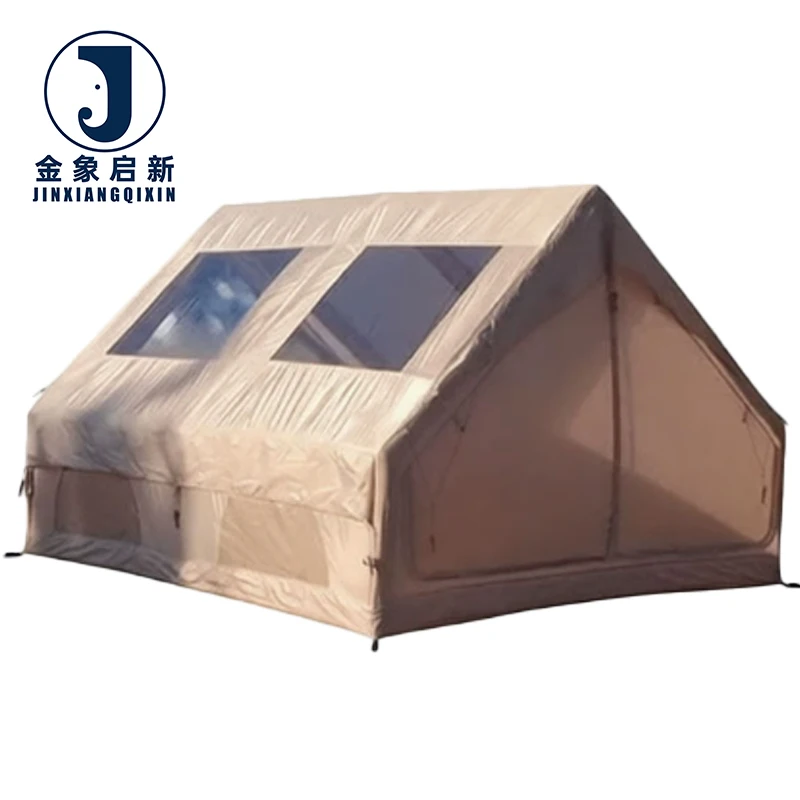
Coating Weight Control — 3 full production lines and 36 sets of equipment ensure that every roll of inflatable tent fabric is coated to the exact GSM agreed at quotation, verified at pre-shipment inspection rather than assumed from the label.
Technical Specifications
| Parameter | Value |
|---|---|
| Product Type | Inflatable Tent |
| Core Material | PVC Tarpaulin |
| Key Performance | Waterproof, UV-resistant, Tear-resistant, Flame-retardant, Anti-static |
| Flame Retardant | Available in flame retardant grades — confirm the grade required for your market |
| Anti-static | Available in anti-static grades — confirm the standard required for your site |
| UV Resistance | Available with UV treatment — request test report for your exposure zone |
| Customization | OEM & ODM including sample customization and pattern printing |
| Quality Control | Dedicated QA & QC on-site full-process inspection |
| Certifications | ISO 9001, ISO 14001, ISO 45001, CE |
Application Suitability
| Application | Exposure & Requirement |
|---|---|
| Commercial glamping tent tubes | Internal air pressure, repeated inflation cycles, flex stress at tube joints and bends |
| Resort membrane roof panels | Prolonged UV exposure, wind-driven rain, thermal expansion and contraction across seasons |
| Outdoor event inflatable shelters | Quick-deploy and takedown cycles, crowd proximity requiring fire-safety compliance |
| Temporary hospitality structures | Interior climate control demanding airtight seams, guest safety codes for flame behaviour |
| Inflatable exhibition enclosures | Branding and print adhesion on coated surface, repeated relocation and re-inflation |
What "Flame Retardant" Means Without a Grade Behind It
A fabric labelled flame retardant is only as compliant as the test report that accompanies it.
Inflatable tent fabric for commercial glamping must meet the fire-safety classification enforced at the installation site. Some jurisdictions require B1 per DIN 4102, others demand M2 or NFPA 701, and a certificate that satisfies one authority may be rejected by another. We have seen inflatable tent fabric arrive on site with a fire classification from a different standard entirely, forcing the buyer to halt installation while new test reports were arranged — costing weeks of lost bookings during peak season [NEED_CITE: DIN 4102 fire classification for building materials].
Coating Adhesion and Air-Holding Integrity
Inflatable tent tubes live under constant internal pressure. Every square centimetre of PVC coating must bond to the base fabric with enough peel strength to resist delamination when the tube flexes in wind or under thermal load. Inflatable Tent Fabric material and coating technology centres on controlling how the PVC layer is applied and cured so that adhesion remains uniform across the full roll length. If adhesion drops at any point along the tube, the coating can separate from the yarn under pressure, creating a slow leak that is nearly impossible to locate once the structure is inflated.
Weld Behaviour at Flex Points
Where tube sections join or bend, heat-welded seams carry the full internal pressure. The PVC coating must soften and re-bond under controlled temperature and dwell time so that the weld line reaches the same tensile value as the parent fabric. Inflatable Tent Fabric material and coating technology determines whether the weld fails before the fabric does — a common failure mode when coating formulation or plasticiser content is not matched to the welding parameters used on the production floor [NEED_CITE: tensile and tear test methods for coated fabrics per ISO 1421].
Reading the Specification Sheet Beyond GSM
GSM alone tells you how much material sits on the scale, but it does not describe how that weight is distributed between base yarn and coating. A high-denier polyester base with lighter coating may outperform a heavier, coating-dominant construction in tear resistance because the yarn carries the mechanical load. Conversely, a coating-heavy build may deliver better airtightness for inflatable tubes where porosity matters more than tensile rating. Understanding the ratio of base fabric weight to coating weight is essential when comparing Inflatable Tent Fabric material and coating technology between suppliers who quote the same GSM.
The Cost of Underspecifying for Inflatable Structures
Choosing a fabric grade based on price rather than coating adhesion data often surfaces its consequences after the first season of use. Tubes that hold air during factory testing may develop micro-leaks at welded joints after repeated thermal cycling in the field, forcing the resort operator to run compressors continuously to maintain pressure. Colour inconsistency between rolls becomes visible only after adjacent panels are welded side by side in full sunlight, turning a premium glamping site into a patchwork appearance that guests notice immediately [NEED_CITE: coating weight variance and batch colour consistency in PVC tarpaulin production].
Why Source Inflatable Tent Fabric Through This Process
Three full production lines dedicated to coated fabric allow roll-to-roll consistency in GSM and coating weight, verified at each stage rather than sampled once per batch. A 10-person R&D team develops custom Inflatable Tent Fabric material and coating technology formulations matched to specific inflation pressures and climate conditions. In-process QA tracks adhesion, colour, and weight from coating bath to final wind-up, with 100 percent pre-shipment inspection catching deviations before rolls leave the facility. Sample rolls are produced within days so buyers can run their own weld and pressure tests before committing to bulk volume.
Documentation & Verification
- Material specification sheet confirming GSM, base fabric denier, and PVC coating type per roll
- UV and flame-retardant test reports matched to the grade specified at order placement
- Pre-shipment inspection record with batch traceability linking each roll to production data
- Certificate of origin and full customs documentation accompanying every international dispatch
- Roll packing list detailing net weight, dimensions, and roll count per shipment
Fabrication, Handling & Storage
- Heat-weld PVC inflatable tent fabric at temperatures matched to coating plasticiser content for full seam fusion
- Allow coated rolls to acclimatise to workshop temperature before unrolling to prevent surface cracking
- Store PVC tarpaulin rolls upright on pallets to avoid permanent crease marks across the coating surface
- Use compatible PVC-based adhesives for field repair of inflatable tube punctures and seam separation
- Cut pattern pieces along the roll length to align warp yarns with the primary stress axis of each tube
Requesting the Right Fabric for Your Inflatable Project
To receive an accurate specification recommendation, share the inflation pressure your tubes operate under, the fire-safety classification your local authority enforces, and the annual volume of fabric you plan to procure. If your design calls for custom width, colour matching across multiple rolls, or printed branding on the membrane surface, include those requirements so the sample stage reflects your final production intent. Samples of Inflatable Tent Fabric material and coating technology can be dispatched for your own weld testing and pressure-holding trials before bulk order confirmation.
Frequently Asked Questions
Q: What flame-retardant grades are available and how do I confirm the right one for my market?
A: The fabric can be produced in multiple flame-retardant grades. The correct grade depends on the fire-safety code enforced at your installation site — for example DIN 4102 B1 in parts of Europe or NFPA 701 in North America. Provide your local authority’s classification requirement at inquiry stage so the test report included with shipment matches that standard.
Q: How is UV resistance verified and what should I expect for outdoor deployment?
A: UV treatment is available and its performance is documented through laboratory test reports supplied with the batch. Actual outdoor service life depends on installation latitude, seasonal exposure hours, and whether the structure remains inflated year-round. Request the UV test report at inquiry to evaluate the data against your site conditions.
Q: Can you guarantee colour consistency across all rolls in a single order?
A: Every roll in a production batch is inspected for colour deviation before shipment. The pre-shipment inspection record confirms roll-to-roll consistency against the approved colour reference. For large orders spanning multiple production runs, request that all rolls be allocated from the same batch to eliminate any inter-batch shade variation.
Q: What information do you need to produce a sample of inflatable tent fabric?
A: Provide the target GSM, coating type, colour reference, and any flame-retardant or anti-static grade required. The 10-person R&D team develops a sample roll within days so you can conduct weld trials and pressure-holding tests in your own workshop before approving bulk production.
Q: How are welded seams tested to ensure they hold under tube pressure?
A: Welded seam samples are pulled to failure alongside the parent fabric to compare peel and tensile values. The goal is seam strength equal to or exceeding the base material so that the tube flexes without the weld line splitting first. Request seam test data with your sample shipment.