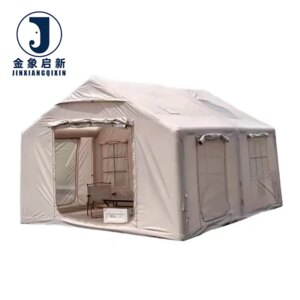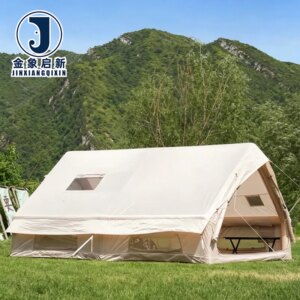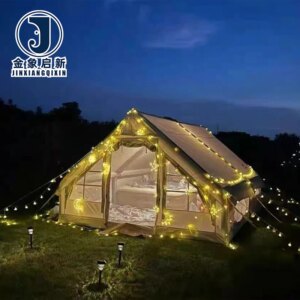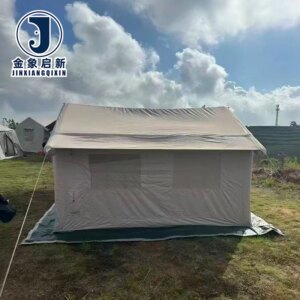
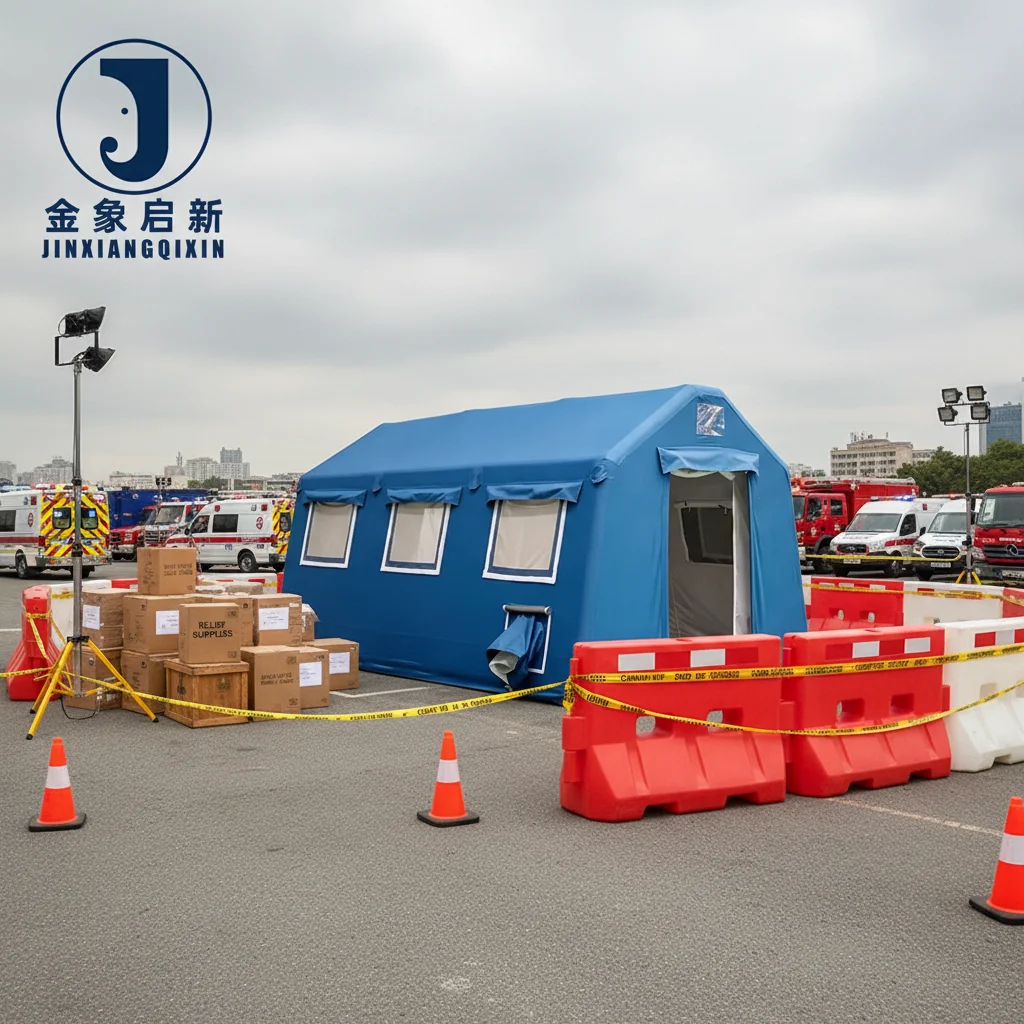
Process-Controlled Coating Expertise — With 3 full production lines and 36 sets of processing equipment, the PVC tarpaulin used for inflatable tent structures undergoes coating weight and adhesion verification at every stage, ensuring the base fabric and coating bond meets the airtight demands of commercial inflatable deployment.
Technical Specifications
| Parameter | Value |
|---|---|
| Product Type | Inflatable Tent Fabric |
| Core Material | PVC tarpaulin |
| Waterproof Rating | >3000mm |
| Season Design | 4-season |
| Construction | Single layer |
| UV Treatment | Anti-UV (test basis not stated — confirm UV resistance class required for your market) |
| Flame Retardant Grade | Available in flame retardant grades — confirm the grade required for your market |
| Opening Mechanism | Quick automatic opening |
| Customization | OEM & ODM (sample customization, pattern printing) |
| Certifications | ISO 9001, ISO 14001, ISO 45001, CE |
| Sample Lead Time | 7–10 business days |
| Production Lead Time | 15–20 business days |
Application Suitability
| Application | Exposure & Requirement |
|---|---|
| Temporary site offices at construction projects | Wind loading, rain ingress, repeated inflation/deflation cycles, UV degradation on exposed membrane surfaces |
| Mobile equipment shelters for outdoor events | Rapid deployment and teardown, foot traffic abrasion at entry points, weather exposure across seasons |
| Auxiliary storage facilities for logistics operations | Sustained inflation pressure, temperature fluctuation, protection of stored goods from moisture and particulates |
| Commercial rapid-deployment shelters | Airtight seam integrity under continuous inflation, transport weight constraints, batch colour consistency across multiple units |
Why Inflatable Structures Fail at the Seam Before the Fabric Does
Welded seam failure under sustained inflation pressure is the most common field failure in commercial inflatable tent fabric applications.
When an inflatable shelter is deployed on a construction site or at a remote logistics yard, the seams carry concentrated stress at every flex point where the membrane meets a rigid connection or an entry panel. If the PVC tarpaulin coating does not bond to the base fabric with sufficient peel strength, the heat-welded joint separates under inflation load while the surrounding fabric remains intact. I have seen heavy-grade coated rolls fail at the weld line on structures that never experienced extreme weather — the failure was entirely a material construction issue, not an environmental one [NEED_CITE: peel strength and weld integrity test methods for PVC coated fabrics]. Technical buyers sourcing PVC inflatable tent fabric must evaluate coating adhesion as a primary specification, not an afterthought.
Base Fabric Construction and Airtight Performance
The base fabric of PVC inflatable tent fabric determines how well the membrane holds inflation pressure over extended deployment. The denier of the yarn and the weave density control the dimensional stability of the material when it is under tension from internal air pressure. A loosely woven base fabric allows the coating to stretch unevenly, creating thin spots that compromise waterproof integrity. For 4-season inflatable structures, the base fabric must resist deformation across the full temperature range without losing its coated bond.
Coating Weight and Waterproof Integrity
The >3000mm waterproof rating of this PVC inflatable tent fabric is achieved through controlled coating weight applied to both faces of the base fabric. In single-layer inflatable construction, the coating must form a continuous barrier with no pinholes or thin areas, because there is no secondary membrane to catch leaks. The coating process — whether knife-over-roll or calender — determines how uniformly the PVC penetrates the weave. Inconsistent coating weight across a roll leads to sections that pass waterproof testing in the lab but develop micro-leaks after repeated inflation cycles in the field.
Single-Layer Construction and Transport Weight Trade-Off
Single-layer inflatable tent fabric is specified where transport weight and pack-down volume are operational constraints. For rapid-deployment shelters used at construction sites or outdoor events, the structure must arrive compact and inflate quickly. A single-layer PVC tarpaulin membrane achieves this while maintaining the airtight performance required for sustained inflation. The trade-off is that single-layer construction places the full performance burden on one material — the base fabric, the coating, and the weld must each perform without a backup layer [NEED_CITE: single vs double layer membrane performance in inflatable structures].
Reading the Specification Sheet Beyond GSM
GSM alone does not predict how PVC inflatable tent fabric will perform under inflation pressure. A 650 GSM fabric with a loosely woven base and heavy coating may have lower tensile strength than a lighter fabric with a tightly woven base and balanced coating weight. The base fabric denier and thread count determine tear propagation resistance — critical at seam junctions where inflation stress concentrates. The coating method affects peel strength: knife-coated fabrics generally achieve deeper PVC penetration into the weave, producing stronger welds during fabrication. Anti-UV treatment and flame retardant additives are incorporated into the coating formulation, and their effectiveness depends on coating uniformity across the roll width. Temperature range matters for 4-season deployment — PVC becomes brittle at low temperatures and softens at high temperatures, and the formulation must maintain flexibility across that range without losing airtightness.
The Hidden Cost of Batch Inconsistency Across Rolls
When a commercial buyer orders multiple rolls of inflatable tent fabric for a production run, colour variation between rolls becomes visible once the panels are welded together on the finished structure. Beyond aesthetics, batch inconsistency in coating weight means some rolls weld at different temperatures or speeds than others, forcing fabricators to recalibrate equipment mid-run. More critically, coating weight variation within a single roll creates weak sections that pass visual inspection but fail under sustained inflation pressure. This is why batch-specific quality inspection — covering waterproof performance, tensile strength, and seam integrity — is essential before shipment [NEED_CITE: batch consistency standards for coated technical textiles].
Why Source Inflatable Tent Fabric Here
Material specification sheets for this PVC inflatable tent fabric state the base fabric construction, coating type, and waterproof test results — not just a generic product family description. The 10-person R&D team develops custom samples within 7–10 business days, allowing technical buyers to validate weld parameters and inflation performance before committing to production volumes. Each production run undergoes in-process QA with dedicated inspection at every stage, and 100% pre-shipment inspection covers waterproof testing, tensile strength, and seam integrity. The facility operates 3 full production lines with 36 sets of professional equipment, supporting bulk capacity with reliable scheduling. ISO 9001, ISO 14001, ISO 45001, and CE certifications accompany every commercial shipment, and third-party testing at accredited laboratories is available for large-scale projects requiring independent verification.
Documentation & Verification
- Material specification sheet confirming base fabric denier, coating weight, and PVC formulation for inflatable use
- Batch-specific inspection report with waterproof test data and seam integrity results per roll
- UV and flame retardant test reports provided where applicable grades are specified
- ISO 9001, ISO 14001, ISO 45001, and CE certificates included with each shipment
- Pre-shipment inspection record documenting coating weight verification before dispatch
- Third-party laboratory test reports available for project compliance requirements
Fabrication, Handling & Storage
- Heat weld temperature and speed must be calibrated to the specific PVC coating formulation of this inflatable tent fabric
- Single-layer membrane panels should be welded with overlap joints sized to inflation pressure requirements
- Store rolls vertically on pallets to prevent flat-spot deformation of the PVC coating surface
- Allow cold-stored rolls to acclimatise before unrolling to avoid cracking the PVC coating at low temperatures
- Clean with mild detergent only — solvents may degrade the anti-UV treatment in the coating
- Repair field punctures using PVC-compatible adhesive patches matched to the coating weight
What to Include in Your Inquiry
Provide the intended deployment environment and expected inflation duration so the correct coating formulation and base fabric weight can be recommended. Specify any fire-retardant or anti-static certification required by the site or local regulations. Confirm whether you need rolls in standard widths for your own fabrication line, or pre-cut panels with welded seams. Indicate your annual volume and colour requirements so batch consistency can be planned across production runs. Request sample rolls to validate weld parameters and inflation performance on your equipment before placing a bulk order.
Frequently Asked Questions
Q: How is the waterproof rating of inflatable tent fabric verified before shipment?
A: Each production batch undergoes waterproof testing to confirm the >3000mm rating. The inspection report records the test method, the result per roll, and any variation across the batch. This data is included in the pre-shipment documentation package so buyers can verify performance against their specification before the material leaves the facility.
Q: What base fabric and coating options are available for inflatable tent applications?
A: The PVC tarpaulin is available in base fabric constructions suited to inflatable structures, with coating weights selected for airtight performance. A material specification sheet is provided stating the base fabric denier, weave density, and coating type. Custom base fabric and coating combinations can be developed through the sample process for specific inflation pressure requirements.
Q: Are flame-retardant and anti-static grades available with certified test reports?
A: Flame-retardant grades are available — confirm the classification required for your market or site regulations. Where a specific grade is specified, the corresponding test report from an accredited laboratory is provided with the shipment. Anti-static treatment is also available on request with supporting documentation for regulated environments.
Q: How is batch-to-batch colour and material consistency controlled across orders?
A: Production runs are managed with in-process quality control at each stage, including coating weight verification and colour matching against approved references. Batch-specific inspection reports document the results per roll. For large orders spanning multiple production runs, colour reference standards are maintained to ensure consistency across all rolls in the delivery.
Q: What is the sample development process for custom inflatable tent fabric specifications?
A: Submit your requirements including target waterproof performance, base fabric preference, colour, and any treatment grades needed. The R&D team develops samples within 7–10 business days. Samples are tested for weld compatibility and inflation performance, and once approved, the specification is locked for production with a typical lead time of 15–20 business days for bulk orders.