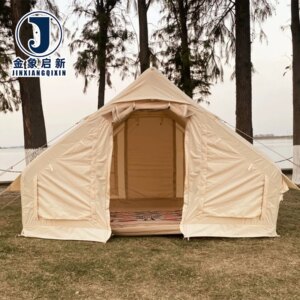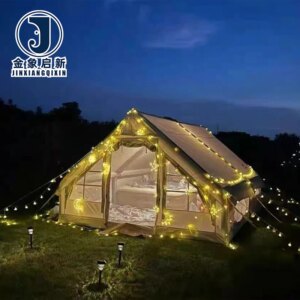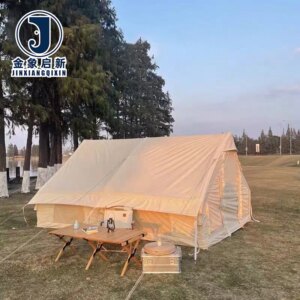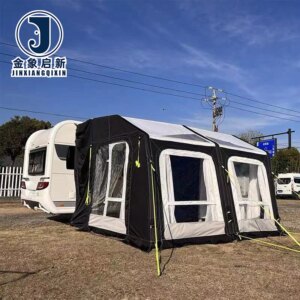
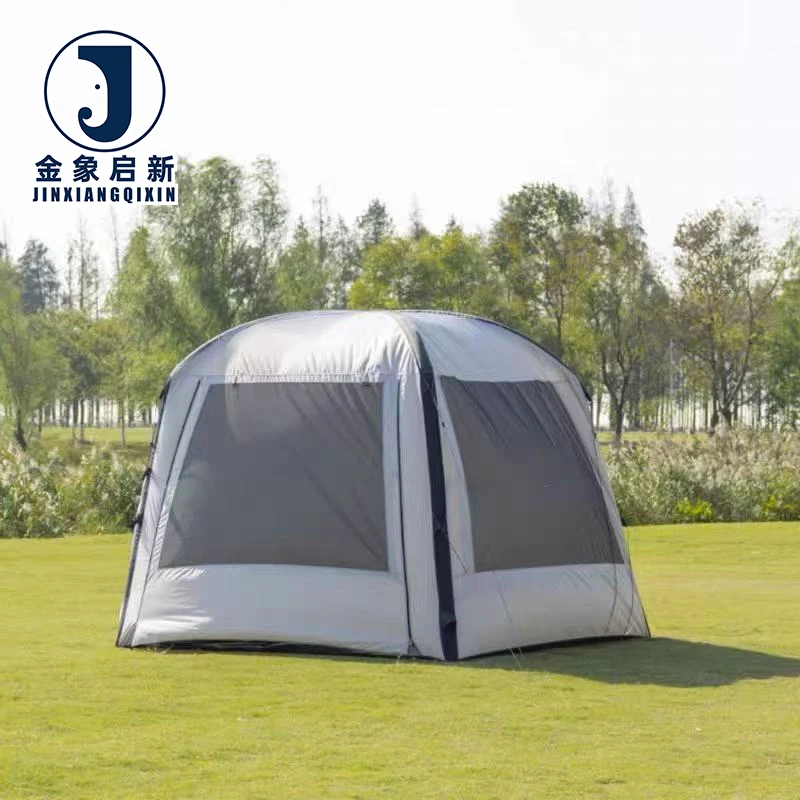
Process-Controlled Coating — Every roll of inflatable tent material passes through dedicated QA checkpoints to verify coating weight and adhesion consistency before leaving the factory.
Technical Specifications
| Parameter | Value |
|---|---|
| Product Type | Inflatable Tent |
| Core Material | PVC tarpaulin |
| Structure | Single-layer PVC construction |
| Capacity | 6-person |
| Opening Mechanism | Automatic opening |
| Season Rating | Four-season |
| Waterproof | Stated (test basis not stated in source) |
| UV-Resistant | Stated (test basis not stated in source) |
| Tear-Resistant | Stated (test basis not stated in source) |
| Flame Retardant | Stated (grade not stated in source) |
| Anti-Static | Stated (test basis not stated in source) |
| Customization | OEM & ODM — sample customization, pattern printing |
| Certifications | ISO 9001, ISO 14001, ISO 45001, CE |
Application Suitability
| Application | Exposure & Requirement |
|---|---|
| Commercial glamping sites | Continuous outdoor exposure, UV and weather cycling, guest safety compliance, four-season deployment |
| Event infrastructure contractors | Rapid inflation and deflation cycles, temporary structure wind loads, membrane tension stress |
| Outdoor gear manufacturers | Roll-to-roll colour consistency, weld seam integrity, pattern printing adhesion, material specification matching |
| Tourism operators | Repeated seasonal setup and teardown, abrasion from ground contact, fire-retardant site regulations |
| Industrial temporary shelters | Extended standing time, environmental exposure, anti-static requirements in sensitive zones |
Why Inflatable Tent Fabric Fails at the Seams Before the Shell Does
Weld strength depends on coating formulation compatibility, not just fabric weight.
When a PVC inflatable tent manufacturer sources material, the focus often lands on base fabric denier and overall weight. Yet field failures consistently appear at heat-welded seams — the exact point where the inflated structure flexes under wind and occupant movement. The coating chemistry must bond cleanly under thermal welding; a formulation mismatch causes delamination long before the shell fabric itself shows wear. For commercial operators running glamping domes through multiple seasons, this distinction determines whether a structure requires panel replacement after the first storm cycle or holds reliably [NEED_CITE: tensile and tear test methods for coated fabrics per ISO 1421].
Coating Formulation and Adhesion Behaviour
The PVC coating applied to inflatable tent base fabric must serve two functions simultaneously: protect the yarn structure from moisture and UV degradation, and provide a thermally weldable surface that fuses without peeling. As a PVC inflatable tent fabric manufacturer, we control the coating compound formulation in-house, adjusting plasticiser ratios to match the thermal welding window that tent fabricators require. This means the heat-activated bond at a seam can achieve strength approaching the base fabric itself, rather than becoming the weakest link in the inflated structure.
Flame Retardant and Anti-Static Options for Structure Compliance
Commercial inflatable structures — particularly those deployed at public events or permanent glamping sites — must meet fire safety codes that vary by jurisdiction. Our material is available in flame retardant grades — confirm the grade required for your market before specifying. Anti-static treatment is also available where inflatable structures operate near sensitive equipment or in dust-prone environments. Each treatment option modifies the coating formulation and must be validated with corresponding test documentation for your compliance submission [NEED_CITE: DIN 4102 fire classification for building materials].
Understanding the Base Fabric to Coating Relationship
The PVC tarpaulin used in inflatable tent construction relies on a woven base fabric for structural strength and a coating layer for environmental protection. The denier of the yarn and the weave density determine how the material resists tear propagation — critical when an inflated panel is under tension and a puncture or cut initiates a tear line. Coating weight adds stiffness and abrasion resistance but does not compensate for a loosely woven base. When evaluating inflatable fabric, both parameters must be reviewed together: a higher coating weight on a low-density weave produces a heavy but tear-vulnerable material, while a tightly woven base with balanced coating delivers reliable performance under inflation pressure. The single-layer PVC construction specified here is designed to maintain dimensional stability once inflated, reducing stress concentrations at curved panel junctions.
The Hidden Cost of Undocumented Material Claims
Purchasing inflatable tent fabric based on a quotation that lists UV-resistant or flame-retardant treatment without accompanying test reports creates a verification gap that only appears after installation. Colour variation between rolls from the same production batch forces glamping operators to reject installed panels that look mismatched in daylight. Weld seams that delaminate under inflation pressure require on-site repair that compromises the structure’s appearance and guest confidence. These are not theoretical concerns — they represent documented failure modes in coated fabric procurement where in-process quality checks were absent from the supply agreement [NEED_CITE: coating adhesion failure mechanisms in PVC tarpaulins].
Why Source Inflatable Tent Fabric Here
Our three full production lines and 36 sets of processing equipment handle inflatable tent fabric orders at volume while maintaining batch-level coating consistency — every roll from a given production run carries the same coating weight and colour reference. A 10-person R&D team manages material selection and sample development, supporting custom sizing, thickness modifications, and pattern printing directly from our facility. The production process includes full-process inspection with a 24-hour inflation test before shipment, verifying that welded seams and material behaviour meet inflation requirements. ISO 9001, ISO 14001, ISO 45001, and CE certifications are maintained on file and available for buyer audit. OEM and ODM capabilities allow tent manufacturers to specify material parameters aligned with their fabrication equipment and end-market compliance needs.
Documentation & Verification
- Material specification sheet stating base fabric, PVC coating compound, and treatment details per roll
- Test reports for UV and flame retardant grades matched to batch numbers where applicable
- 24-hour inflation test record confirming weld seam and material performance before dispatch
- Pre-shipment inspection report covering coating weight, colour consistency, and surface quality
- ISO 9001, ISO 14001, ISO 45001, and CE certificates available for compliance review
Fabrication, Handling & Storage
- Heat weld parameters must match the PVC coating formulation — request recommended temperature and dwell time before first production run
- Store rolls upright on pallets in climate-controlled space to prevent pressure marks on the PVC coating surface
- Allow cold-stored rolls to reach ambient temperature before unrolling to avoid coating micro-cracking
- Use compatible PVC-based repair adhesive for field patching of single-layer inflatable tent panels
- Plan cutting layout to minimise seam count across high-tension inflation panels and reduce weld failure points
What to Include in Your Inquiry
To specify the correct inflatable tent fabric for your application, share the deployment environment, expected inflation pressure range, and target-market fire safety regulations. Confirm whether you require raw roll stock or finished cut panels, the annual volume, and any colour or pattern printing requirements. Sample development is available for material approval before bulk production commitment.
Frequently Asked Questions
Q: How is coating weight and material thickness verified on arrival?
A: Each roll ships with a pre-shipment inspection record documenting measured coating weight. Buyers can verify independently using a calibrated scale and known sample area. We recommend confirming the acceptable tolerance range during the specification stage so both parties align before production begins.
Q: What flame-retardant grades are available and how do they map to fire codes?
A: Our PVC inflatable tent fabric is available in flame retardant grades — confirm the grade required for your market. Different jurisdictions reference standards such as DIN 4102, NFPA 701, or local building codes. Share your target market and applicable standard so we can supply matching test documentation.
Q: What is the UV test basis and how does it translate to outdoor service life?
A: UV-resistant treatment is stated in our material specifications; the test basis should be confirmed for your deployment conditions. Outdoor exposure outcomes depend on latitude, altitude, and seasonal intensity. We provide test data upon request so buyers can assess suitability for specific climate zones.
Q: What customization options exist and what are the minimums?
A: OEM and ODM services cover custom sizing, thickness modifications, colour selection, and pattern printing. Minimum order quantities vary by customisation level — standard stock grades carry lower minimums, while bespoke colour matches and printed patterns require dedicated production runs. Submit your specification for a detailed quotation.
Q: How is batch-to-batch colour and coating consistency controlled across large orders?
A: Our production process includes in-process QA checks at every stage, with full-process inspection maintaining coating weight and colour reference within agreed tolerances. For large orders spanning multiple production runs, we retain reference samples and match subsequent batches against them before dispatch.