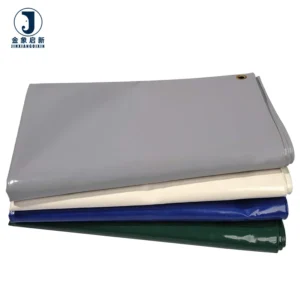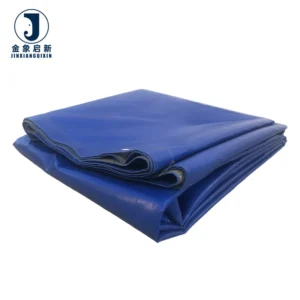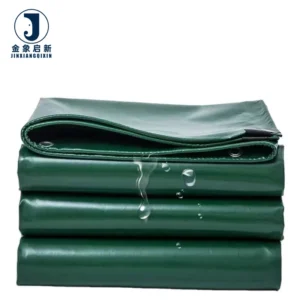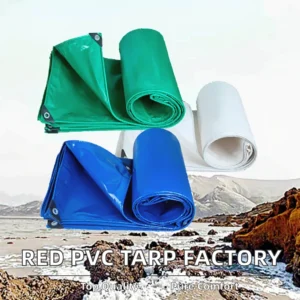
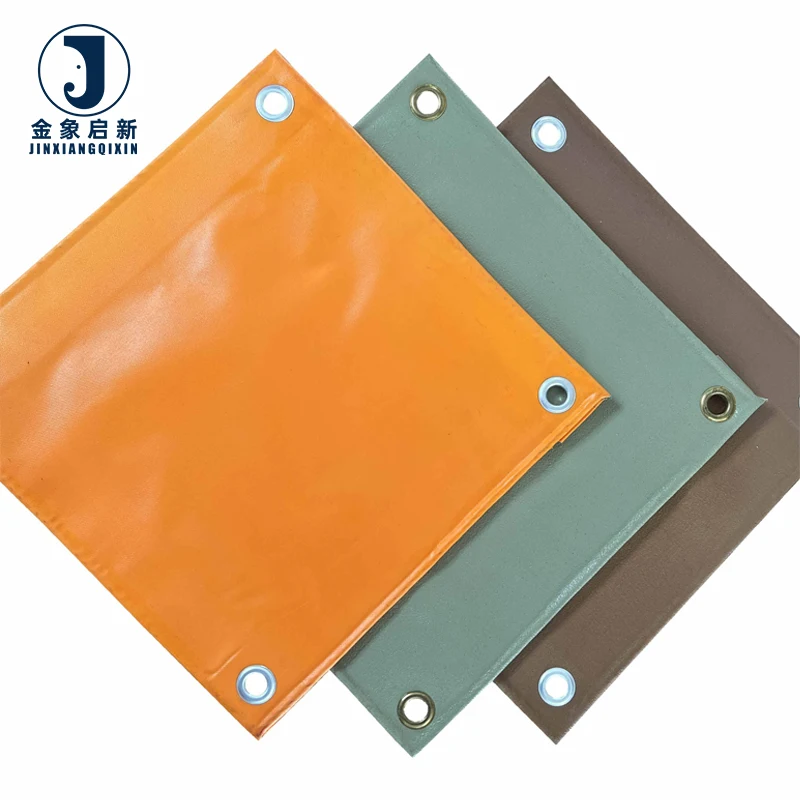
Coating Weight Control — hot melt coating technology applied across three GSM tiers ensures adhesion strength and surface consistency verified at every production stage.
Technical Specifications
| Parameter | Value |
|---|---|
| Product Type | Anti-Static Printable PVC Coated Tarpaulin with Laminated Grade |
| Base Fabric | 100% high toughness polyester yarn |
| Coating Material | PVC |
| Coating Technology | Lamination technology and hot melt coating technology |
| Weight (Medium Grade) | 400–500 g/m² |
| Base Fabric Denier (Medium) | 500D |
| Total Thickness (Medium) | 0.35–0.45 mm |
| Tensile Strength (Medium) | Longitude 1500–2000 / Latitude 1200–1800 N/5cm |
| Weight (Heavy-Duty Grade) | 700–1000 g/m² |
| Base Fabric Denier (Heavy) | 1000D |
| Total Thickness (Heavy) | 0.70–1.0 mm |
| Tensile Strength (Heavy) | Meridian 2000–2500 / Latitude 1800–2200 N/5cm |
| Weight (Super Heavy Grade) | 1100–1500 g/m² |
| Base Fabric Denier (Super Heavy) | 500D–2000D |
| Total Thickness (Super Heavy) | 1.2–1.5 mm |
| Tensile Strength (Super Heavy) | Warp 2500–3000 / Weft 2200–2800 N/5cm |
| Cold Crack Resistance | -30°C |
| Flame Retardant | Flame retardant treatment available — confirm the grade required for your market |
| Anti-Static | Anti-static treatment available — surface resistance value and test standard to be confirmed per order |
| UV Treatment | Anti-UV treatment available — test basis to be confirmed |
| Waterproof | Yes |
| Mold Proof | Yes |
| Welding Tear Strength | Excellent |
| Color Fastness | Best color fastness |
| Certifications | ISO, CE |
Application Suitability
| Application | Exposure & Requirement |
|---|---|
| Exhibition booth backdrops | Indoor static discharge risk, wide-format solvent and UV ink adhesion, frequent rigging and de-rigging |
| Event backdrop fabric | Tension loads from frame mounting, surface flatness for high-resolution printing, handling abrasion |
| Tensioned structural displays | Sustained tensile load on seams and welds, dimensional stability under varying humidity |
| Inflatable display structures | Air retention at welded seams, repeated inflation cycles, flex fatigue at fold lines |
| Truck tarpaulin covers | Road abrasion, weather exposure, flexing at load points, tie-down stress at reinforced edges |
| Industrial pipe canopy | UV and moisture exposure, chemical-laden atmosphere, thermal expansion and contraction |
What "Anti-Static" Means Without a Verified Surface Resistance Value
Anti-static treatment on exhibition backdrop fabric must be backed by a measured surface resistance value and a recognised test standard — otherwise the claim is unverified.
Technical buyers sourcing Anti-Static Printable PVC Coated Tarpaulin material and coating technology for indoor event environments face a recurring problem: the fabric is described as anti-static, yet no surface resistance reading or test method accompanies the quotation. In venues where printed graphics sit near sensitive audio-visual equipment and LED walls, static discharge can damage electronics and attract dust that degrades print clarity. Specifying a fabric without documented anti-static verification leaves the fabricator exposed to venue compliance rejection and costly on-site remediation. [NEED_CITE: electrostatic discharge standards for indoor exhibition materials]
Coating Technology and Surface Consistency for Print Applications
The lamination technology and hot melt coating technology used on this PVC coated tarpaulin delivers a uniform coating layer across the polyester base fabric. This consistency matters directly for wide-format print shops: solvent and UV-curable inks require a surface free from coating voids, gloss variation, or adhesion weak points that cause ink pooling or dropout. The printable surface is engineered to accept high-resolution graphics without pre-treatment, reducing preparation steps for exhibition booth and event backdrop fabricators who run tight production schedules.
Base Fabric Denier and the Tensile-to-Weight Relationship
Selecting the correct grade requires understanding how base fabric denier interacts with coating weight to produce tensile strength. The medium grade at 500D and 400–500 g/m² suits lightweight backdrop applications where the fabric is mounted on rigid frames and subjected to moderate tension. The heavy-duty grade at 1000D and 700–1000 g/m² addresses tensioned structural displays and inflatable structures where sustained loads demand higher warp and weft strength. The super heavy grade spanning 500D–2000D at 1100–1500 g/m² covers industrial canopy and heavy truck tarpaulin applications requiring maximum tear resistance. [NEED_CITE: tensile and tear test methods for coated fabrics per ISO 1421]
How Coating Method Affects Weld Performance and Seam Integrity
Lamination technology bonds the PVC coating to the polyester base fabric under heat and pressure, creating a layered structure where the coating penetrates the weave. Hot melt coating technology adds further adhesion by fusing additional PVC layers. Together, these methods produce welding tear strength that resists separation at heat-welded seams — a critical property for exhibition backdrops assembled from multiple panels and for inflatable structures where seam failure means total air loss. The coating-to-fabric bond must exceed the stress applied during rigging, transport, and wind loading to prevent delamination at the weld line.
Specification Breakdown: Reading GSM, Denier, and Tensile Together
GSM alone does not determine how a PVC coated fabric performs under load. The base fabric denier defines the individual yarn thickness, while the weave density determines how those yarns distribute force across the fabric plane. A 1000D yarn in the heavy-duty grade carries more load per yarn than 500D, but if the weave is less dense, the total tensile strength may not scale proportionally with GSM. Coating weight adds mass and abrasion resistance but contributes minimally to tensile capacity — it is the polyester base fabric that bears the structural load. Understanding this relationship prevents over-specifying GSM when the application actually requires higher denier or tighter weave for tear propagation resistance.
The Hidden Cost of Specifying PVC Coated Fabric on GSM Alone
When buyers select Anti-Static Printable PVC Coated Tarpaulin material and coating technology based solely on a quoted GSM figure, several failures emerge downstream. A medium-grade backdrop fabric specified at the lower end of the 400–500 g/m² range may arrive lighter than agreed, with reduced coating thickness that compromises print surface quality and cold crack resistance. Welded seams on underweight material fail before the fabric body does, particularly at the points where exhibition frames apply concentrated stress. Batch-to-batch coating weight variation across rolls in the same order creates visible gloss differences once panels are installed side by side at the booth. [NEED_CITE: coating weight variance impact on welded seam integrity in PVC tarpaulin]
Why Source This Coated Fabric From Jinan Jinxiang
Deep process control over coating weight and adhesion across nearly 30 years of coated fabric production means each roll of Anti-Static Printable PVC Coated Tarpaulin material and coating technology is verified against specification at every production stage. Three full production lines and 36 sets of professional equipment support bulk roll orders with reliable on-time delivery for event fabricators working to exhibition deadlines. A 10-person R&D team handles material selection, custom sizing, and sample development — providing swatches within days so print shops can validate ink adhesion before committing to a full order. Dedicated QA/QC with 100% pre-shipment inspection ensures the GSM, coating weight, and colour reference stated on the quotation match what arrives at the dock. The lamination and hot melt coating process is controlled to maintain roll-to-roll consistency, eliminating the visible variation that forces fabricators to reject panels mid-installation.
Documentation & Verification
- Material specification sheet stating exact GSM, base fabric denier, coating weight, and colour reference for the selected grade
- Anti-static surface resistance test report supplied where anti-static treatment is specified for the order
- Flame retardant test documentation matching the grade required by your venue or market regulation
- Pre-shipment inspection record confirming GSM and coating weight verification per roll before dispatch
- ISO and CE certificates included with customs documentation for cross-border shipment
Fabrication, Handling & Storage
- Heat weld parameters must account for coating thickness — the 0.70–1.0 mm heavy-duty grade requires higher dwell time than the 0.35–0.45 mm medium grade
- Store rolls vertically on end cores to prevent flat-spot deformation on the PVC coating surface
- Allow cold-stored rolls to reach ambient temperature before unrolling to avoid creasing at the -30°C cold crack threshold
- Use compatible PVC adhesive for field repairs on laminated grade seams rather than solvent-based cements that attack the coating bond
- Plan panel cutting layout to minimise waste across the available roll width, especially for wide-format backdrop sections
Request a Specification Match for Your Application
Provide the end-use environment, expected tension or rigging loads, and any anti-static or flame retardant compliance requirements for your target venue or market. Specify the roll width, GSM range, and colour reference needed, along with whether you require raw roll stock or pre-cut panels. Include your print method — solvent, eco-solvent, or UV-curable — so the surface finish can be matched to your ink system for optimal adhesion.
Frequently Asked Questions
Q: How is the anti-static treatment measured, and what surface resistance value can be supplied with a test report?
A: Anti-static treatment is applied during the coating process and must be verified by a surface resistance measurement per a recognised test standard. We supply a test report stating the measured value for your batch. Confirm the surface resistance range required by your venue or regulatory body so the treatment can be formulated to match before production begins.
Q: What is the relationship between GSM, base fabric denier and tensile strength across the available grades?
A: GSM defines total weight including coating, while base fabric denier determines individual yarn strength. The medium grade at 500D and 400–500 g/m² delivers lower tensile values suited to frame-mounted backdrops. The heavy-duty 1000D grade at 700–1000 g/m² provides higher warp and weft strength for tensioned structures. The super heavy grade scales further for industrial applications.
Q: How is coating adhesion and weld strength verified — can a test report per a recognised standard be provided?
A: Coating adhesion from our lamination and hot melt coating technology is verified through in-process QA at every production stage. Welding tear strength is assessed during pre-shipment inspection. Where your project requires a test report per a specific standard such as ISO 1421, request this during the inquiry stage so testing is scheduled before dispatch.
Q: What base fabric construction and coating method ensure consistent ink adhesion for wide-format printing?
A: The 100% high toughness polyester yarn base fabric provides a dimensionally stable substrate, while the hot melt coating technology produces a uniform PVC surface free from voids. This combination supports consistent solvent and UV ink adhesion across the full roll width, minimising ink dropout or gloss variation that affects print quality on exhibition backdrops.
Q: How is cold crack resistance tested, and what documentation accompanies each shipment?
A: Cold crack resistance is rated at -30°C for this PVC coated tarpaulin range. Each shipment includes a material specification sheet, pre-shipment inspection record, ISO and CE certificates, and a packing list. Where cold-environment logistics or outdoor winter events are your application, request the cold crack test documentation during the sample approval stage.