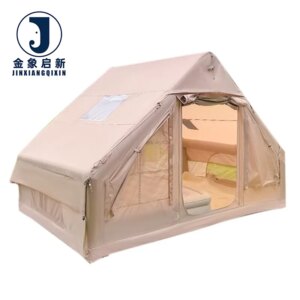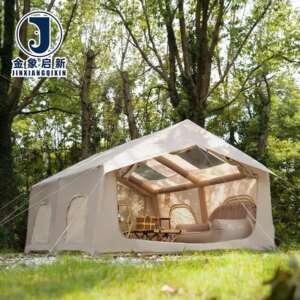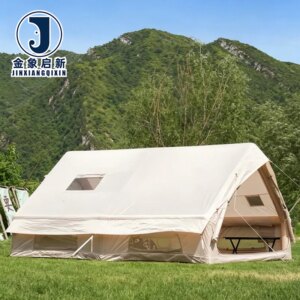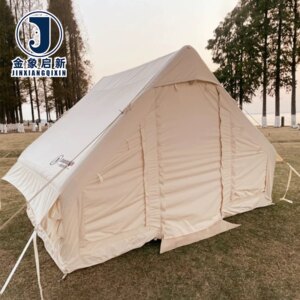
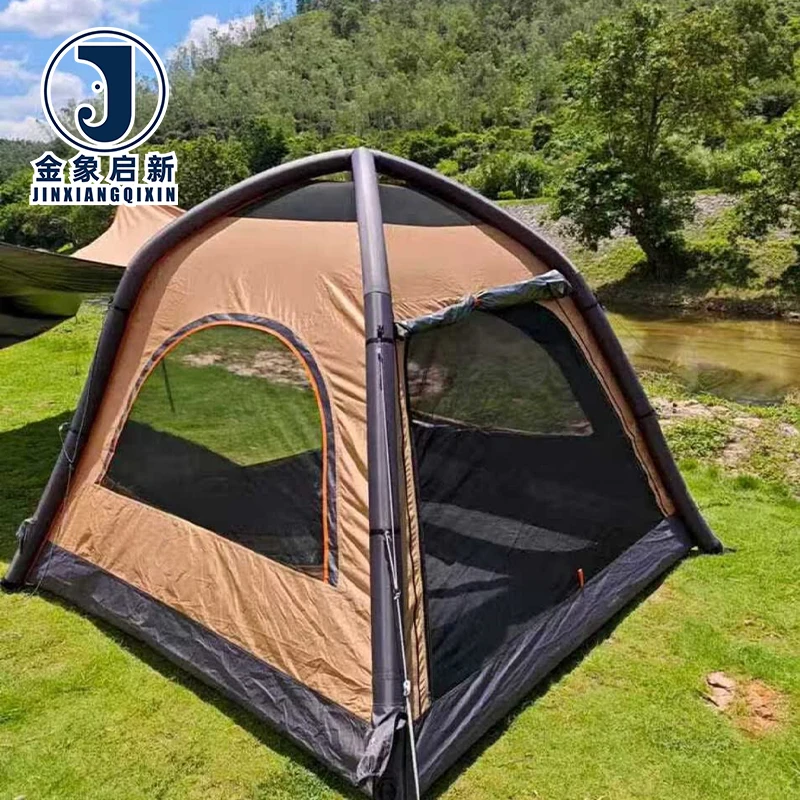
Coating Adhesion Mastery — nearly 30 years of process control over PVC formulation and base fabric compatibility, ensuring inflatable structures hold pressure through repeated flex cycles.
Technical Specifications
| Parameter | Value |
|---|---|
| Product Type | Inflatable Tent |
| Core Material | PVC Tarpaulin |
| Capacity | 8-10 Person |
| Season Rating | 4 Season |
| Waterproof Rating | Hydrostatic head ≥ 5000mm |
| Tensile Strength | ≥ 3000N/5cm |
| Flame Retardant | EN 13501-1 |
| Anti-Static | Stated (test basis not stated in source) |
| UV Treatment | Stated (test basis not stated in source) |
| Fabric Thickness Tolerance | ±0.1mm |
| Airtightness Test | 24-hour pressure testing before shipment |
| Key Features | Waterproof, UV-resistant, Tear-resistant, Fire-retardant, Anti-static |
| Certifications | ISO9001, ISO14001, ISO45001, CE |
| Customization | OEM & ODM, custom dimensions, fabric thickness adjustments, pattern printing |
Application Suitability
| Application | Exposure & Requirement |
|---|---|
| Disaster relief emergency shelters | Prolonged rain and wind exposure, rapid deployment, verified flame retardant compliance for populated sites |
| Mobile command centers | Sensitive communication equipment requiring anti-static interior, frequent inflation and deflation cycles |
| Temporary equipment storage for infrastructure projects | UV exposure during multi-month site use, abrasion from loading and unloading operations |
| Temporary personnel accommodation | Thermal stability across seasons, waterproof integrity in sustained wet conditions |
What "Flame Retardant" Means Without a Verified Grade
A fabric labeled flame retardant is only as credible as the test report behind it. PVC inflatable tent fabric rated to EN 13501-1 gives procurement teams a traceable classification that maps directly to European and internationally recognized fire safety frameworks. [NEED_CITE: EN 13501-1 classification system for construction products and building elements]
In emergency shelter deployments, site inspectors frequently reject materials that arrive with generic fire-retardant claims but no supporting documentation. The consequence is not merely a delayed project — entire shelter installations have been dismantled and replaced at significant cost when the supplied material cannot demonstrate compliance against the local fire code. Inflatable structures concentrate risk because the airframe and skin operate as a single pressurized system; a material failure under flame exposure compromises the entire shelter simultaneously. Buyers specifying PVC inflatable tent fabric for disaster relief must confirm the grade required for their market before production begins, rather than discovering the gap at the inspection stage.
Coating Formulation and Airtight Weld Integrity
The coating applied to the base fabric determines how reliably seams hold under continuous inflation pressure. PVC inflatable tent fabric requires a formulation that achieves consistent thermal bonding across the full weld zone, not just at the surface layer. When coating adhesion and base fabric compatibility are engineered together from the formulation stage, the resulting welded seams resist delamination even where the inflatable structure flexes most during wind loading and packing cycles.
Manufacturers who treat coating selection and weld parameter setting as separate decisions often encounter seam failures that appear unpredictably across production batches. Our R&D team addresses this by controlling coating weight, plasticizer ratio, and surface preparation as a unified system, so that the thermal bonding window remains stable whether you are welding straight runs or complex curved joints in an inflatable frame.
Thickness Tolerance and Batch-to-Batch Consistency
Maintaining fabric thickness within ±0.1mm tolerance across a full production run directly affects how uniformly the material behaves during high-frequency or hot-air welding. Even minor thickness variation forces fabricators to adjust weld temperature and dwell time on the fly, introducing inconsistency into seam strength.
For inflatable tent manufacturers producing multiple units from the same fabric batch, this tolerance control means each structure inflates to the same rigidity and holds pressure for the same duration during the 24-hour airtightness test. Variability in thickness also affects how the material folds and packs — thicker spots create hard crease lines that become preferential wear points after repeated deployment cycles. [NEED_CITE: relationship between coating thickness tolerance and weld consistency in PVC-coated technical textiles]
Reading the Specification Sheet Beyond Surface Numbers
Tensile strength at ≥ 3000N/5cm tells you how the base fabric resists pulling forces during inflation, but this value only holds when the coating contributes to load distribution rather than acting as a dead weight layer. The hydrostatic head rating of ≥ 5000mm reflects the combined barrier performance of the coating and its bond to the substrate — a high reading achieved through coating thickness alone, without adequate adhesion, will degrade once the material is folded and transported.
Flame retardant classification to EN 13501-1 is measured on the finished composite, meaning the base fabric, coating, and any surface treatments must all perform together under the test protocol. Anti-static and UV-resistant treatments are available, and buyers should confirm the test basis applicable to their deployment environment before ordering. The 24-hour pressure test conducted before shipment validates the fabricated product rather than the raw fabric, providing a system-level checkpoint that catches seam and valve integration issues early.
The Cost of Overlooking Coating-Fabric Compatibility
When the coating formulation is not matched to the base fabric denier and weave density, the first visible symptom is usually weld failure rather than fabric tearing. Inflatable structures place concentrated stress at valve attachment points and frame junctions, and an incompatible coating will separate from the substrate at these locations long before the fabric itself reaches its tensile limit.
Buyers who specify PVC inflatable tent fabric based solely on GSM and price frequently discover this incompatibility during prototype testing, after tooling and cutting dies have already been committed. The cost of re-sourcing, re-testing, and re-certifying a replacement material can exceed the original fabric savings many times over. [NEED_CITE: weld peel strength testing methods for PVC-coated fabrics per ISO 2411]
Why Source Inflatable Tent Fabric Here
Our in-house PVC formulation capability means coating weight and plasticizer balance are adjusted for the specific base fabric and end-use, not pulled from a standard catalogue. This directly addresses the adhesion failures that generic coated fabrics produce in inflatable applications.
Three full production lines and 36 sets of processing equipment give us the capacity to run consistent, large-volume orders while maintaining the ±0.1mm thickness tolerance that inflatable fabricators depend on. A 10-technician R&D team develops samples within days for custom thickness, dimension, and performance requirements, allowing you to validate weld parameters and inflation behaviour before committing to full production. Dedicated QA/QC at every production stage, culminating in 100% pre-shipment inspection and 24-hour pressure testing, catches batch-level variation before it reaches your cutting table.
Documentation & Verification
- Material specification sheet stating base fabric denier, coating weight, and GSM for full traceability
- EN 13501-1 flame retardant test report accompanying each production batch
- Hydrostatic head and tensile strength test data tied to specific roll numbers
- 24-hour airtightness pressure test record for each fabricated inflatable unit
- Pre-shipment inspection record covering thickness, colour, and surface quality
- Certificate of origin and customs documentation for international dispatch
Fabrication, Handling & Storage
- Hot-air welding temperature and speed should be calibrated against the specific PVC coating formulation and ±0.1mm thickness tolerance
- Store rolls vertically on padded racks to prevent permanent creasing in the coated surface layer
- Allow cold-stored rolls to reach workshop temperature before unrolling to avoid coating micro-cracking
- Use PVC-compatible solvent cleaners that do not attack the flame retardant or anti-static surface treatments
- Reinforce valve and junction patches with additional coating-compatible adhesive layers matching the base fabric construction
- Plan cutting layouts to minimize weld seams across high-stress inflation zones of the tent frame
Preparing Your Fabric Inquiry
To receive an accurate specification recommendation, share the inflation pressure range your structures operate under and the deployment climate you are targeting. Confirm the fire safety classification required in your destination market — EN 13501-1 covers many jurisdictions, but regional adaptations exist. Specify whether you need rolls at standard or custom width, the annual volume you anticipate, and whether pattern printing or branding is part of your finished product. If you have not yet locked your weld parameters, request sample yardage first so you can validate fabrication settings on your own equipment.
Frequently Asked Questions
Q: How does EN 13501-1 map to fire safety requirements in my market?
A: EN 13501-1 is recognized across Europe and referenced in many international building and temporary structure codes. However, some regions adopt local adaptations or require additional test classifications. We provide the full EN 13501-1 test report with each shipment so your compliance team can cross-reference it against local regulations. Confirm the exact classification your project specification demands before we begin production.
Q: What welding parameters work best for this PVC inflatable tent fabric?
A: Optimal hot-air or high-frequency welding settings depend on the specific coating formulation and thickness you order. We recommend ordering sample yardage first and running test welds on your equipment. Our technical team can then advise on temperature, speed, and pressure adjustments based on your results, ensuring consistent seam strength across your production run.
Q: How do I verify the GSM and coating weight on arrival?
A: Each shipment includes a material specification sheet with stated GSM, base fabric denier, and coating weight tied to specific roll numbers. We recommend conducting incoming weight checks using standardized sample cuts from multiple rolls. Any discrepancy against the documented specification should be flagged before fabrication begins, and our QA team is available to support resolution.
Q: What UV test data supports the outdoor exposure claims?
A: UV-resistant treatment is available and can be applied to this PVC inflatable tent fabric. The specific test basis and exposure duration data depend on the grade selected. Request the applicable UV test report for your chosen specification before ordering, and confirm with us whether the exposure conditions in your deployment environment require an upgraded treatment level.
Q: What are the customization options and minimum order for roll stock?
A: We offer OEM and ODM customization including custom dimensions, fabric thickness adjustments beyond standard tolerance, and pattern printing. Minimum order quantities depend on the width, colour, and treatment combination you require. Share your target roll dimensions and annual volume with us, and we will confirm the applicable minimum and lead time for your specific configuration.