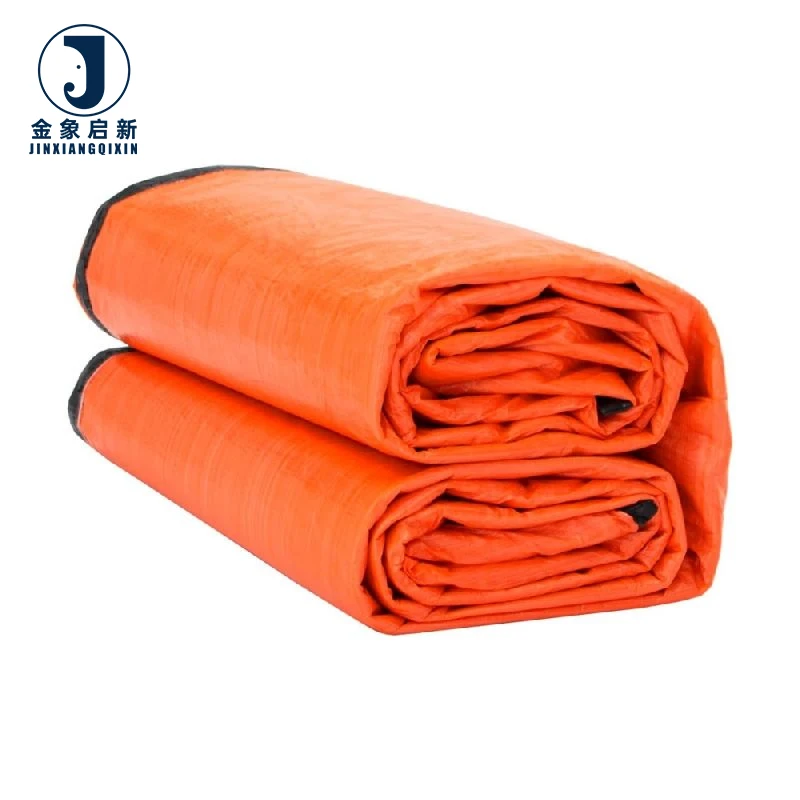
Engineered Layer Control — Three full production lines and 36 sets of equipment give us repeatable lamination quality across every roll of insulated PE tarpaulin, keeping foam core thickness and surface adhesion within tolerance from the first metre to the last.
Technical Specifications
| Parameter | Value |
|---|---|
| Product Type | Insulated PE Tarpaulin |
| Material Structure | PE cloth + closed cell PE foam core + PE cloth |
| Coating Material | PE |
| Available Dimensions | 6ftx24ft / 8ftx25ft / 12ftx20ft / 12ftx24ft |
| Thickness Options | 2x2mm / 3×1.5mm / 1x4mm / 5mm / 6mm / 8mm / 12mm |
| Color Options | Orange / Black / White / Silver / Customized color |
| Grommet Configuration | Aluminum grommets, hole distance 61cm and 91.5cm |
| Edge Finish | Reinforcement stitch, rust-proof brass grommets around all finished stitched edges |
| Waterproof | Yes (surface fabric waterproof) |
| UV Treatment | Yes (test basis not stated — request report) |
| Flame Retardant | Grade not stated — confirm the grade required for your market |
| Insulation Core | Closed cell PE foam |
Application Suitability
| Application | Exposure & Requirement |
|---|---|
| Concrete curing blanket | Prolonged ground contact, moisture retention, thermal stability across diurnal temperature swings |
| Cold weather construction enclosure | Vertical hang under wind load, low-temperature exposure, sustained thermal retention for heated tent environments |
| Wind block and building wrap | Lateral wind pressure on grommets and stitched edges, UV exposure on outer face |
| Snow and rain weather protection | Surface water shedding, low-temperature flexibility, repeated handling and repositioning |
Why Thickness Claims Without Layer Breakdown Leave Buyers Exposed
A single total-thickness figure tells you nothing about how heat is actually retained or where the fabric will fail first.
Many insulated tarpaulins are quoted by overall thickness alone, yet the thermal behaviour depends entirely on whether the core is closed cell or open cell foam, and how reliably the outer PE cloth is bonded to that core. When the bond degrades under repeated flexing or temperature cycling, the layers delaminate and the insulating air pockets collapse — often before the surface fabric shows any visible damage [NEED_CITE: peel strength test methods for laminated coated fabrics per ISO 2411]. Specifiers evaluating Insulated PE Tarpaulin material properties need a layer-by-layer breakdown, not a single headline number, to compare products on equal terms.
What the Three-Layer Lamination Actually Does for Thermal Retention
The outer PE cloth serves as the primary waterproof barrier and takes the mechanical abrasion from handling, tie-down straps, and contact with formwork or scaffolding. Beneath it, the closed cell PE foam core traps air in discrete pockets that resist heat transfer — unlike open cell foam, moisture cannot migrate into the cells and compromise insulation value over time. The inner PE cloth protects the foam from puncture and provides a second moisture barrier, which matters when the blanket is laid directly on wet concrete or hung as a heated enclosure wall. Understanding these Insulated PE Tarpaulin material properties at the layer level is what separates a curing blanket that holds temperature through a winter night from one that looks adequate on paper but underperforms on site.
How Foam Density and Bonding Method Shape Long-Term Behaviour
Not all closed cell PE foam is equal — density determines both the compression resistance under foot traffic or stacked materials and the actual R-value the core delivers once installed. A low-density core may measure correctly on a thickness gauge at the factory but compress under its own weight when hung vertically as a wind block, reducing effective insulation [NEED_CITE: compression set testing for cellular plastics per ISO 1856]. The lamination bond between foam and outer cloth must also survive repeated folding and unfolding in cold conditions, where PE becomes stiffer and the peel force at the interface increases. This is where production line control matters: consistent heat and pressure during lamination prevents weak spots that later show up as bubbling or separation along fold lines.
Reading the Thickness Range Against Your Actual Curing Scenario
The available options — 2x2mm, 3×1.5mm, 1x4mm, 5mm, 6mm, 8mm and 12mm — represent different balances between flexibility and thermal resistance rather than simply "thicker is better." A 2x2mm construction gives a total of 4mm with a symmetric layup that drapes well over curved formwork and is practical for short-duration pours where the main risk is overnight frost rather than sustained sub-zero conditions. The 12mm option provides maximum core depth for extended curing cycles in colder climates, but the added stiffness means it requires more grommet points to hang flat and may need two people to position on large slab pours. The intermediate grades let specifiers match insulation to the specific temperature differential and exposure duration rather than over-specifying weight and cost on every project. Choosing the right Insulated PE Tarpaulin material properties profile at this stage avoids both thermal shortfalls and unnecessary handling difficulty on site.
What Happens When Layer Integrity Fails in the Field
When the bond between PE cloth and foam core is inconsistent across a batch, delamination tends to appear first at the stitched edges where flexing concentrates — precisely where grommet loads and wind gusts already place the highest stress. Once a pocket opens, water ingress into the core eliminates the insulating value locally and adds weight, which pulls the surrounding bond apart further. Contractors then find themselves replacing individual panels mid-project rather than completing the curing cycle as planned [NEED_CITE: field failure analysis for laminated insulation blankets in cold weather construction]. Batch-to-batch variability in lamination pressure or foam surface preparation is the usual root cause, and it is invisible on a thickness measurement taken at the receiving dock.
What Process Control Means for This Specific Laminated Fabric
Maintaining three full production lines dedicated to coated and laminated fabrics allows lamination parameters — temperature, roller pressure, line speed — to be locked per product grade rather than adjusted on the fly between unrelated materials. The 10-person R&D team develops and validates the bond recipe for each foam-to-cloth combination before it enters volume production, which is how thickness consistency is achieved roll after roll. A dedicated QA/QC stage at every production phase catches adhesion weak spots before they reach the packing line, and the 100% pre-shipment inspection verifies grommet spacing, edge stitch integrity and colour match against the confirmed sample. This is not generic quality language — it is the specific workflow that keeps Insulated PE Tarpaulin material properties aligned with the data sheet from first article to final roll.
Documentation & Verification
- Material specification sheet stating layer structure, foam core type and total thickness per grade
- UV treatment test report — request documentation before ordering to confirm test basis
- Pre-shipment inspection record verifying grommet spacing, edge reinforcement and thickness consistency
- ISO and CE certificates available at company level; confirm product-level compliance for your project
- Roll packing list with batch reference for traceability across large multi-roll orders
Fabrication, Handling & Storage
- Heat welding is not applicable to the closed cell foam core — stitch-and-grommet joining with reinforced hems is the standard method for this PE laminated structure
- Store rolls flat or on wide-diameter cores to prevent compression creases in the foam layer that reduce local insulation value
- Aluminum grommets at 61cm and 91.5cm spacing distribute tie-down load; avoid concentrating stress on a single point in high wind conditions
- Clean the PE surface with mild detergent only — solvent-based cleaners can attack the lamination bond at the cloth-to-foam interface
- Unfold in temperatures above freezing where possible; PE cloth stiffens in cold and increases peel stress at fold lines
What to Include When Requesting a Quotation
Tell us the application — concrete slab curing, vertical enclosure wall, or equipment cover — along with the lowest ambient temperature and the duration the blanket needs to stay in place. If your site has specific fire classification requirements, state the standard your local authority references so we can confirm whether the available grades meet that threshold. Specify which dimensions from the range work for your formwork or scaffolding module, and whether you need a custom colour for site identification or visibility purposes.
Frequently Asked Questions
Q: How does closed cell PE foam differ from open cell foam for insulation performance?
A: Closed cell foam traps air in sealed pockets that resist moisture ingress, maintaining insulation value even when the blanket contacts wet concrete or is exposed to rain. Open cell foam absorbs water, which replaces insulating air and adds weight. For concrete curing and outdoor enclosure use, closed cell construction prevents the thermal degradation that moisture causes in open cell alternatives.
Q: What thickness should I specify for concrete curing in cold weather?
A: The choice depends on the temperature differential and curing duration. Short overnight frost protection on mild pours can work with the thinner 2x2mm or 3×1.5mm options. Extended curing cycles in sustained sub-zero conditions typically require 8mm or 12mm to maintain adequate thermal retention. Share your specific climate data and we will recommend the matching grade.
Q: Is the UV treatment applied as a surface coating or built into the PE fabric?
A: The UV treatment is incorporated during fabric production rather than applied as a topical finish after lamination. This means protection does not wash off with rain or wear away through handling. However, the specific test basis for the UV claim should be confirmed — request the test report to verify the exposure standard used.
Q: Can this multi-layer PE structure be heat-welded on site?
A: The closed cell foam core and multi-layer lamination make conventional heat welding unsuitable, as the foam compresses and melts inconsistently. Stitch-and-grommet joining with reinforced edge hems is the recommended fabrication method. For field repairs, mechanical fasteners or adhesive patches compatible with PE surfaces are the practical options.
Q: What flame retardant grades are available for project compliance?
A: Flame retardant grades are available, but the specific grade and test standard must be confirmed against your local building authority or site safety requirements. State the classification your project references — such as NFPA 701, DIN 4102, or a local equivalent — and we will verify whether a matching grade can be supplied with supporting test documentation.