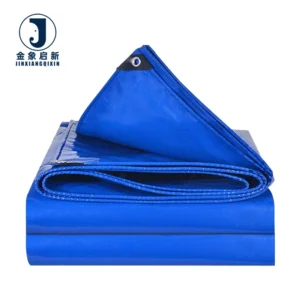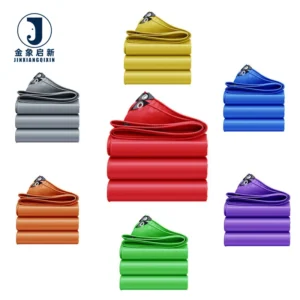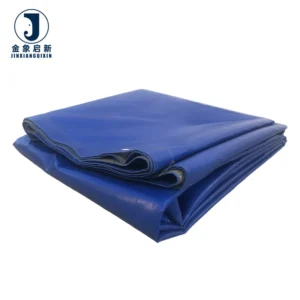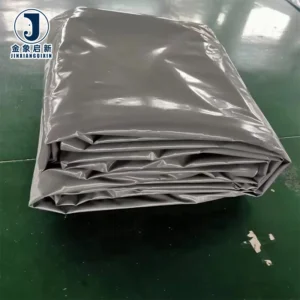
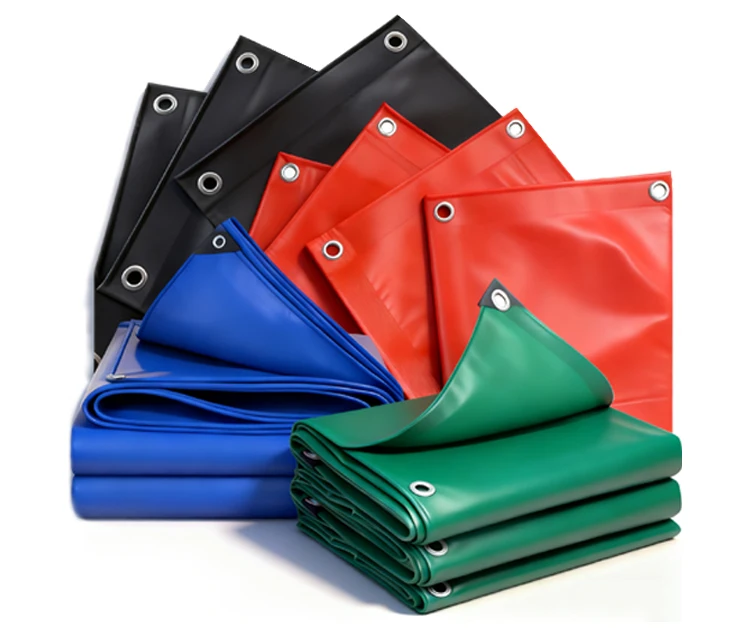
Precision Coating Control — Every roll of laminated PVC coated polyester fabric is verified against stated GSM and coating weight before dispatch, backed by stage-by-stage inspection across three full production lines.
Technical Specifications
| Parameter | Value |
|---|---|
| Product Type | PVC Coated Tarpaulin |
| Base Fabric | 100% high toughness polyester yarn |
| Coating Material | PVC |
| Coating Method | Lamination technology / Hot melt coating technology |
| Weight (Medium) | 400–500 g/m² |
| Weight (Heavy-duty) | 700–1000 g/m² |
| Weight (Super Heavy) | 1100–1500 g/m² |
| Thickness (Medium) | 0.35–0.45 mm |
| Thickness (Heavy-duty) | 0.70–1.0 mm |
| Thickness (Super Heavy) | 1.2–1.5 mm |
| Base Fabric Denier (Medium) | 500D |
| Base Fabric Denier (Heavy-duty) | 1000D |
| Base Fabric Denier (Super Heavy) | 500D–2000D |
| Tensile Strength (Medium) | Warp 1500–2000 / Weft 1200–1800 N/5cm (test standard not stated) |
| Tensile Strength (Heavy-duty) | Warp 2000–2500 / Weft 1800–2200 N/5cm (test standard not stated) |
| Tensile Strength (Super Heavy) | Warp 2500–3000 / Weft 2200–2800 N/5cm (test standard not stated) |
| Flame Retardant | Available — confirm the grade required for your market |
| Anti-Static | Available — confirm the standard required for your site |
| UV Treatment | Available — confirm test basis for your region |
| Cold Resistant | Cold resistant cracking treatment available |
| Anti-Mildew | Mold proof treatment available |
| Weld Tear Strength | Excellent (test standard not stated) |
| Waterproof | Yes |
| Weather Resistance | 3–5 years outdoor living guarantee |
| Color | Customizable |
| Standards | ISO, CE |
Application Suitability
| Application | Exposure & Requirement |
|---|---|
| Truck side curtain and trailer cover | Constant flexing at tie-down points, road debris abrasion, sustained UV exposure |
| Tensioned membrane and inflatable structures | High tensile load at anchor points, long-term weathering, weld integrity under wind load |
| Industrial pipe canopy | Chemical splash, standing water, UV degradation over extended outdoor service |
| Construction site enclosure | Wind load, mechanical puncture risk, dust containment, potential flame retardant compliance |
| Pond and reservoir liner | Permanent water immersion, soil chemistry contact, puncture from substrate irregularities |
Why Base Fabric Denier Matters More Than GSM Alone for PVC Coated Fabric
GSM tells you weight per square metre — denier and weave density tell you what the fabric can actually withstand before it tears.
Technical buyers frequently specify PVC coated tarpaulin by GSM alone, only to discover that two rolls at the same weight behave completely differently under tension. A 700 g/m² fabric woven from 500D yarn with heavy coating will flex and crack sooner than a 700 g/m² fabric built on a 1000D base with lighter, more balanced coating. The coating adds mass but not structural strength. When the load shifts against a truck curtain or the wind pulls at a membrane edge, it is the base yarn that carries the force. [NEED_CITE: tensile and tear test methods for coated fabrics per ISO 1421]
Coating Technology and Adhesion Performance
The hot melt coating and lamination methods used for this PVC coated fabric series control how firmly the PVC layer bonds to the polyester base yarn. Lamination technology presses pre-formed PVC films onto the woven substrate under heat and pressure, producing consistent coating thickness across the roll. Hot melt coating applies liquid PVC directly into the weave, penetrating between yarns for mechanical interlocking. Both methods affect how the material behaves at welded seams, where delamination is the most common failure mode in fabricated tarpaulins.
Matching Denier Grade to Structural Demand
The three-tier denier range — 500D medium through 1000D heavy-duty to 500D–2000D super-heavy — corresponds to different structural roles. Medium-duty 500D fabric suits general waterproof covers and light engineering wraps where flexibility matters more than peak tensile values. Heavy-duty 1000D fabric is the standard for truck tarpaulins and transport side curtains that endure daily flexing and tie-down stress. Super-heavy grades up to 2000D serve tensioned membrane structures and industrial pipe canopies where the fabric must carry sustained static load without elongation. [NEED_CITE: PVC coated fabric denier and tensile correlation for structural applications]
How GSM, Denier, and Tensile Strength Interact
In PVC coated polyester fabric, the relationship between weight and strength is not linear. Coating weight contributes to abrasion resistance and waterproofing but adds little to tensile capacity. The base fabric denier and weave density determine warp and weft strength values. A heavy-duty 1000D fabric at 700–1000 g/m² achieves warp tensile figures of 2000–2500 N/5cm because the yarn itself is thicker and more tightly woven. A super-heavy 2000D base pushes that further to 2500–3000 N/5cm in the warp direction, necessary when the fabric spans large unsupported areas in tensioned structures. Specifying solely by GSM risks selecting a coating-heavy, yarn-light fabric that tears before it wears through.
The Hidden Cost of Specifying PVC Coated Fabric by Weight Only
When a buyer orders coated fabric by GSM without verifying denier or tensile values, the material may pass the initial weight check on arrival but fail prematurely in service. Weld seams are the first point of failure — if the coating is thick but the base yarn is thin, the heat from welding weakens the yarn at the joint while the heavy coating masks the problem during inspection. Fabricators then see seams splitting under load while the surrounding fabric remains intact. Batch-to-batch inconsistency compounds this: one roll performs correctly while the next, at the same stated GSM but a different denier balance, tears during fabrication. [NEED_CITE: weld seam failure rates in coated fabric assemblies]
Process Control Behind Every Roll
Coating weight and adhesion are monitored at every stage across three full production lines, not just at final inspection. This prevents the common problem of GSM stated on the quotation diverging from what arrives. The ten-person R&D team develops custom samples within days, allowing buyers to verify material behaviour before committing to bulk production. A 100% pre-shipment inspection checks every roll against the stated GSM, colour reference, and treatment specification, with findings documented before dispatch. ISO and CE certified production supports compliance documentation for regulated markets. Functional treatments — flame retardant, anti-static, cold-resistant, mold-proof — are available in selectable grades, each backed by test documentation you can review before shipment.
Documentation & Verification
- Material specification sheet stating exact GSM, base fabric denier, and coating method for each roll
- Test reports for flame retardant, anti-static, and UV treatment grades applicable to the order
- Pre-shipment inspection record with weight verification per roll against stated GSM before dispatch
- ISO and CE certificates provided for compliance documentation
- Colour reference matched across rolls in the same shipment with inspection notation
Fabrication, Handling & Storage
- Hot melt welded seams require adjusted temperature and dwell time depending on whether the grade is 400 g/m² medium or 1100 g/m² super heavy
- Lamination coated surfaces bond differently under high-frequency welding versus hot-air welding — test parameters on sample offcuts first
- Store rolls upright on core ends to prevent flat-spot deformation that shows as visible creases after unrolling
- Cold-resistant treated fabric remains flexible at low temperatures but should be unrolled gradually to avoid coating micro-cracking
- Cut panels from super-heavy 2000D grades with allowance for weld shrinkage, which increases with coating thickness
- Clean gloss-surface PVC coated fabric with neutral pH detergent only — solvent cleaners strip the plasticiser from the coating layer
Requesting a Technical Quote
Provide the end-use application and the specific exposure conditions the fabric will face — continuous UV, standing water, chemical contact, or flex cycling. State the flame retardant or anti-static grade your local regulations require, along with any certification documentation your site inspector will demand. Confirm whether you need roll stock in standard widths or custom dimensions, and whether sample panels are required for weld parameter testing before bulk order placement.
Frequently Asked Questions
Q: How is GSM verified on arrival and what tolerance applies per roll?
A: Every roll undergoes weight verification during the pre-shipment inspection, with results documented against the stated GSM on your material specification sheet. Rolls are sampled at multiple points along the length to confirm consistency. If your market requires a specific tolerance band, state this at the inquiry stage so it can be built into the production control parameters and recorded in your inspection documentation.
Q: What test standards support the flame retardant and anti-static treatment claims?
A: Flame retardant and anti-static treatments are available in multiple grades, and the applicable test standard depends on your regional compliance requirements. State the standard your market demands — such as DIN 4102 B1, NFPA 701, or a specific mining ventilation regulation — and the corresponding test report will be supplied with the shipment documentation. Confirm the required grade before sample approval.
Q: How does base fabric denier relate to tensile and tear strength in PVC coated fabric?
A: Denier indicates the thickness of the polyester yarn in the base weave. A 1000D yarn carries substantially more tensile load than a 500D yarn at the same weave density, which is why heavy-duty grades achieve higher N/5cm values. Coating weight adds mass and abrasion resistance but contributes minimally to tear propagation resistance — that is determined primarily by the base fabric construction.
Q: What is the difference between hot melt coating and lamination technology?
A: Hot melt coating applies liquid PVC directly into the polyester weave, filling interstices for strong mechanical adhesion. Lamination bonds pre-formed PVC films onto the substrate under heat and pressure, producing uniform coating thickness. The choice affects weld behaviour, flexibility, and surface finish. Request sample panels of each method to test which suits your fabrication process and end-use requirements.
Q: How is batch-to-batch colour and coating weight consistency controlled across multiple rolls?
A: Each production run follows controlled coating parameters with in-process quality checks at every stage. Rolls within the same order are cross-referenced for colour and weight during the 100% pre-shipment inspection, with any deviation recorded before dispatch. For large orders spanning multiple production batches, request a colour consistency report covering all rolls in the shipment.