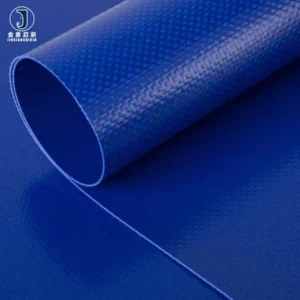
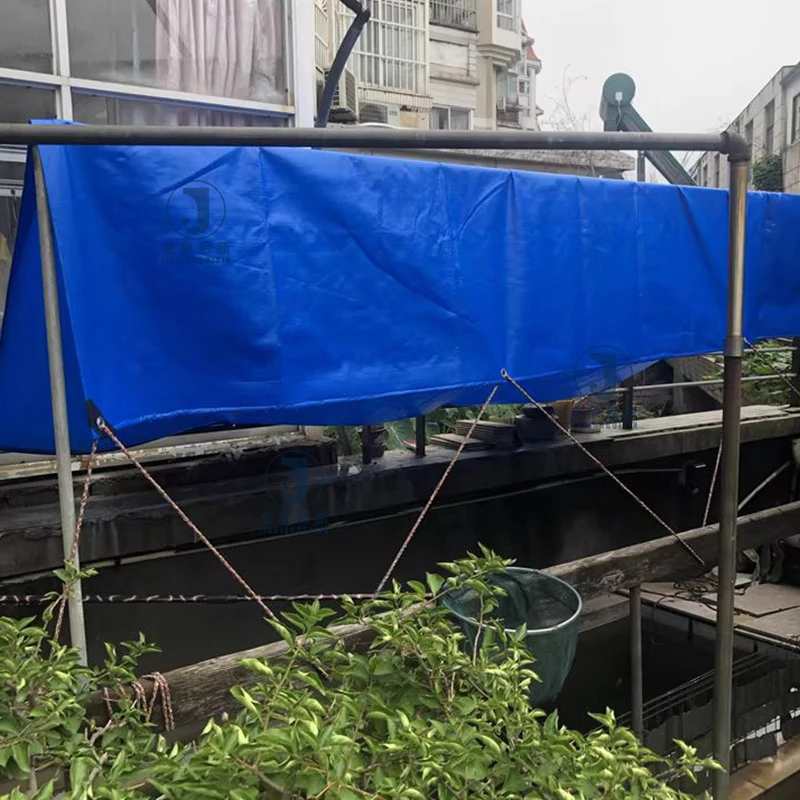
Deep Process Control Over Coating Weight — Every roll of this PVC coated tarpaulin for truck cover applications ships with documented GSM, base fabric construction, and coating method so you can verify material against the agreed grade before fabrication begins.
Technical Specifications
| Parameter | Value |
|---|---|
| Product Type | PVC Coated Tarpaulin |
| Coating Method | Knife Coated |
| Base Fabric | High-tenacity polyester woven scrim |
| Surface Finish | Available in glossy or matte finish |
| Weight (GSM) | Multiple GSM grades available — confirm the grade required for your application |
| Width | Supplied in widths up to 3.2m or custom |
| Roll Length | 100 yards, 100 meters, or custom |
| Color Options | Blue, Blue/Orange, Green, Grey, Black, Clear, Grey/Green, Orange, or custom |
| Edge Reinforcement | PP rope reinforced hem on all four edges |
| Eyelets | Galvanized eyelets every 3ft or 1 meter interval |
| Corner Reinforcement | Reinforced plastic corners |
| UV Treatment | Available in UV stabilised grades — confirm the treatment level required for your market |
| Flame Retardant | Available in flame retardant grades — confirm the grade required for your market |
| Waterproof | Fully waterproof coated construction |
| Key Features | Tear resistant, washable, anti-mildew, anti-aging |
Application Suitability
| Application | Exposure & Requirement |
|---|---|
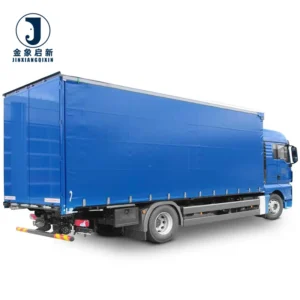
| Truck side curtain | Constant flexing at load points, road debris abrasion, UV and weather exposure, tie-down stress at eyelets |
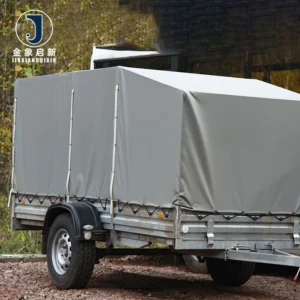
| Flatbed trailer cover | Wind load during transit, water ingress prevention, repeated folding and unfolding |
| Tipper and dump truck tarpaulin | Heavy material impact, abrasion from aggregate, tension from ratchet straps |
| Intermodal container cover | Long-haul exposure across climate zones, handling equipment contact, stacking abrasion |
| Fleet-branded side curtain | UV and weather resistance to preserve printed fleet livery over extended service |
Why the Coating Method Matters More Than GSM Alone for PVC Truck Cover Fabric
Knife coating delivers the adhesion and seam integrity that truck covers demand at their flex points.
Many buyers specify PVC coated tarpaulin by GSM alone, yet two fabrics with identical weight can perform very differently depending on how the coating was applied. A knife coated structure forces the PVC compound into the interstices of the base fabric under controlled pressure, producing a mechanical bond between coating and yarn that resists delamination when the fabric flexes repeatedly. This matters on a truck side curtain that flexes every time the load shifts or the wind gusts. The PVC coated tarpaulin aftermarket supplier you choose should be able to show you how coating weight and adhesion are controlled at every production stage, not just quote a GSM figure [NEED_CITE: tensile and tear test methods for coated fabrics per ISO 1421].
Knife Coated Construction and What It Means for Truck Cover Durability
The knife coating process applies a measured thickness of PVC compound across the woven polyester scrim, ensuring the coating penetrates the yarn crossings rather than sitting on the surface. This penetration is what gives the material its resistance to peeling apart at welded seams — a critical property for truck covers where the seams at flex points carry as much load as the fabric itself. A well-coated PVC tarpaulin material will behave predictably under high-frequency welding, producing seams that match the service life of the parent fabric.
Coating Weight, Base Fabric Density, and Their Combined Effect on Performance
Specifying by GSM alone misses the structural contribution of the base fabric weave. A dense scrim with lighter coating can outperform a heavy coating on a loose weave in tensile and tear resistance, because the yarn-to-yarn interlocking in the base fabric is what arrests tear propagation. For PVC truck cover applications, the relationship between coating weight and base fabric construction determines how the material handles both sustained tension from ratchet straps and sudden impact loads from road debris [NEED_CITE: DIN 53354 tear resistance test for coated fabrics].
Reading GSM, Tensile, and Tear Data as a System
GSM tells you the total mass per square metre, which includes both the base fabric and the coating. Tensile strength reflects the load-bearing capacity of the yarn system under steady pull, while tear strength measures how well the fabric resists the propagation of a cut or nick — a common starting point for failure on truck covers where straps and hardware contact the fabric. When evaluating PE tarpaulin material coating GSM specification data, always look at these three parameters together rather than selecting on any single value. A heavier GSM does not automatically mean higher tear resistance if the base fabric denier and weave density remain unchanged.
Surface Finish Selection: Glossy vs Matte for Truck and Fleet Use
The choice between glossy and matte finish affects more than appearance. A glossy surface sheds water and road grime more readily, making it easier to clean after long-haul trips through wet or muddy conditions. A matte finish reduces glare and provides a better key for printed fleet branding and logos. Both finishes are available across this PVC coated tarpaulin range, and the decision should match the operating environment and whether the cover will carry printed identification [NEED_CITE: surface finish impact on print adhesion for PVC coated fabrics].
The Hidden Cost of Specifying Coated Fabric on Weight Alone
When a truck cover fails prematurely, the root cause is rarely the GSM being slightly off — it is more often a mismatch between the fabric construction and the mechanical demands of the application. A cover that flexes constantly at the same points needs a coating method that delivers reliable adhesion, not just a high weight figure. Selecting a flame retardant grade without verifying the test basis can mean the material fails a site inspection after installation, requiring full replacement. Colour inconsistency between rolls in the same order becomes visible once installed side by side on a fleet, forcing rework or accepting a patchwork appearance across vehicles.
Why Sourcing This PVC Truck Cover Material Here Makes Sense
Nearly three decades focused on coated fabric production means the coating weight and adhesion on every roll are controlled through established process parameters, not adjusted on the fly. Three full production lines and thirty-six sets of professional equipment support bulk roll orders with consistent output quality across batches. A ten-person R&D team handles material selection, custom sizing, colour matching, and sample development, producing samples within days so you can verify the specification before committing to volume. Dedicated QA/QC inspection at every production stage, including pre-shipment weight and dimension checks per roll, means the material arriving at your facility matches what was agreed at the quotation stage.
Documentation & Verification
- Material specification sheet stating GSM, base fabric construction, and coating method for each roll
- Test report for UV stabilisation grade where applicable to your market requirements
- Test report for flame retardant grade where specified for your compliance needs
- Pre-shipment inspection record with roll-by-roll weight and dimension verification
- ISO and CE certificates included with shipment documentation package
- Certificate of origin and customs support documentation for international dispatch
Fabrication, Handling & Storage
- High-frequency welding parameters should be adjusted to match the specific coating thickness and GSM grade selected
- Galvanized eyelets at regular intervals distribute tie-down load and reduce tearing risk at stress concentration points
- Store rolls horizontally on a flat surface to prevent permanent creasing in the knife coated PVC layer
- Allow cold-stored rolls to reach ambient temperature before unrolling to avoid cracking the PVC coating
- Use mild detergent and soft brush for cleaning to preserve the surface finish and any applied treatment
- Reinforced plastic corners and PP rope hem protect edges during fabrication and extend service life at high-wear points
What to Include in Your Enquiry
To receive an accurate specification recommendation, share your truck or trailer model dimensions, the expected operating environment including UV and temperature exposure, and any flame retardant or anti-static requirements your market mandates. If fleet branding is needed, specify the print method and colour references so the correct surface finish can be selected. Indicate whether you require roll stock for in-house fabrication or finished cut-to-size covers with eyelets and hems, along with your annual volume estimate.
Frequently Asked Questions
Q: How is GSM verified per roll before dispatch?
A: Every roll undergoes a weight check during pre-shipment inspection, and the results are recorded on the material specification sheet that ships with your order. This sheet states the exact GSM, base fabric weave, and coating type so you can cross-check the received material against the agreed grade before cutting or welding.
Q: What test basis supports the UV treatment claim?
A: UV stabilisation is available across this PVC coated tarpaulin range, and the treatment level should be confirmed against your market’s exposure requirements. Request the applicable test report when specifying, as UV performance varies by grade and the correct level depends on the expected duration and intensity of outdoor exposure in your operating region.
Q: How does knife coated PVC compare to laminated PE for truck cover applications?
A: Knife coated PVC generally offers higher adhesion strength between coating and base fabric, which translates to better weld seam integrity and delamination resistance at flex points. Laminated PE serves lighter-duty applications well, but for truck covers subject to constant flexing, road abrasion, and tie-down tension, knife coated PVC construction provides the durability technical buyers specify.
Q: How is colour consistency controlled across multiple rolls in one order?
A: Colour matching is managed through controlled pigment dosing and in-process inspection at the coating stage. A colour reference is documented on the material specification sheet, and rolls from the same production run are checked side by side before packing to ensure batch-to-batch consistency across your order.
Q: Can I get samples before placing a bulk roll order?
A: Samples are developed within days to your exact GSM, colour, finish, and treatment requirements. This allows you to test weld parameters, check colour accuracy, and verify the specification matches your application before committing to a full production order.