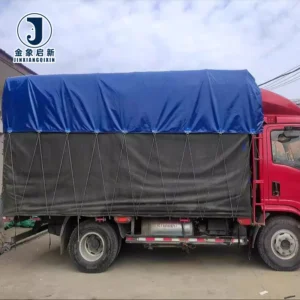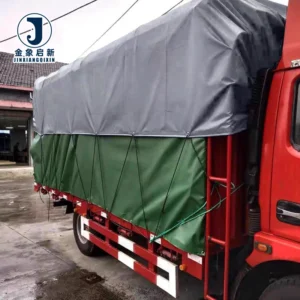
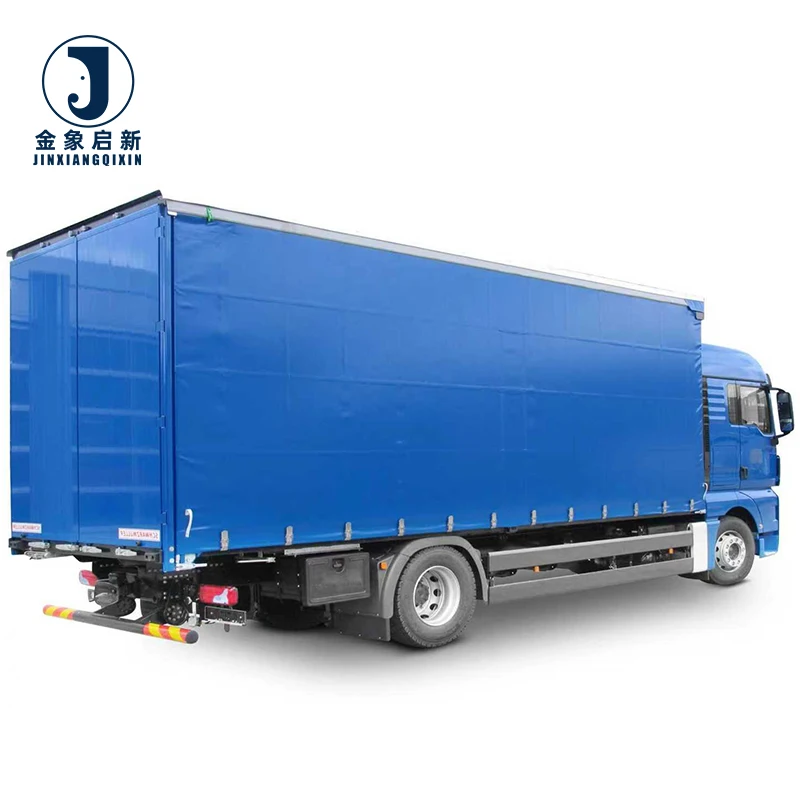
Coating Weight Control — Nearly 30 years of PVC formulation experience ensures consistent GSM and adhesion across every roll of truck tarpaulin fabric produced.
Technical Specifications
| Parameter | Value |
|---|---|
| Product Type | PVC Tarpaulin Truck Cover |
| Coating Material | PVC |
| Construction | Double-Faced |
| Surface Treatment | Anti-UV (test basis not stated in source) |
| Flame Retardant | Flame retardant (grade not stated in source) |
| Water Resistance | Water resistant |
| Mildew Resistance | Mildew resistant |
| Color Options | Multiple colors available |
| Customization | Logo printing, custom sizes |
| Standards | ISO, CE |
Application Suitability
| Application | Exposure & Requirement |
|---|---|
| Truck and trailer side curtains | Constant flexing at hinge points, road debris abrasion, prolonged UV exposure, frequent roll and unroll cycles |
| Vehicle cargo covers | Direct rainfall, wind uplift force, temperature fluctuation, tie-down tension at edges |
| Advertising truck tarpaulins | Ink adhesion on PVC surface, colour fastness under sunlight, large-format print durability |
Why PVC Coated Truck Tarpaulin Material Properties Matter More Than Stated Weight
A 650 GSM claim on paper means nothing if the coating adhesion fails at the weld line under real load flexing.
Technical buyers and fabricators have repeatedly seen truck covers fail not because the fabric tore, but because the PVC coating delaminated from the base fabric at the seam. [NEED_CITE: tensile and tear test methods for coated fabrics per ISO 1421]. When specifying PVC coated truck tarpaulin material properties, the relationship between base fabric denier, coating weight, and the method of coating application determines whether a side curtain survives a full season or needs mid-route replacement. The gap between a quotation and the actual roll delivered is where most procurement problems begin.
Coating Adhesion and Base Fabric Interaction
The PVC coating must bond completely with the woven base fabric to resist peeling under repeated flexing. When a side curtain folds and unfolds daily, any weakness in the coating-to-fabric bond shows up first at the high-stress fold lines. Double-faced PVC coated truck tarpaulin construction applies coating to both sides, which distributes tension evenly and prevents one-sided delamination that single-coated fabrics experience when the uncoated side absorbs moisture.
Flame Retardant and Anti-UV Treatment Verification
Flame retardant grades are available — confirm the specific grade required for your market and request the corresponding test report before placing a production order. [NEED_CITE: fire classification standards for transport and building materials]. Anti-UV treatment is applied to extend service life under continuous road and weather exposure, and the test basis should be documented in the material specification sheet. Without written verification, these treatments are claims rather than specifications, and a technical buyer has no recourse when a cover degrades prematurely in sunlight or fails a site fire inspection.
Reading the Specification Sheet Beyond GSM
GSM alone does not predict how a PVC coated truck tarpaulin will perform in the field. The base fabric denier and weave density determine tensile and tear strength, while the coating weight and method influence flexibility, weld behaviour, and surface durability. A heavier coating does not automatically mean a stronger fabric — a high-denier base fabric with moderate coating weight often outperforms a low-denier fabric loaded with coating to reach the same GSM. Knife-over-roll coating produces a thicker, more uniform PVC layer suited to heavy-duty side curtains, while laminated constructions offer flexibility at lower cost but may separate under sustained tension.
The Hidden Cost of Incorrect Material Specification
When colour varies between rolls in the same shipment, the mismatch becomes visible the moment two panels are installed side by side on a trailer — forcing a full strip and refit. [NEED_CITE: batch colour consistency standards in coated fabric production]. Welded seams that fail before the fabric does typically trace back to inconsistent coating thickness or incompatible welding temperature settings for the specific PVC formulation. Ordering by GSM alone, without verifying base fabric construction or coating adhesion data, leaves the buyer exposed when the cover flexes at the load point and the seam opens.
Why Procurement Teams Source PVC Truck Fabric Here
Deep process control over PVC coating weight means the GSM stated on the quotation is the GSM verified on the roll at pre-shipment inspection. Three full production lines with 36 sets of equipment support bulk roll output while maintaining batch-to-batch coating consistency. A dedicated 10-person R&D team handles material formulation, sample development, and custom printing compatibility for specific client requirements. Every production stage includes QA checkpoints, and a 100% pre-shipment inspection with documented record is standard before any roll leaves the facility. Samples for custom material evaluation are developed within days, not weeks.
Documentation & Verification
- Material specification sheet stating GSM, base fabric denier, and PVC coating weight per roll
- Test reports for UV resistance and flame retardant grades supplied where applicable
- ISO and CE certificates covering the coated fabric production process
- Pre-shipment inspection record verifying colour consistency and coating adhesion
- Roll packing list with individual roll weight and dimension data
Fabrication, Handling & Storage
- Heat welding temperature must match the specific PVC coating formulation to prevent seam failure
- Double-faced construction allows welding from either side without uncoated-edge weakness
- Store rolls upright on cores to prevent flat-spot creasing in the PVC coating layer
- Avoid folding PVC tarpaulin in cold conditions where coating becomes brittle and may crack
- Clean printed surfaces with mild detergent to preserve custom logo adhesion on the PVC coating
- Allow rolls to acclimatise to ambient temperature before unrolling for cutting and fabrication
What to Include in Your Material Enquiry
Specify the target application — side curtain, cargo cover, or advertising tarpaulin — along with the exposure conditions and any regulatory fire classification required in your destination market. Provide the required PVC coated truck tarpaulin material properties including preferred GSM range, base fabric denier, colour references, and whether custom logo printing is needed on the finished rolls or cut panels.
Frequently Asked Questions
Q: What GSM and base fabric denier options are available for PVC truck tarpaulin?
A: Multiple GSM grades and base fabric denier constructions are available. The right combination depends on whether the fabric will be used for side curtains requiring high flex endurance or cargo covers prioritising tensile strength. Request a material specification sheet with exact GSM and denier data for the grade recommended for your application.
Q: Which flame retardant grade applies to my target market?
A: Flame retardant grades are available, but the specific grade required depends on local transport or building regulations in your destination country. Confirm the applicable standard before ordering and request the matching test report to ensure the PVC coated truck tarpaulin material meets compliance at the point of use.
Q: How is anti-UV treatment verified and documented?
A: Anti-UV treatment is applied during the PVC coating process. The test basis and exposure duration data should be requested in the material specification sheet. Ask for the specific test report that supports the UV resistance claim for your PVC truck tarpaulin order.
Q: What welding behaviour should fabricators expect from this PVC coating?
A: Double-faced PVC construction supports hot-air and high-frequency welding from either side. Welding temperature and speed must be calibrated to the specific coating formulation. Request welding parameter guidance with your sample to ensure seam strength matches the base fabric tensile performance.
Q: How is colour consistency maintained across multiple rolls for one truck curtain order?
A: Colour matching is controlled at the coating stage with reference standards checked during production and verified at 100% pre-shipment inspection. For fleet-wide orders requiring identical colour across multiple shipments, provide a physical colour reference and request a pre-shipment inspection record documenting batch consistency.