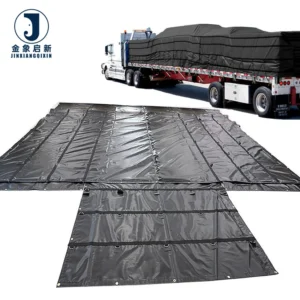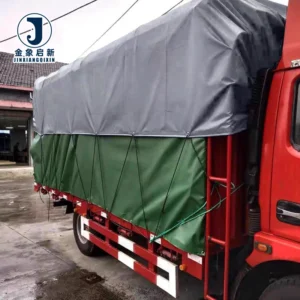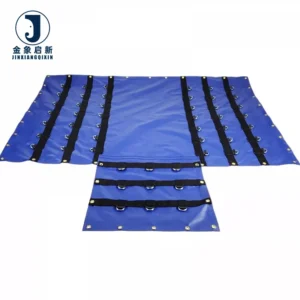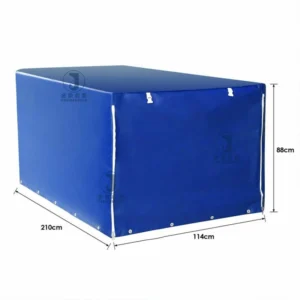
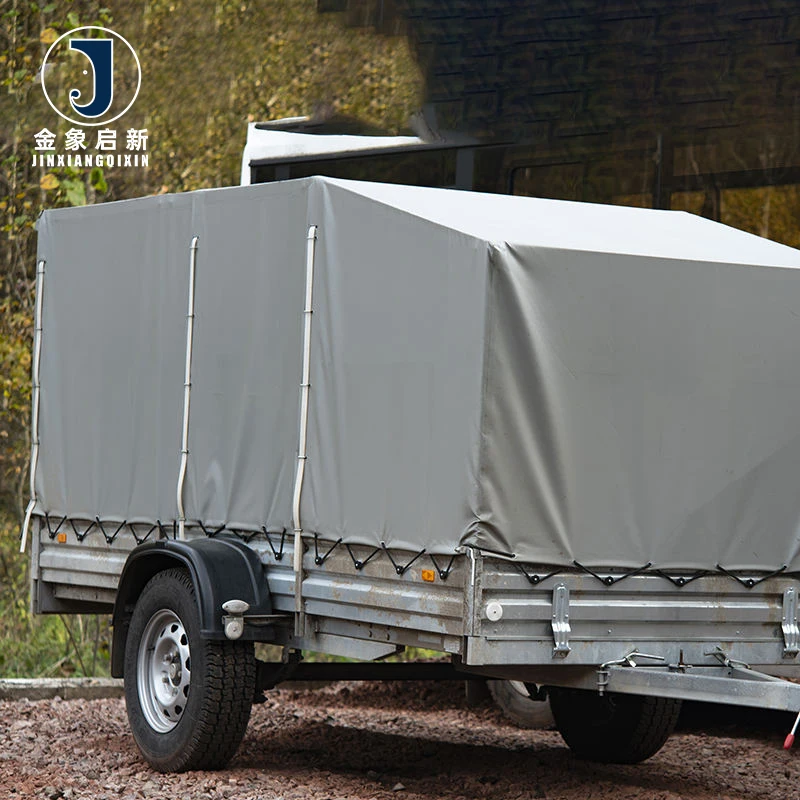
Deep Coating Process Control — Each roll of PVC Coated Tarpaulin for Truck Cover undergoes dedicated QA/QC with 100% pre-shipment inspection, ensuring the GSM you specify on the drawing matches the coating weight measured at dispatch.
Technical Specifications
| Parameter | Value |
|---|---|
| Product Type | PVC Coated Tarpaulin for Truck Cover |
| Material | PVC coating on high-strength polyester mesh fabric |
| Weight (GSM) | 350gsm / 420gsm / 500gsm / 550gsm / 600gsm / 750gsm (available across the range) |
| Total Thickness | 0.32mm / 0.35mm / 0.4mm / 0.45mm / 0.5mm / 0.65mm (corresponds to selected GSM) |
| Roll Width | 2m / 2.1m |
| Roll Length | 75m (for 2m width) / 50m (for 2.1m width) |
| Coating Technology | Laminated technology & Hot-melt coating technology |
| Finish Product Size | Custom sizes per buyer specification or sold by inventory roll |
| Color | Blue / Red / Yellow / Light blue / Grey (custom colors available) |
| Key Features | Waterproof, cold crack resistance, anti-mildew, color fastness, outstanding tearing strength for welding |
| Special Treatments | Flame retardant (grade not stated — confirm grade required for your market), anti-static (grade not stated) |
| Standards | ISO, CE |
Application Suitability
| Application | Exposure & Requirement |
|---|---|
| Truck side curtain and awning | Constant flexing at tie-down points, road abrasion, sun and weather exposure requiring high adhesion and weld tear strength |
| Cargo ship and marine cover | Salt spray, permanent moisture contact, anti-mildew treatment needed for extended deployment |
| Tent and inflatable structure | Tensile load across large spans, UV exposure, need for consistent color batch-to-batch across multiple rolls |
| Construction scaffolding enclosure | Wind load, debris impact, scaffolding pole abrasion, and requirement for flame retardant grades on regulated sites |
| Equipment and temporary industrial cover | Outdoor storage exposure, repeated folding and unfolding, mechanical handling stress at fold lines |
Why Coating Technology Matters More Than GSM for Truck Covers
The coating method — laminated or hot-melt — determines how the PVC bonds to the polyester mesh and how that bond survives repeated welding and flexing on a moving truck load.
Technical buyers often specify PVC coated tarpaulin by GSM alone, assuming a heavier weight automatically delivers a stronger cover. In practice, a 550gsm roll with poor adhesion between the PVC layer and the base fabric will delaminate at the weld seam long before a well-bonded 500gsm roll shows any sign of failure. The coating technology defines the mechanical link between layers, and that link is where fabricated truck covers either survive years of road use or fail within the first season. [NEED_CITE: tensile and tear test methods for coated fabrics per ISO 1421]
How the Base Fabric Construction Sets the Strength Floor
The high-tenacity polyester yarns in the base mesh carry the structural load of any PVC coated tarpaulin truck cover. The denier of the yarns and the weave density determine the tensile and tear baseline before any coating is applied. A tighter weave with heavier yarns resists tear propagation, particularly at the critical flex zones where a truck side curtain folds and unfolds with every load cycle. Coating weight adds abrasion resistance and environmental protection, but it cannot compensate for a base fabric that lacks mechanical integrity.
Laminated vs Hot-Melt Coating: Choosing the Right Bond for Welded Fabrication
Laminated technology bonds the PVC film to the polyester mesh under heat and pressure, producing a clean, uniform surface with strong adhesion that supports reliable heat welding. Hot-melt coating technology applies molten PVC directly to the mesh, creating a deeper penetration into the weave structure. The choice between them affects how the material behaves during fabrication — laminated stock tends to weld more predictably at standard temperature settings, while hot-melt coated fabric can offer different flexibility characteristics that influence how the finished cover drapes and folds on a trailer. [NEED_CITE: comparison of laminated and hot-melt PVC coating adhesion performance]
Reading the GSM-to-Thickness Ratio for Your Application
Across the available range — from 350gsm at 0.32mm to 750gsm at 0.65mm — the relationship between weight and thickness reveals the density of the coating formulation. A lower GSM with proportionally higher thickness indicates a less dense coating compound, which may affect abrasion resistance at high-wear zones like roller contact points on curtain-side trailers. Conversely, a dense coating at moderate thickness can deliver the surface durability needed for road-exposed truck covers without the extra weight penalty. Specifiers should match the weight-to-thickness ratio to the mechanical demands of their fabrication method and end-use environment.
The Hidden Cost of Specifying Material Without Considering Fabrication
When a truck cover fails, the tear almost always starts at a welded seam or an eyelet reinforcement point — not in the field of the fabric. This happens because the coating adhesion and the base fabric tear strength were evaluated independently, without considering how they interact during heat welding. A coating that melts unevenly at welding temperatures creates a weak zone precisely where the cover flexes most under load. [NEED_CITE: weld seam failure analysis in fabricated PVC tarpaulin covers]
Specifying PVC coated tarpaulin gsm and coating technology together — rather than weight alone — gives fabricators the data they need to set welding parameters that match the material, preventing premature seam failure in the field.
Why Technical Buyers Source This Material From Jinxiang
Nearly 30 years focused on coated fabric production gives this team deep process control over PVC coating weight and adhesion consistency across every roll produced.
Three full production lines and 36 sets of professional equipment support bulk roll orders with reliable scheduling for transport and industrial fabricators.
A 10-person R&D team handles material selection, sample development, and custom GSM or treatment specification, with samples developed within days for evaluation.
Dedicated QA/QC at every production stage ensures that coating weight, color, and base fabric construction match the agreed specification — verified by 100% pre-shipment inspection.
Dual coating technologies — laminated and hot-melt — are available on the same production site, allowing buyers to compare adhesion profiles and select the right process for their welding method.
Documentation & Verification
- Material specification sheet stating exact GSM, base fabric construction, and coating method per roll
- Test reports for UV and flame retardant grades provided where applicable — request before ordering treated grades
- Pre-shipment inspection record confirming coating weight and color consistency against specification
- Roll packing list with batch reference for traceability across multi-roll orders
- Certificate of origin and customs documentation supporting international shipment
Fabrication, Handling & Storage
- Heat weld at temperatures matched to the selected coating technology — laminated and hot-melt grades require different thermal settings
- Store rolls upright in a shaded area to prevent flat-spot deformation on the PVC coating surface
- Allow cold-stored rolls to reach ambient temperature before unrolling to avoid cracking the PVC layer
- Cut patterns to maximize yield from 2m or 2.1m roll widths, minimizing waste at selvedge edges
- Use compatible PVC-based repair patches and solvent cements matching the coating chemistry for field repairs
- Handle rolls with edge protectors to prevent damage to the mesh structure at roll ends
What to Include in Your Material Inquiry
Provide the specific application, expected mechanical loads, and environmental exposure so the right GSM grade and coating technology can be recommended from the available range. If your market requires flame retardant or anti-static compliance, state the target standard so the correct treatment grade is selected and documented. Confirm whether you need rolls in standard widths and lengths or custom-finished panels cut to your trailer or structure dimensions.
Frequently Asked Questions
Q: How is GSM verified on each roll before shipment?
A: Every roll undergoes weight measurement as part of the 100% pre-shipment inspection process. The measured GSM is recorded against the material specification sheet and compared with the value stated in your order. You can recheck on arrival using a calibrated scale and a measured sample cut from the roll edge. Request the pre-shipment inspection record with your documentation package.
Q: What is the difference between laminated and hot-melt coating for weld seam strength?
A: Laminated coating bonds a pre-formed PVC film to the polyester mesh under heat and pressure, producing a predictable surface for standard heat welding. Hot-melt coating applies molten PVC directly*may require adjusted welding temperatures. The choice affects both fabrication parameters and the flexibility of the finished truck cover.
Q: Which flame retardant grade is available and does it meet my market standard?
A: Flame retardant treatment is available as a special option, but the specific grade must be confirmed before ordering. Different markets require different fire safety classifications. State your target standard in your inquiry so the correct treatment can be applied and a matching test report provided with your shipment documentation.
Q: How does anti-UV treatment performance get tested and what data can I request?
A: UV resistance is offered as a treatment option across the PVC coated tarpaulin range. Test reports documenting UV exposure performance are available upon request for treated grades. Specify your target market’s UV exposure requirements when inquiring so the appropriate treatment level is applied and documented before production begins.
Q: How do I ensure color consistency across multiple rolls in one order?
A: Rolls within a single production batch are coated from the same dye lot, which maintains color uniformity across the order. The 100% pre-shipment inspection includes visual color comparison between rolls. For large multi-batch orders, request a production batch sample to verify color match before the full quantity is dispatched.