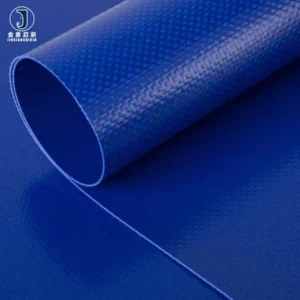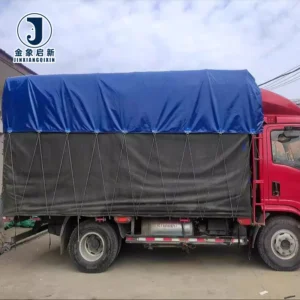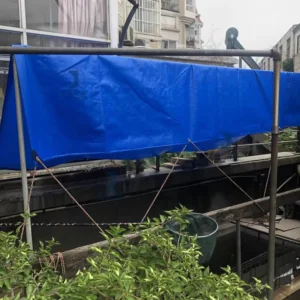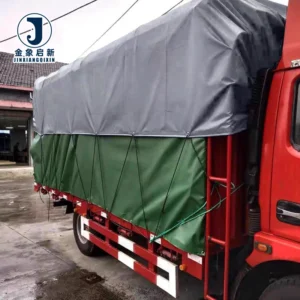
Coated Fabric Process Control — Deep control over PVC coating weight and adhesion ensures the stated 610 gsm on the quotation matches the material that arrives at your dock, verified roll by roll before dispatch.
Technical Specifications
| Parameter | Value |
|---|---|
| Product Type | PVC Lumber Tarpaulin for Flatbed Transport |
| Dimensions | 24′ x 27′ with 8 ft drop |
| Base Fabric Denier | 1000 x 1000D |
| Weave Density | 20 x 20 / 18 x 18 |
| Coating Material | PVC (polyvinyl chloride) |
| Weight Options | 18 oz (610 gsm) / 16 oz / 14 oz |
| Color Options | Black / Blue |
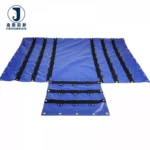
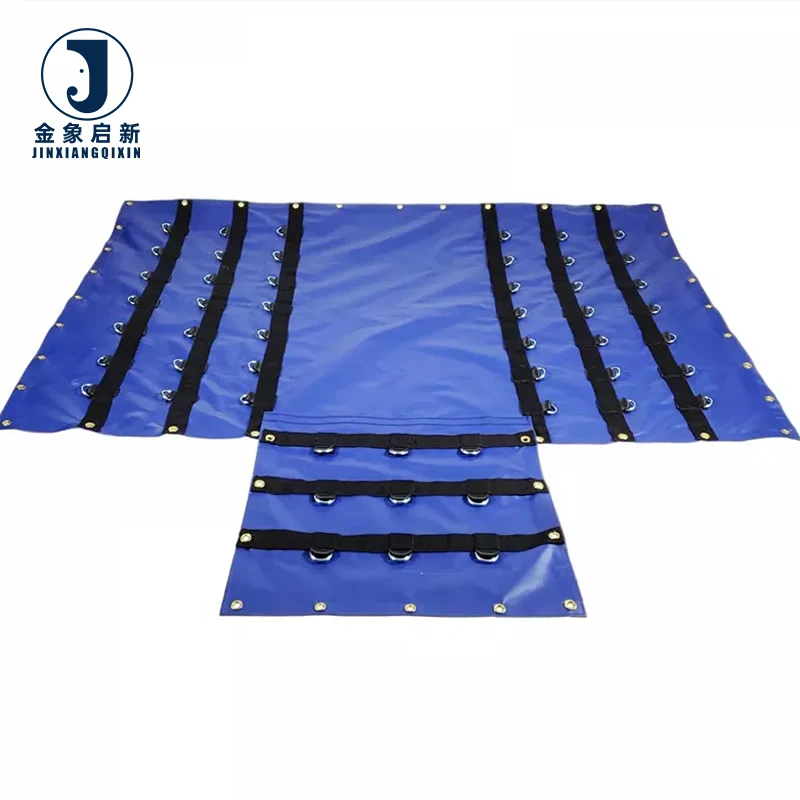
| Drop Options | 4 ft (2 rows D-rings + tail flap) / 6 ft and 8 ft (3 rows D-rings + tail wing) |
| Hardware | 3 rows of D-rings |
| Temperature Range | -35 °C to 70 °C |
| Properties | Waterproof, acid-resistant (grade not stated), UV-resistant (test basis not stated) |
| Thickness Options | 0.35–0.45 mm / 0.70–1.0 mm / 1.2–1.5 mm |
| Standards | ISO, CE |
Application Suitability
| Application | Exposure & Requirement |
|---|---|
| Flatbed lumber transport | Rainwater, road spray, UV exposure, wind load at highway speed, abrasion from load flexing at tie-down points |
| Wall panel and siding haulage | Moisture ingress prevention, surface scratch protection, secure enclosure of tall stacked loads |
| Engineered wood product delivery | Long-haul UV and weather exposure, requirement for consistent tarp colour across fleet units |
| Prefabricated building component transport | Debris impact, water pooling on flat surfaces, multi-point tie-down for irregular load profiles |
Why a 610 gsm PVC Lumber Tarpaulin for Flatbed Transport Still Fails at the Seams
Welded seams carry the load at the exact point the cargo flexes most — and that is where most lumber tarps split first.
When a flatbed hits a series of expansion joints at speed, the lumber stack shifts and the tarp billows. The stress concentrates at the hem and D-ring attachment zones, not in the middle of the fabric panel. A tarp that tests well for tensile strength in the field can still fail early if the heat-weld parameters were set for a lighter grade or if the seam overlap is too narrow for the actual load movement. [NEED_CITE: tensile and tear test methods for coated fabrics per ISO 1421] We see this pattern repeatedly: the specification sheet shows the correct GSM, the base fabric is adequate, yet the tarp comes back torn at the perimeter within the first season. The fix is not a heavier fabric — it is seam engineering matched to the drop height and D-ring spacing.
Base Fabric Density and Coating Adhesion Under Highway Wind Load
The 1000 x 1000D polyester base at 20 x 20 mesh count gives the PVC lumber tarpaulin for flatbed transport its structural backbone. At highway speed, wind pressure cycles across the tarp surface thousands of times per trip. A tighter weave holds the PVC coating more securely because the coating penetrates deeper between the yarn intersections, reducing the chance of delamination at flex points. When the mesh count drops to 18 x 18, the fabric is more pliable for tighter folding, which suits crews that handle the tarp manually every day. The trade-off is slightly lower tear propagation resistance, so the choice depends on whether your loads are tall and rigid or shorter and frequently re-tarped.
D-Ring Configuration Matched to Drop Height and Load Profile
An 8 ft drop with three rows of D-rings encloses a full-height lumber stack and spreads the tie-down load across the vertical face of the cargo. On a 4 ft drop, two rows of D-rings plus a tail flap are sufficient for lower-profile loads and reduce the weight the crew drags across the deck. The tail wing option on the 6 ft and 8 ft drops wraps around the rear of the load, closing the gap that wind uses to get underneath and start lifting the tarp from the back. Each configuration changes where the highest stress sits on the welded seams, and the reinforcement pattern is set accordingly during production.
How GSM, Denier, and Coating Weight Interact on a Lumber Tarp
The 18 oz (610 gsm) grade pairs the heaviest PVC coating with the 1000 x 1000D base to handle long-haul trips where the tarp stays in place for days. The coating weight contributes to puncture resistance against sharp lumber edges, while the base fabric denier determines how far a tear will travel once it starts. [NEED_CITE: relationship between GSM, base fabric denier, and tear propagation in PVC coated fabrics] A lighter 14 oz option reduces crew fatigue during daily tarping and is suited to shorter regional runs where the tarp is removed and re-applied multiple times per shift. The temperature range of -35 °C to 70 °C keeps the PVC flexible in winter starts and stable under summer deck heat, which matters because a stiff tarp in cold weather transfers more shock load directly to the D-ring attachments. The acid-resistant surface provides an additional layer of protection when loads pass through industrial zones where airborne chemical residue settles on the tarp exterior.
What Happens When the Wrong Grade Meets the Wrong Route
A 14 oz tarp specified for a cross-country route that includes mountain passes and high-wind corridors will fatigue faster than expected, not because the material is defective but because the wind cycles exceed what the lighter coating can absorb at the seam overlap. Conversely, running a full 18 oz tarp on short-distance delivery trucks adds unnecessary weight that slows down the tarping crew and increases the physical toll over hundreds of cycles per week. Colour inconsistency between replacement tarps on the same fleet is a separate frustration — a batch that arrives in a noticeably different shade of blue or black signals inconsistent pigment dosing, which often correlates with inconsistent coating weight across the same production run. [NEED_CITE: batch colour consistency standards for PVC coated tarpaulins]
Why Buyers Source This Tarp Here
Three full production lines and 36 sets of professional equipment support bulk orders with consistent output across every unit, so the D-ring spacing and hem reinforcement on the last tarp match the first. A 10-person R&D team develops samples within days when you need a PVC lumber tarpaulin for flatbed transport sized to a specific trailer model or load profile that falls outside the standard 24′ x 27′ footprint. Dedicated quality control runs at every production stage, with 100 percent pre-shipment inspection covering seam integrity, D-ring placement accuracy, and drop dimensions against the approved drawing. Material specification sheets and test documentation ship with every order, closing the gap between what was quoted and what arrives. Custom width, colour, and print options are available without punitive minimums, which matters when you are replacing tarps across a mixed fleet in small batches.
Documentation & Verification
- Material specification sheet stating GSM, base fabric denier, and coating weight per roll
- Test report for UV treatment where applicable to confirm exposure rating
- Pre-shipment inspection record confirming D-ring placement and drop dimensions
- Roll packing list with weight and dimensions for customs clearance
- Certificate of origin for import duty classification
Fabrication, Handling & Storage
- Heat-weld seams at temperatures matched to the selected GSM grade to avoid under- or over-curing the PVC coating
- Store rolled tarps upright on pallets to prevent creasing that weakens the 1000 x 1000D base fabric at fold lines
- Avoid dragging the tarp across rough deck surfaces to protect the PVC coating face from abrasion scoring
- Deploy cold-weather tarps gradually below freezing to let the PVC reach flexibility before full tensioning
- Clean with mild detergent only; solvents can break down the acid-resistant PVC surface layer
- Repair minor punctures with compatible PVC adhesive patches applied to clean, dry fabric surfaces
Before You Request a Quote
Provide your flatbed trailer model, typical load dimensions, and the drop height needed to fully enclose your cargo. Specify whether your routes include sustained highway speeds or frequent stop-and-go tarping, as this determines the GSM grade and D-ring configuration that will hold up. Let us know if your market requires a specific fire classification or UV test standard so we can confirm availability before sampling begins.
Frequently Asked Questions
Q: How is the lumber tarp secured to prevent wind lift and load shift at highway speed?
A: The 8 ft drop panels with three rows of D-rings allow multiple tie-down straps across the vertical face of the load, distributing tension evenly. The tail wing on longer drops wraps the rear of the cargo to block wind from entering underneath. D-ring spacing is set during production to align with standard flatbed strap positions.
Q: What D-ring spacing and reinforcement options are available for different flatbed configurations?
A: D-ring placement is configured per drop size — two rows on 4 ft drops, three rows on 6 ft and 8 ft drops. Spacing can be adjusted during production to match your trailer’s stake pocket positions or existing strap patterns. Reinforcement patches are added at each D-ring attachment point to handle repeated tension cycles.
Q: How do you verify GSM and coating weight on the finished tarp before dispatch?
A: Every roll undergoes pre-shipment inspection where GSM is measured and recorded against the material specification sheet. The inspection record ships with your order so you can cross-reference the stated weight against the quotation. Any deviation is flagged before packing.
Q: Can the tarp be sized to fit specific trailer lengths and high-profile loads?
A: Yes. The R&D team develops custom-sized samples within days based on your trailer model and maximum load height. Dimensions outside the standard 24′ x 27′ footprint are available, and drop heights can be adjusted to fully enclose tall stacked loads without excess material dragging on the deck.
Q: What documentation is provided to confirm material specs and compliance on arrival?
A: Each shipment includes a material specification sheet stating GSM, denier, and coating weight, a pre-shipment inspection record, and test reports for UV treatment where applicable. ISO and CE certificates and a certificate of origin are provided for customs and compliance verification at destination.