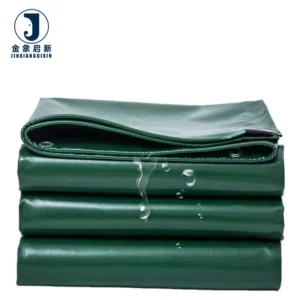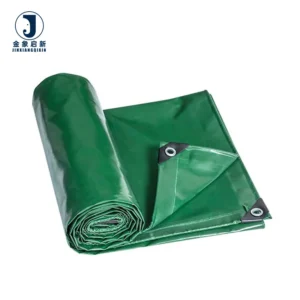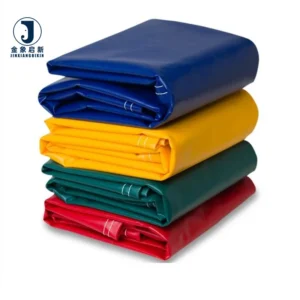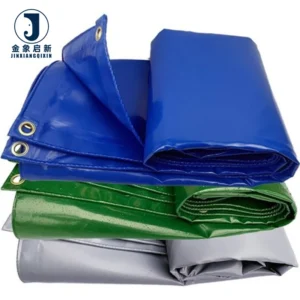
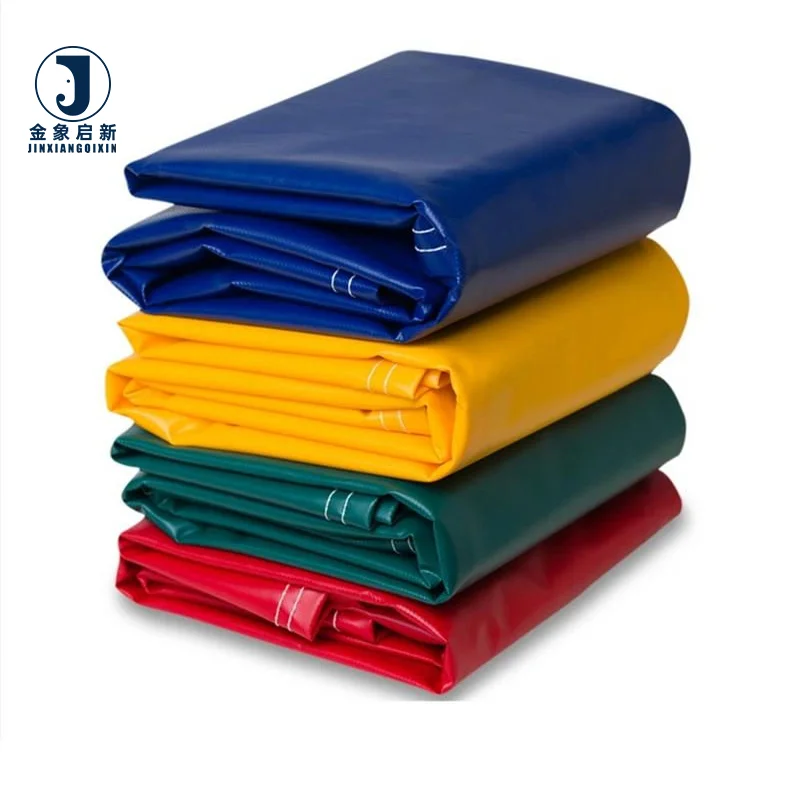
Coating Weight Adhesion Control — every roll of PVC Coated Tarpaulin Knife Coated Grade is produced with verified coating adhesion across three dedicated lines, ensuring base fabric denier and GSM align with the material specification sheet on arrival.
Technical Specifications
| Parameter | Value |
|---|---|
| Product Type | PVC Coated Tarpaulin |
| Material Construction | Polyester Base Fabric + Double-Sided PVC Coating |
| Weight Range | 350, 400, 420, 500, 600, 650, 750, 900 GSM |
| Thickness Range | 0.29 mm / 0.32 mm / 0.38 mm / 0.44 mm / 0.46 mm / 0.55 mm / 0.65 mm |
| Base Fabric Denier Options | 500D×840D / 500D×1000D / 1000D×1000D / 1000D×1300D / 1300D×1300D / 1000D×2000D |
| Mesh Count Options | 30×19 / 20×20 / 30×15 |
| Tensile Strength (Warp) | 1650N – 3900N (test basis not stated in source) |
| Tensile Strength (Weft) | 1600N – 3500N (test basis not stated in source) |
| Flame Retardant | Available in flame retardant grades — confirm the grade required for your market |
| UV Treatment | Anti-UV treatment available — test report available on request |
| Key Features | Waterproof, anti-mildew, printable, flexible, self-clean surface |
| Joining Compatibility | High frequency hot melt, hot air welding, sewing |
| Edge Finish | High temperature heat sealed seamless edge wrapping |
| Eyelet & Reinforcement | 3 cm enlarged aluminium alloy buttonhole, reinforced corners, 5 mm rope without splicing |
| Temperature Performance | Brittle point ≤ -50 to -60 °C, softening ≥ 80 °C, melting 212 °C |
| Density | 1.15 – 2.00 g/cm³ |
| Standards | ISO, CE certified production |
Application Suitability
| Application | Exposure & Requirement |
|---|---|
| Truck side curtain and trailer cover | Constant flexing at load points, road abrasion, UV exposure, high tensile demand at tie-down zones |
| Outdoor event tent and block-out structure | Wind loading, sustained UV, waterproofing, light exclusion, flame retardant compliance per venue code |
| Inflatable and membrane structure fabric | Internal air pressure stress, seam integrity under inflation cycles, coating adhesion under repeated flex |
| Awning and rain shelter | Static water pooling, thermal expansion and contraction, surface mildew in humid climates |
| Army tent and carriage tent | Field deployment abrasion, rapid assembly tension, variable climate exposure across deployment zones |
| Container roof and construction cover | Puncturing from debris, standing water, wind uplift forces on large unsupported spans |
Why the Denier-to-GSM Ratio Determines Real Fabric Performance
Base fabric denier and mesh count together dictate tensile behaviour far more than coating weight alone.
When a technical buyer specifies PVC Coated Tarpaulin by GSM without checking the underlying yarn construction, the result is often a material that meets the scale test but tears under the first flex load. A 650 GSM fabric woven from 500D×840D yarn will behave entirely differently under tension than a 650 GSM fabric built on 1000D×1000D base cloth — the coating mass is identical, but the polyester skeleton carrying the mechanical load is not. This gap between stated weight and actual structural performance is one of the most common specification failures in coated fabric procurement. [NEED_CITE: relationship between base fabric denier and tensile performance in PVC coated polyester per ISO 1421]
How Base Fabric Construction Drives Tensile and Tear Response
The denier options available — from 500D×840D through to 1000D×2000D — define the load-carrying capacity of the polyester skeleton before any coating contribution is factored in. Higher denier yarns distribute point loads across a wider fibre bundle, slowing tear propagation when the PVC Coated Tarpaulin fabric encounters a puncture or edge stress during installation. Mesh count works alongside denier: a 30×19 weave packs more yarn intersection points per square centimetre than a 20×20, which increases biaxial stability but also raises the GSM contribution from the base fabric itself.
Coating Method and Adhesion Under Fabrication Stress
Knife coating applies PVC compound directly onto the moving base fabric under controlled blade gap and oven temperature, producing a mechanical and chemical bond between coating and yarn. This method supports high frequency hot melt welding, hot air welding and sewing without delamination at the seam line. For fabricators producing truck side curtains or inflatable structures, the joining method chosen must match the coating adhesion characteristics — a seam that fails before the fabric body does is a specification error, not a material defect. [NEED_CITE: hot air welding parameters for PVC coated polyester fabrics]
Reading the Specification Sheet Beyond the GSM Number
Tensile strength values across this product family range from 1650N to 3900N in the warp direction and 1600N to 3500N in the weft, but these figures are meaningless without knowing which denier and mesh count produced them. A technical buyer comparing two 650 GSM options should request the specific base fabric denier and mesh count alongside the tensile test result, then match that combination to the actual loading conditions of the end application. The temperature data — brittle point at -50 to -60 °C, softening above 80 °C — further confirms the operational envelope: cold-climate deployment demands low brittle temperature assurance, while hot-climate roof applications require confidence that the softening threshold will not be reached under direct solar load.
The Cost of Underspecifying Coating Weight and Denier
Selecting a lighter denier to reduce material cost on a high-load application leads to early failure at stress concentration points — typically the eyelet zone, the weld line, or where the fabric folds over a structural member. Flame retardant grades specified without a confirmed test standard create a second problem: the material passes factory dispatch but fails the on-site inspection required by local fire safety codes, forcing replacement after installation. [NEED_CITE: fire classification standards for temporary structures and PVC coated fabrics]
Colour variation between rolls in the same production run compounds the cost further. When rolls arrive with visible shade differences, the entire installed surface must be replaced rather than patched, turning a specification oversight into a full re-order. Batch colour and coating weight consistency is controlled through in-process QA at every production stage with pre-shipment inspection records.
Production Capability Behind This PVC Coated Tarpaulin Range
Three full production lines with 36 sets of professional equipment support bulk output while maintaining coating weight consistency roll-to-roll. A 10-person R&D team handles material selection, custom width and sample development, enabling specification adjustments before production commitment rather than after. Nearly 30 years of focused coated fabric production provides process control over coating adhesion and GSM accuracy — every grade in the 350 to 900 GSM range is produced on the same lines with identical quality checkpoints. Dedicated QA/QC inspection at every production stage, with 100 percent pre-shipment verification, means the specification sheet you approve is the material you receive. Custom GSM, denier and treatment samples are developed within days for buyer approval before bulk runs begin.
Documentation & Verification
- Material specification sheet stating exact GSM, base fabric denier, coating type and colour reference per roll
- UV and flame retardant test reports provided where applicable — request before ordering to confirm your market standard
- Pre-shipment inspection record documenting roll-by-roll weight and visual verification
- ISO and CE certificates included in the dispatch documentation package
- Certificate of origin and customs support documents for international shipment
- Roll packing list with net weight, gross weight and roll dimensions for container planning
Fabrication, Handling & Storage
- High frequency and hot air welding both compatible; adjust temperature and dwell time to the specific GSM grade being joined
- 3 cm aluminium eyelets with reinforced corners distribute tie-down loads; position eyelets away from weld seams to avoid stress concentration
- Store rolls upright on pallets in a shaded area to prevent flat-spot deformation and surface marking on the PVC coating
- Allow cold-stored rolls to reach ambient temperature before unrolling to avoid coating micro-cracking at brittle threshold
- Clean with mild detergent and soft cloth; avoid solvents that attack the PVC surface and compromise the self-clean treatment
- Plan cutting layout to minimise off-cuts; seam placement should align with the lower-stress zones of the finished cover geometry
Starting a Specification Conversation
To move from inquiry to sample efficiently, provide the intended application and primary exposure conditions — mechanical loading type, climate range and any fire safety code applicable to the installation market. Specify your target GSM and preferred base fabric denier if known, along with required roll width and estimated annual volume. Confirm whether you need raw roll stock for your own fabrication or finished panels with eyelets and edge finishing, and indicate whether a pre-production sample is required for internal approval before bulk order placement.
Frequently Asked Questions
Q: How can I verify the GSM on arrival matches what was quoted?
A: Every shipment includes a material specification sheet stating the exact GSM, base fabric denier and coating type for each roll. Our pre-shipment inspection records document weight verification roll by roll before dispatch. On receipt, you can cross-check with a calibrated scale sample cut to a measured area. If any discrepancy arises, the documentation package provides the traceability basis for resolution.
Q: Which base fabric denier and mesh count should I choose for my tensile requirement?
A: Higher denier yarns like 1000D×1000D or 1300D×1300D provide greater load-bearing fibre mass and slower tear propagation, suited to truck side curtains and structural membrane applications. Tighter mesh counts such as 30×19 increase biaxial stability for tensioned installations. Share your end-use loading data and we will recommend the denier and mesh combination that matches your tensile and tear requirements with the appropriate GSM grade.
Q: What test reports support flame retardant and anti-UV treatment claims?
A: Flame retardant grades are available across this range — confirm the specific standard required by your market before ordering. Anti-UV treatment is applied during coating with test documentation available on request. We recommend requesting the relevant test reports at the sample approval stage so you can verify compliance against your local fire safety code or outdoor durability requirement before bulk production begins.
Q: How is roll-to-roll colour and coating weight consistency controlled?
A: Production runs are monitored through in-process QA checkpoints covering coating weight, colour shade and surface finish across every roll. The pre-shipment inspection records each roll individually. For orders spanning multiple production batches, colour reference standards are maintained on file to ensure continuity across repeat orders, and batch samples can be provided for your visual comparison before dispatch.