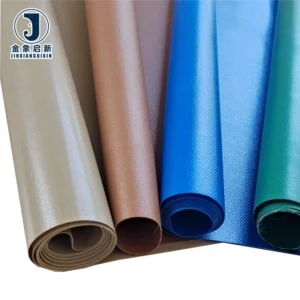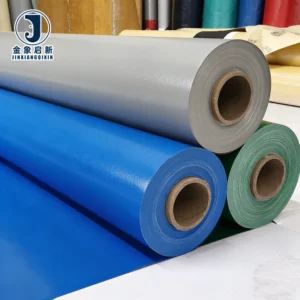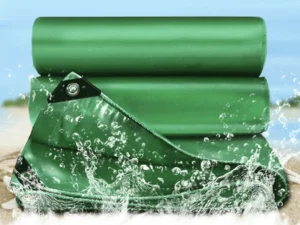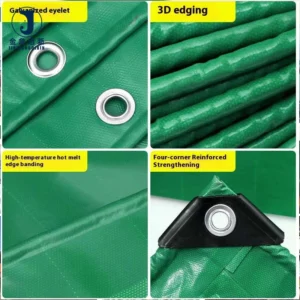
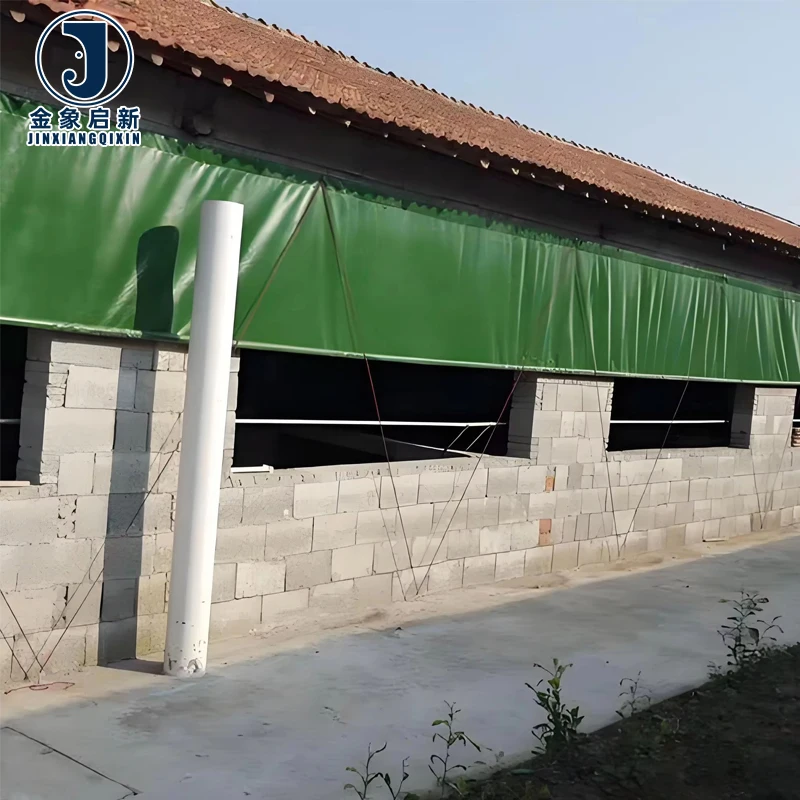
Verified Coating Adhesion — Every roll undergoes controlled PVC coating with in-process adhesion checks, ensuring seam welds hold as long as the fabric itself in demanding farm environments.
Technical Specifications
| Parameter | Value |
|---|---|
| Product Type | PVC Coated Tarpaulin Roll |
| Coating Material | PVC |
| Base Fabric | Warp Knitted Polyester |
| Weave Style | Plain |
| Waterproof | Yes — fully coated construction |
| Anti-Static | Available (test basis to be confirmed at inquiry) |
| Tear Resistance | Inherent to warp knitted base structure |
| Color | Customizable per order |
| Application Grade | Industrial / Heavy-Duty |
| Surface Finish | Standard coated |
Application Suitability
| Application | Exposure & Requirement |
|---|---|
| Poultry broiler house sidewall covers | Continuous moisture, ammonia vapour, ventilation airflow, frequent wash-down |
| Pig shelter tent enclosures | High humidity, mechanical abrasion from livestock contact, thermal cycling |
| Sheep pen weatherproof wrapping | Rain and wind exposure, ground-level moisture, seasonal temperature swings |
| Agricultural storage tent membrane | UV and weather exposure, heat-welded seam integrity across large spans |
| Temporary farm structure roofing | Water ingress prevention, wind load, structural flex under load |
Why PVC Coated Tarpaulin for Poultry Farm Demands More Than a GSM Number
Coating weight and base fabric construction together define real-world performance, not GSM in isolation.
I have reviewed farm cover specifications where the quoted GSM looked adequate on paper, yet the material failed within a single season because the coating adhesion was insufficient for the welding process used on-site [NEED_CITE: tensile and tear test methods for coated fabrics per ISO 1421]. In livestock environments, the fabric faces ammonia exposure, repeated wash-down cycles, and constant flex from wind loading on large-span tent panels. A number printed on a quotation tells you nothing about how the PVC bonds to the warp knitted substrate or whether the weld line will survive the same conditions the fabric body endures. For PVC coated tarpaulin for poultry farm applications, the verification must go deeper than weight alone.
Warp Knitted Base Fabric and Dimensional Stability
The warp knitted polyester base fabric provides multidirectional yarn interlocking that resists tear propagation across large tent panels. Unlike simple woven scrim constructions where a single yarn break can unzip a tear line, the knitted structure distributes stress across adjacent loops, containing damage locally. For poultry and livestock farm enclosures that span several metres without intermediate support, this tear containment behaviour is critical when the structure flexes under wind load or snow accumulation. PVC coated tarpaulin for poultry farm structures relies on this base stability to maintain panel geometry season after season.
Coating Adhesion and Weld Integrity in Farm Environments
PVC coating applied to the warp knitted substrate must achieve full penetration into the yarn structure, not merely sit on the surface. When coating adhesion is inadequate, heat-welded seams peel apart under mechanical stress long before the fabric body shows wear [NEED_CITE: PVC coating adhesion test methods for industrial fabrics]. In livestock shelters, welded joints face continuous moisture exposure and ammonia contact that accelerate any existing adhesion weakness. The relationship between coating method, coating weight, and the resulting peel strength at the weld line determines whether the assembled farm cover fails at the seam or at the fabric — and seam failure is almost always the more costly outcome because it requires on-site repair under operational conditions.
How Base Fabric and Coating Together Define Tear and Tensile Performance
GSM alone cannot predict how a PVC coated tarpaulin roll will perform under load. The base fabric denier and yarn density set the tensile baseline, while the coating weight and formulation contribute stiffness, tear resistance, and surface durability. A warp knitted base with high yarn count provides tensile strength in both warp and weft directions, but without sufficient PVC coating penetration, the individual yarns lack the binding that prevents tear initiation at cut edges and eyelet points [NEED_CITE: relationship between base fabric weave and coated fabric tear strength per DIN 53363]. For farm tent covers, the combination of knitted substrate stability and controlled coating weight produces a material that cuts cleanly, welds reliably, and resists tear propagation across the wide panels typical of livestock enclosure designs.
The Hidden Cost of Underspecifying Farm Cover Fabric
When a PVC coated tarpaulin roll arrives lighter than the quoted specification, the consequences compound in farm environments. Reduced coating weight means lower abrasion resistance against livestock contact, weaker weld adhesion at panel overlaps, and faster degradation from ammonia-rich atmospheres inside poultry houses [NEED_CITE: PVC degradation mechanisms in ammonia-exposed agricultural environments]. Batch-to-batch colour variation across rolls in the same order creates visible shade differences once panels are installed side by side on a single structure — not a performance failure, but one that triggers rejection and replacement. Welded seams that fail before the fabric body reaches end of service life require emergency repairs that disrupt farm operations and compromise the waterproof barrier the cover was meant to provide.
Why Sourcing PVC Coated Tarpaulin for Poultry Farm Use Here Makes Sense
Our coating process is controlled at every stage with dedicated QA/QC checkpoints, not outsourced to third-party coaters, so the PVC adhesion and GSM stated on the specification sheet match what arrives on the roll. The warp knitted base fabric is selected specifically for the tear propagation resistance that farm tent panels require, not substituted with lighter woven alternatives to cut cost. Anti-static treatment is available for environments where static discharge poses risks to poultry health, and we provide test documentation rather than a data sheet claim alone. Roll-to-roll colour consistency is managed through in-line coating controls, verified before shipment, so panels installed side by side present a uniform appearance. The R&D team handles material selection and sample development, delivering custom colour and width samples within days rather than weeks.
Documentation & Verification
- Material specification sheet stating PVC coating weight, base fabric denier, and warp knitted construction details
- Anti-static test report with surface resistance value, provided where treatment is specified
- Pre-shipment inspection record with roll-by-roll coating adhesion and colour consistency check
- ISO and CE certificates included with dispatch documentation
- Certificate of origin and customs paperwork prepared per destination market requirements
Fabrication, Handling & Storage
- Heat-weld seams at temperatures suited to PVC coated warp knitted fabric, with overlap width matched to panel load
- Store rolls upright on pallets to prevent flat-spot deformation of the PVC coating surface
- Allow rolls to acclimatise before unrolling in cold conditions to avoid coating stiffness cracking
- Use compatible PVC adhesive for field repairs on coated farm tent panels
- Cut panels with consideration for warp knitted fabric direction to optimise tear resistance at stress points
- Clean surfaces with mild detergent only; solvent-based cleaners may degrade PVC coating over time
What to Include in Your Inquiry
Specify the livestock type and enclosure dimensions so we can recommend the appropriate PVC coated tarpaulin roll grade and base fabric density. Confirm whether anti-static treatment is required by your local agricultural standards and provide the applicable test specification if one exists. State your target colour with a RAL or Pantone reference, along with required roll width and estimated annual volume. If you need pre-production samples for weld testing or colour approval, indicate this at inquiry stage.
Frequently Asked Questions
Q: How is the PVC coating weight verified and what GSM tolerance applies per roll?
A: Each roll undergoes in-process GSM verification against the material specification sheet before it leaves the production line. Coating weight is measured at multiple points across the roll width to confirm consistency. The acceptable tolerance band is confirmed during the quotation stage based on your application requirements, and pre-shipment inspection records document the actual measured values for every roll dispatched.
Q: What test standard supports the anti-static claim for poultry farm environments?
A: Anti-static treatment is available and can be supplied with a test report stating the measured surface resistance value. The specific test standard applied depends on the market and application requirement — confirm your local regulatory or industry standard at inquiry stage so we can align the testing and documentation accordingly.
Q: How does warp knitted base fabric compare to woven scrim in tear strength for large tent panels?
A: Warp knitted construction interlocks yarns in a loop structure that contains tear damage locally, whereas woven scrim relies on yarn crossing points that can allow tears to propagate along a single direction. For large-span poultry and livestock tent panels subject to wind flex, the knitted base provides more predictable tear behaviour and greater resistance to damage spreading from cut edges or installation stress points.
Q: What is the recommended heat-weld temperature and seam overlap for PVC coated farm tarpaulin?
A: Weld parameters depend on the specific PVC coating formulation and weight applied to the warp knitted base. We provide recommended temperature range, pressure, and overlap dimensions with the material specification sheet for each production batch. Testing a sample weld before full-scale fabrication confirms the settings suit your equipment and produces a seam that matches the fabric body strength.
Q: How is roll-to-roll color consistency controlled when ordering multiple rolls for a single farm structure?
A: Colour consistency is managed through controlled pigment dosing during the PVC coating process, with verification checks at intervals throughout each production run. Rolls destined for side-by-side installation on a single structure are grouped within the same batch, and pre-shipment inspection includes a visual comparison under standardised lighting to confirm shade uniformity before dispatch.