Deep Coating Process Control — our PVC knife-coated fabrics for inflatable structures maintain consistent coating adhesion and GSM uniformity across every production run, verified before dispatch.
Technical Specifications
| Parameter | Value |
|---|---|
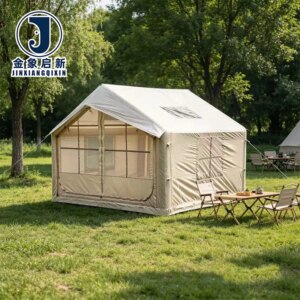
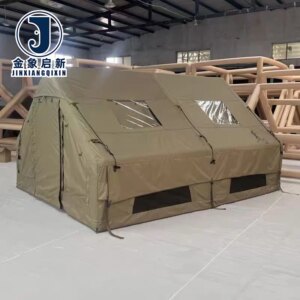
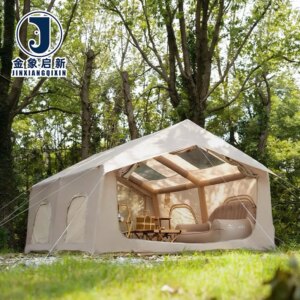
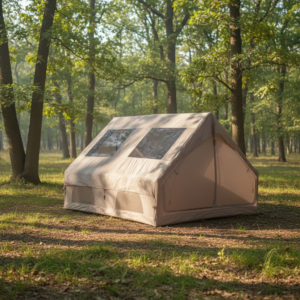
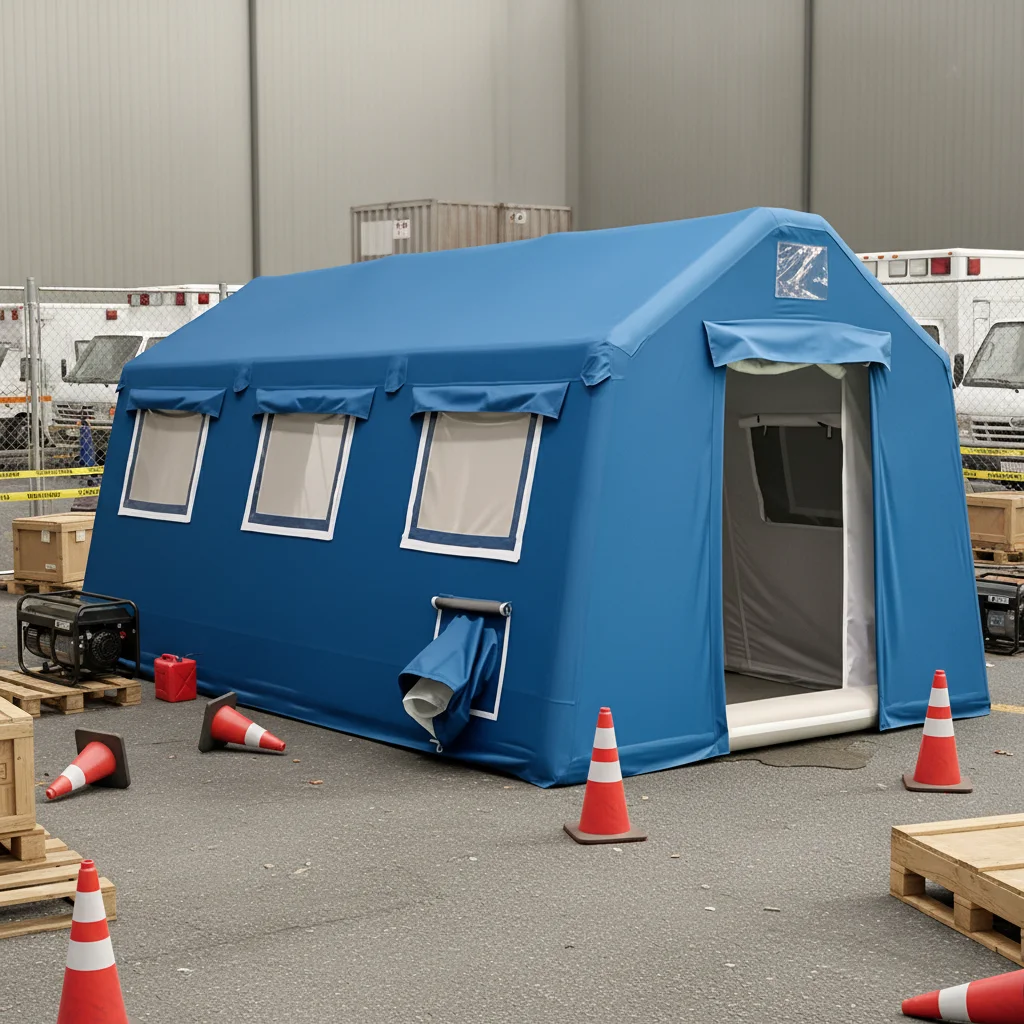
| Product Type | Inflatable Tent |
| Core Material | PVC tarpaulin (PVC knife-coated fabric) |
| Waterproof | Yes — waterproof seam technology |
| UV Treatment | UV-resistant coating (test basis not stated — confirm required standard) |
| Flame Retardant | Fire-retardant properties available (grade not stated — confirm grade for your market) |
| Tear Resistance | Tensile and tear resistance stated (test standard not stated — request report) |
| Product Forms | Quick automatic opening, single layer construction, extended type |
| Customization | OEM & ODM, sample customization, pattern printing, size adjustments, color options, specialized access configurations |
| Standards | ISO9001, ISO14001, ISO45001, CE |
| Quality Testing | Air pressure retention testing (minimum 24 hours), seam strength tensile testing, environmental simulation testing (temperature cycling and UV exposure) |
Application Suitability
| Application | Exposure & Requirement |
|---|---|
| Emergency response command centers | Rapid deployment, all-weather exposure, fire safety compliance, repeated inflation cycles |
| Temporary storage during disaster recovery | Waterproof integrity, UV degradation resistance, puncture protection for stored inventory |
| Mobile field operations bases | Wind-loaded structural stability, abrasion from ground contact, frequent relocation |
| Infrastructure maintenance shelters | Continuous outdoor UV exposure, fire-retardant compliance near hot work zones |
| Four-season outdoor industrial deployment | Temperature cycling, snow load, freeze-thaw stress on seams |
Why "Fire Retardant" Without a Documented Grade Is a Compliance Risk
Material that claims fire resistance but ships without a matching grade certificate can halt a project at the inspection stage.
Emergency shelters and temporary industrial structures sit under scrutiny from site safety officers who check documentation before allowing occupation. When a PVC inflatable tent fabric manufacturer supplies material described only as "fire retardant" without naming the classification standard, the buyer faces a gap between what was ordered and what the inspector requires. The cost of replacing an entire shelter fleet on-site dwarfs the effort of confirming grade alignment at the quotation stage [NEED_CITE: fire classification standards for temporary membrane structures].
Coating Method and Structural Integrity for Inflatable Forms
PVC knife-coated fabric delivers a continuous coating layer bonded directly into the base weave, which is critical for inflatable tent structures that rely on uniform air pressure retention. The coating fills the interstices of the polyester scrim rather than sitting on top as a laminated film, resulting in higher peel strength at the weld zones where inflatable beams join the membrane body. For rapid-deployment shelters that inflate in minutes and must hold pressure continuously, this bond quality separates a reliable structure from one that bleeds air at the seams.
Weld Zone Performance Under Inflation Stress
Inflatable tent beams concentrate flex stress at every junction where a curved beam meets a flat panel. PVC knife-coated fabric supports high-frequency welding that fuses the coating layers into a single continuous joint, rather than relying on adhesive or thread that can degrade under cyclic loading. When disaster relief teams deploy shelters in high winds, the welded seams must carry the same tensile load as the parent fabric. Our PVC inflatable tent fabric is engineered so that seam strength tensile testing is conducted alongside base fabric evaluation, ensuring the joint does not become the structural weak point.
How Base Weave and Coating Weight Interact in Inflatable Applications
The relationship between GSM and base fabric denier determines whether an inflatable shelter resists wind load or tears at the first gust. A higher GSM achieved solely through heavier coating adds weight without proportional tensile gain — the base polyester scrim carries the structural load, while the PVC coating provides environmental protection [NEED_CITE: tensile and tear test methods for coated fabrics per ISO 1421]. Knife coating allows precise control over coating weight applied to each side of the scrim, so the ratio of structural fiber to protective coating can be optimized for inflatable beam rigidity versus overall pack weight. This balance matters when shelters must be air-freighted to disaster zones where every kilogram of cargo counts.
What Happens When Coating Adhesion Fails Mid-Deployment
An inflatable shelter that loses coating adhesion at a beam junction will not re-inflate once it deflates in the field. The delaminated zone cannot hold air pressure, and field repairs using adhesive patches rarely match the original peel strength achieved during factory welding. Buyers who specify material based on GSM alone, without requesting coating adhesion data or reviewing pre-shipment inspection records, discover this failure mode only after deployment. Batch-to-batch consistency in coating weight and oven curing temperature is what prevents adhesion breakdown from appearing selectively across a shipment [NEED_CITE: peel strength testing for PVC coated fabrics].
Why Fabric Documentation Matters at Every Procurement Stage
Specifying PVC inflatable tent material requires alignment between what the quotation states and what arrives at the container terminal. Our production process supports documentation at every checkpoint. Material specification sheets confirm the base fabric denier, coating type, and GSM for each batch rather than quoting a product family range. Where UV-resistant or fire-retardant treatments are specified, we supply test reports tied to the production run — not generic certificates disconnected from your shipment. Pre-shipment inspection includes the 24-hour air pressure retention test on welded samples, with seam strength tensile data recorded and filed per order.
- Near 30 years of coated fabric process control, applied to PVC inflatable tent construction with consistent coating weight management across production runs
- Three full production lines and 36 sets of processing equipment supporting volume orders without compromising individual roll inspection
- 10-person R&D team developing custom inflatable tent patterns, access configurations, and printed branding with sample turnaround before bulk commitment
- 100% pre-shipment inspection protocol covering air retention, seam tensile strength, and coating adhesion — every roll checked before packing
Documentation & Verification
- Material specification sheet confirming GSM, base fabric denier, and PVC coating type per batch
- UV resistance test report matching the stated treatment level for the shipped production run
- Fire-retardant classification documentation aligned to your target market safety regulations
- Pre-shipment inspection record including 24-hour air pressure retention test results
- ISO9001, ISO14001, ISO45001, and CE certificates provided with each dispatch
Fabrication, Handling & Storage
- Heat-weld PVC knife-coated seams using temperature and dwell settings matched to the coating weight grade
- Store inflatable tent rolls flat or on wide-diameter cores to prevent permanent creasing in the coated layer
- Conduct trial welds on each new roll before full production to confirm adhesion to the current batch coating
- Avoid dragging cut panels across abrasive ground surfaces that can score the PVC coating face
- Repair minor field punctures with compatible PVC solvent cement matched to the knife-coat formulation
What We Need to Prepare Your Quotation
Provide your deployment environment details — climate zone, expected wind load range, and whether the shelter will sit on abrasive ground or a prepared surface. Confirm the fire-retardant classification your local authority requires, along with any UV exposure duration expectations for the project timeline. Specify whether you need full finished inflatable units with custom access configurations, or PVC inflatable tent fabric in roll form for your own fabrication line.
Frequently Asked Questions
Q: What is the difference between PVC knife-coated fabric and standard laminated coating for inflatable tent structures?
A: Knife coating forces PVC paste into the base scrim weave under controlled pressure, creating a mechanical and chemical bond throughout the fabric cross-section. Laminated coatings sit on the surface and rely on adhesive layers that can peel under the cyclic inflation stress of inflatable tent beams. Knife-coated construction delivers superior peel strength at weld zones, which is where inflatable structures concentrate the most mechanical load.
Q: Can UV-resistant and fire-retardant treatments be verified with third-party test reports?
A: Yes. For each production run where UV or fire-retardant treatment is specified, we supply test reports linked to that batch. The UV test basis and fire classification grade must be confirmed against your target market regulations at the inquiry stage, so the correct treatment protocol and documentation standard are applied before production begins.
Q: Is custom sizing, color, and access configuration available with sample development?
A: OEM and ODM customization covers size adjustments, color options, pattern printing, and specialized access configurations such as reinforced entry points or partition walls. Sample development is completed within days so you can verify material behavior, weld quality, and color accuracy before committing to full production volume.
Q: How is batch-to-batch material consistency maintained across large-volume inflatable tent orders?
A: Each production run follows controlled coating weight parameters with in-process QA at every stage. Pre-shipment inspection records document GSM verification, coating adhesion, and seam strength for the specific batch shipped. This prevents the scenario where material from one roll performs differently than the next within the same order.
Q: What does the 24-hour air pressure retention test cover?
A: Welded inflatable beam samples from each production batch are pressurized to operating specification and monitored for a minimum 24-hour period. This test detects micro-leaks at weld junctions and confirms that seam strength meets the structural requirements for continuous inflation under field deployment conditions. Results are included in the pre-shipment inspection documentation.