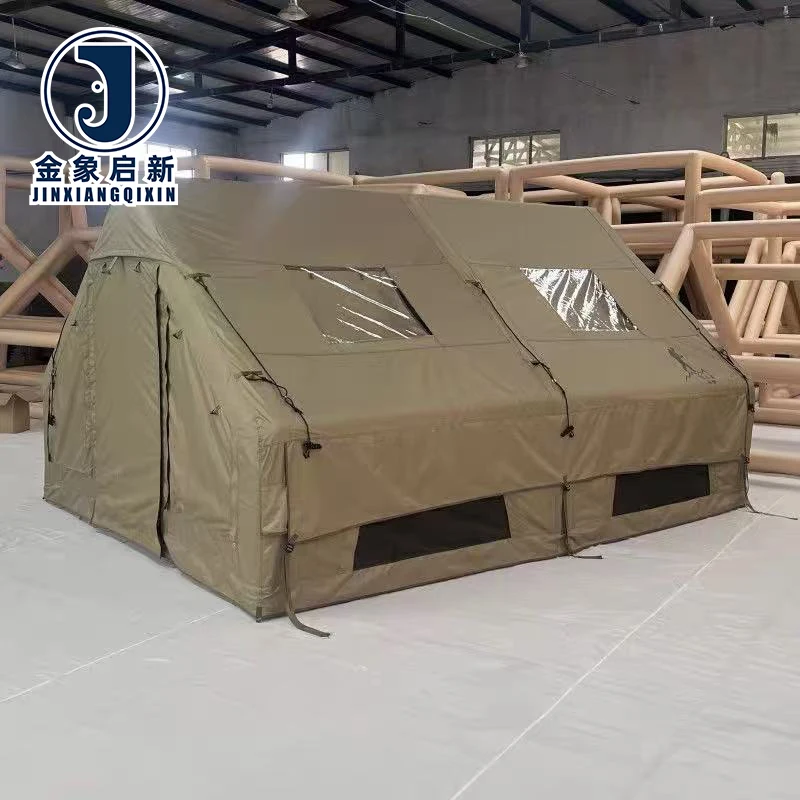
In-Process Coating Control — Every roll of PVC tarpaulin undergoes dedicated QA and QC inspection at each production stage, ensuring coating weight, adhesion, and tensile performance meet specification before reaching the fabrication floor.
Technical Specifications
| Parameter | Value |
|---|---|
| Product Type | Inflatable Tent Fabric / Inflatable Structure |
| Core Material | PVC Tarpaulin |
| Key Performance | Waterproof, Tear-Resistant, Quick Automatic Opening |
| UV-Resistance | Available — confirm the test basis required for your market |
| Flame Retardant Grade | Available in flame retardant grades — confirm the grade required for your market |
| Product Form | Single-layer inflatable structure |
| Customization | OEM & ODM, sample customization, pattern printing |
| Quality Inspection | Full-process QA/QC, 24-hour inflation test before shipment |
| Certifications | ISO 9001, ISO 14001, ISO 45001, CE |
Application Suitability
| Application | Exposure & Requirement |
|---|---|
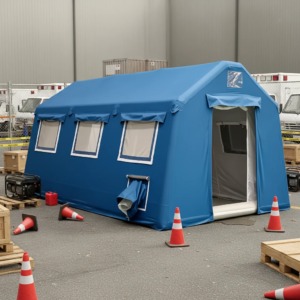
| Disaster relief field hospitals | Rapid deployment under severe weather, full waterproof integrity, repeated inflation cycles |
| Temporary site offices at remote construction projects | Continuous outdoor UV exposure, wind load on inflated walls, abrasion from site debris |
| Equipment storage in disaster recovery zones | Waterproof barrier against standing water, puncture resistance from uneven ground |
| Mobile command centers for infrastructure maintenance | Frequent setup and teardown, airtight seam durability under thermal cycling |
| Commercial emergency preparedness shelters | Long-term storage followed by rapid inflation, coating adhesion stability over time |
Why Coating Adhesion Matters More Than GSM Alone for Inflatable Tent Fabric
A heavy-coated PVC tarpaulin that delaminates at the weld line provides zero structural value once the air beam pressurises.
Technical buyers often specify Inflatable Tent Fabric by weight alone, only to find the welded seams fail during the first inflation test. The coating must bond to the base fabric with enough peel strength to survive repeated pressurisation and thermal expansion cycles. When adhesion is weak, the seam separates before the fabric itself reaches its tensile limit — leaving the structure deflated on site with no visible damage to the outer surface [NEED_CITE: peel strength test methods for coated fabrics per ISO 2411].
Base Fabric Construction and Inflatable Beam Load Capacity
The tear-resistant performance of an inflatable shelter starts with the base fabric denier and weave density. A tighter weave distributes inflation pressure across more yarns, reducing the risk of tear propagation at stress concentration points such as valve cutouts and corner joints. For Inflatable Tent Fabric, the base fabric must carry sustained internal pressure without stretching beyond the coating’s elastic limit, which would cause micro-cracking on the PVC surface over repeated use cycles.
Coating Formulation and Airtight Weld Integrity
The PVC coating weight and formulation directly determine how well high-frequency welded seams hold under inflation pressure. A coating that is too thin may melt through during welding, creating pinholes that compromise airtight integrity. Conversely, an excessively thick coating can trap air between layers, producing blisters that weaken the seam under repeated flexing. Matching coating weight to the welding frequency and dwell time is essential for consistent Inflatable Tent Fabric performance across production batches [NEED_CITE: high-frequency welding parameters for PVC coated fabrics].
UV-Resistant Treatment and Outdoor Exposure Verification
UV-resistant claims on PVC tarpaulin require a documented test basis to be meaningful for procurement decisions. Without a referenced standard or test report, there is no way to distinguish a surface treatment that degrades within months from a formulation designed for extended outdoor exposure. Buyers specifying Inflatable Tent Fabric for disaster relief or four-season deployment should request the test method and exposure duration behind any UV-resistance claim, then cross-reference it with the expected field conditions at the installation site.
Specification Misalignment and Its Field Consequences
Specifying Inflatable Tent Fabric without verifying coating adhesion and weld compatibility leads to failures that appear only after the structure is pressurised in the field. Rolls that pass visual inspection may produce seams that leak within hours when the ambient temperature drops and the PVC stiffens. Batch-to-batch variation in coating thickness compounds the problem, as weld settings optimised for one roll may underperform on the next. This is why pre-shipment inflation testing over a sustained period remains critical for every production run [NEED_CITE: field failure analysis for inflatable membrane structures].
The Hidden Cost of Skipping Pre-Shipment Inflation Verification
When inflatable structures ship without a sustained inflation test, seam leaks and coating delamination surface only after deployment — often in locations where repair resources are limited. The cost of sending replacement fabric or dispatching a technician to a remote disaster zone far exceeds the time invested in factory-side verification. Buyers who accept only visual and dimensional inspection reports leave a gap that field conditions will expose quickly.
Why Procurement Teams Source Inflatable Tent Fabric Here
Three full production lines and 36 sets of processing equipment provide the capacity to deliver container-volume orders with consistent coating weight across every roll. A 10-technician R&D team handles material selection, sample development, and pattern printing in-house, reducing the lead time between specification approval and production start. Dedicated QA and QC staff conduct full-process inspection rather than sampling, catching coating defects before they reach the welding stage. Every inflatable structure undergoes a 24-hour inflation test before shipment, verifying seam integrity under sustained pressure. ISO 9001, ISO 14001, ISO 45001, and CE certifications underpin the production system with traceable process controls.
Documentation & Verification
- Material specification sheet stating base fabric denier, coating composition, and weight for each grade
- UV-resistance and flame retardant test reports referenced to specific recognised standards
- Pre-shipment inspection record including 24-hour inflation test results and seam strength data
- ISO and CE certificates traceable to the specific production batch
- Roll packing list with individual roll identification for field traceability
Fabrication, Handling & Storage
- High-frequency welding settings must be calibrated to the specific PVC coating weight for airtight seams
- Valve cutout edges require reinforcement patches to prevent tear propagation under inflation pressure
- Store rolls flat on pallets to avoid permanent crease marks that weaken the coating layer
- Allow cold-stored PVC tarpaulin to reach ambient temperature before unrolling to prevent coating cracking
- Clean surfaces with pH-neutral detergent only; solvents degrade the PVC coating plasticiser layer
- Field repairs require compatible PVC patch material with matching coating formulation for adhesion
Request a Material Specification for Your Application
Provide the intended deployment environment, expected inflation pressure range, and any fire safety or compliance requirements specific to your target market. Include preferred roll width and annual volume so the quotation reflects your production scale. If colour matching or pattern printing is required, share reference samples or Pantone codes for the development team to assess feasibility before sampling begins.
Frequently Asked Questions
Q: How does PVC coating weight affect the load-bearing capacity of inflatable beams?
A: Coating weight influences peel strength at welded seams, which determines how much internal pressure a beam can sustain before the seam separates. Heavier coatings generally support stronger welds, but only when matched to the correct welding frequency. Request the peel strength data per ISO 2411 for the specific grade under evaluation.
Q: Are welded seams more reliable than stitched seams for inflatable tent structures?
A: High-frequency welded seams create a continuous airtight bond without needle holes, making them the standard for inflatable structures that must hold internal pressure. Stitched seams introduce perforations that allow air leakage and require additional sealing tape, adding weight and potential failure points along the seam line.
Q: What UV-resistance documentation should I request before placing an order?
A: Ask for the specific test method, exposure duration, and retention percentage of tensile strength after UV exposure. A statement without a referenced standard provides no basis for comparing grades or predicting field performance under the solar radiation levels at your installation site.
Q: Can custom dimensions affect the inflatable beam wall thickness requirement?
A: Larger beam diameters and longer unsupported spans increase the internal pressure load on the PVC tarpaulin wall. The material grade and coating weight must be selected to match the calculated stress at the weld line. The R&D team can model the pressure requirements based on your structural design before sampling.
Q: What material test data is available for tensile and tear strength?
A: Tensile and tear test reports are available upon request, referenced to the applicable ISO or DIN standards. These reports provide the basis for structural calculations and compliance submissions. Confirm the test standards required by your market before requesting documentation.