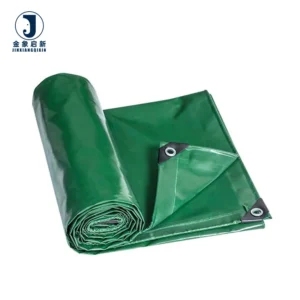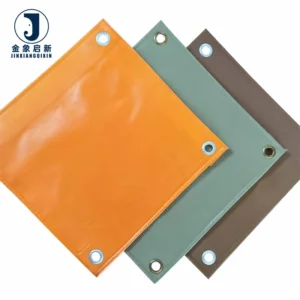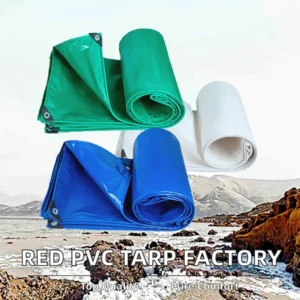
Controlled Coating Weight — Every roll of PVC coated tarpaulin base fabric denier gsm coating technology is verified against the stated specification before leaving the production line, eliminating the gap between quoted and delivered material that causes field failures.
Technical Specifications
| Parameter | Value |
|---|---|
| Product Type | PVC Coated Fabric |
| Material Construction | 100% PES dipping coating process |
| Base Fabric Option | Knitting / Plain Weave |
| Base Fabric Denier (Medium-duty) | 500D |
| Base Fabric Denier (Heavy-duty) | 1000D |
| Base Fabric Denier (Super Heavy-duty) | 500D–2000D |
| Weight (Medium-duty) | 400–500 GSM |
| Weight (Heavy-duty) | 700–1000 GSM |
| Weight (Super Heavy-duty) | 1100–1500 GSM |
| Thickness (Medium-duty) | 0.35–0.45 mm |
| Thickness (Heavy-duty) | 0.70–1.0 mm |
| Thickness (Super Heavy-duty) | 1.2–1.5 mm |
| Tensile Strength (Medium-duty) | Warp 1500–2000 N/5cm, Weft 1200–1800 N/5cm |
| Tensile Strength (Heavy-duty) | Warp 2000–2500 N/5cm, Weft 1800–2200 N/5cm |
| Tensile Strength (Super Heavy-duty) | Warp 2500–3000 N/5cm, Weft 2200–2800 N/5cm |
| Roll Width Options | 2m / 4m / 6m (6ft / 8ft / 10ft / 12ft) |
| Roll Length Options | 100 yards / 100 meters / custom |
| Finished Edge Detail | PP rope reinforced hem on all four edges |
| Eyelet Specification | Galvanized, every 3ft or 1m interval |
| Corner Reinforcement | Reinforced plastic corners |
| Key Features | Waterproof, mildew proof, anti-aging, washable, tear resistant |
| UV Treatment | Available (confirm test basis for your market) |
| Flame Retardant Grade | Available in flame retardant grades — confirm the grade required for your market |
| Certification Reference | ISO, CE |
Application Suitability
| Application | Exposure & Requirement |
|---|---|
| Truck Side Curtain | Constant flexing at load points, road abrasion, high wind load, requires high-frequency weldability |
| Tensioned Structural Fabric | Permanent UV exposure, high wind tension, requires specific flame retardant compliance for public structures |
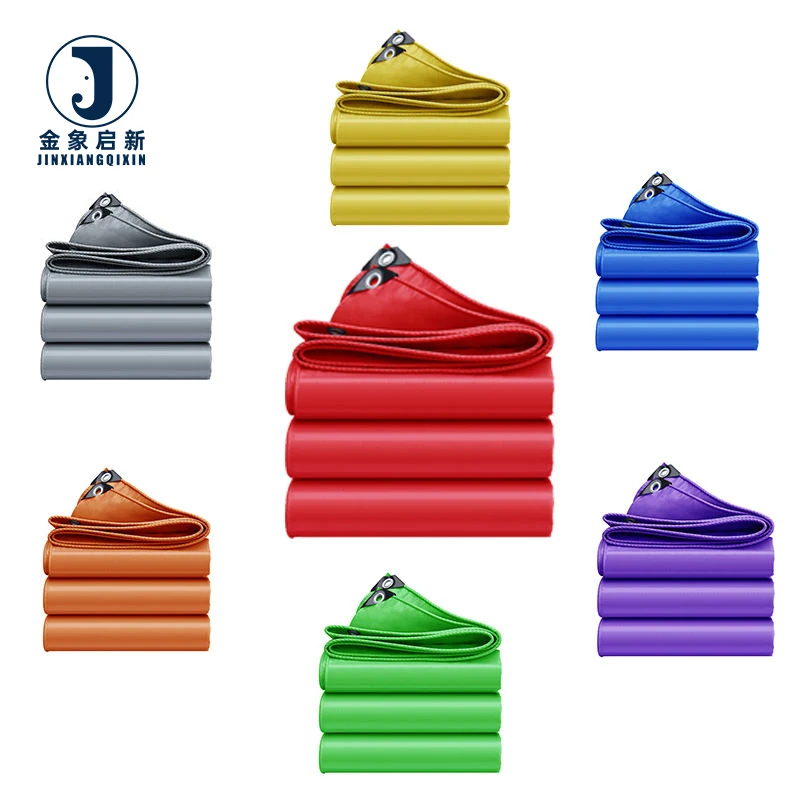
| Tent & Awning Panels | Repeated folding and unfolding, weather exposure, requires consistent colour matching across panels |
| Industrial Pipe Canopy | Outdoor weathering, requires waterproof integrity and mildew resistance in high-humidity environments |
Why PVC Coated Tarpaulin Base Fabric Denier GSM Coating Technology Matters More Than a Single Weight Number
A fabric’s weight is only half the story; the denier of the base yarn and the method of coating determine how that weight translates into structural integrity on your cutting table.
Technical buyers frequently encounter a scenario where a roll arrives on the dock measuring significantly lighter than the 900 GSM stated on the invoice. When the base fabric denier and coating formulation are not strictly controlled, the resulting PVC coated tarpaulin base fabric denier gsm coating technology lacks the tensile balance required for deep fabrication. A lighter base cloth forces the coater to apply more compound to hit the target weight, which alters the hand, drape, and weldability of the final panel [NEED_CITE: coating adhesion and peel strength test methods for technical textiles]. This discrepancy is the root cause of premature seam failure in heavy truck tarpaulins and membrane structures.
Mapping Base Yarn Denier to Structural Load Requirements
The relationship between base fabric denier and tensile strength is linear and unforgiving. A 500D polyester base in the medium-duty 400–500 GSM range provides the necessary drape for tent and lightweight engineering covers, where the fabric must fold without cracking. When the application shifts to heavy truck tarpaulins, the 1000D base fabric provides the warp and weft stability needed to resist the dynamic load of a moving vehicle. The PVC coated fabric aftermarket supplier must align the yarn count with the target tensile values, ensuring the warp strength reaches the 2000–2500 N/5cm range required for transport covers.
Dipping Coating Process and Weld Compatibility
The 100% PES dipping coating process encapsulates the base yarn entirely, rather than simply laminating a film to the surface. This encapsulation is critical for fabricators using high-frequency or hot-air welding, as the coating must melt and fuse uniformly at the seam. If the coating adhesion is poor, the weld will peel away from the base cloth under tension. For technical buyers specifying PVC coated tarpaulin base fabric denier gsm coating technology, the choice between knitting and plain weave construction further dictates how the fabric behaves during welding; knit bases offer more stretch and conform to complex curves, while plain weave provides dimensional stability for flat panels and side curtains [NEED_CITE: weld peel strength requirements for PVC coated polyester fabrics].
Decoding the Relationship Between Thickness, GSM and Tensile Performance
In PVC coated fabrics, thickness is a function of both the base cloth density and the coating weight applied during the dipping process. A 0.70–1.0 mm heavy-duty fabric at 700–1000 GSM achieves its tensile strength not just from the mass of the PVC, but from the 1000D base yarn acting as the structural skeleton. If a manufacturer substitutes a lower denier yarn to reduce cost and adds more coating to maintain the thickness, the tensile strength will drop despite the physical dimension remaining the same. This is why PVC coated tarpaulin base fabric denier gsm coating technology must be evaluated as a complete system. The super heavy-duty 1.2–1.5 mm range, utilizing up to 2000D yarn, is engineered for applications like industrial pipe canopies and tensioned structures where the fabric must resist sustained high-wind loads without elongating permanently.
The Hidden Cost of Ignoring Specification Verification
When a fabricator cuts panels from a roll where the GSM varies from the stated value, the resulting truck cover or tent panel may fail to meet the structural load calculations provided to the end user. A batch with inconsistent coating weight will also exhibit varying weld parameters, leading to seam failure at the points of highest stress. Furthermore, if the flame retardant grade is claimed but not verified by a test report, the material may be rejected at the installation site, causing project delays and financial penalties [NEED_CITE: building material fire classification standards and compliance documentation]. Ensuring the material specification sheet matches the physical roll is the only way to mitigate these fabrication risks.
Procurement Verification and Process Control
Sourcing PVC coated fabric from a facility with 30 years of specialized production experience ensures that the coating weight and adhesion are controlled at every stage. Our three full production lines and 36 sets of professional equipment allow for bulk capacity without compromising the consistency required for roll-to-roll matching. The 10-person R&D team supports technical buyers by developing samples that confirm the exact GSM, base denier, and treatment requirements before full production begins. We provide 100% pre-shipment inspection records that verify the physical properties of every roll, ensuring the material you receive matches the engineering data you specified.
Documentation & Verification
- Material specification sheet stating exact GSM, base fabric denier, and coating formulation.
- Test report for UV or flame-retardant grades supplied with the specific batch number.
- Pre-shipment inspection record covering coating weight, tensile spot-checks, and dimensional tolerances.
- ISO and CE certificates provided to support customs clearance and project compliance.
- Certificate of origin and customs support documentation for international shipments.
Fabrication, Handling & Storage
- Adjust hot-air welder temperature to match the specific GSM and coating thickness of the selected grade.
- Reinforce eyelets with plastic corners to prevent tearing under high tie-down loads on heavy-duty grades.
- Store rolls horizontally on pallets to prevent permanent creasing in the 0.70–1.0 mm heavy-duty fabric.
- Allow cold-stored rolls to reach ambient temperature before unrolling to prevent coating micro-cracking.
- Use mild detergent for cleaning; avoid solvents that may degrade the PVC surface finish or print.
- Plan cutting layout to utilize the 2m, 4m, or 6m roll widths efficiently and minimize off-cut waste.
Initiating the Specification Process
To proceed with an inquiry for PVC coated tarpaulin base fabric denier gsm coating technology, please provide the target application, required tensile strength, and specific roll width. If your project requires a specific flame retardant grade or UV treatment, state the relevant standard for your market. We can also discuss custom colour matching and sample development to ensure the material meets your fabrication requirements before bulk production.
Frequently Asked Questions
Q: How is the actual GSM of the roll verified against the quotation before shipment?
A: We conduct a 100% pre-shipment inspection where sample swatches are cut from random rolls and weighed. The results are recorded on the pre-shipment inspection report, ensuring the physical weight matches the stated 400–500, 700–1000, or 1100–1500 GSM range for your specific grade.
Q: Can you provide a test report for the UV or flame retardant treatment with my batch?
A: Yes, when UV or flame retardant grades are specified, we supply the corresponding test report with the shipment. We advise technical buyers to confirm the specific standard required for their local market, such as B1, M2, or NFPA 701, during the inquiry stage.
Q: How does the choice between knitting and plain weave affect welding performance?
A: Knitting bases offer more flexibility and are suited for complex shapes, while plain weave provides dimensional stability for flat panels. The 100% PES dipping coating process ensures consistent weldability across both constructions, though hot-air parameters may need adjustment based on the specific fabric thickness.
Q: What is the tolerance for colour consistency when ordering multiple rolls?
A: We maintain reference samples for every production run to ensure batch consistency. For large orders spanning multiple batches, we recommend requesting a pre-production sample to verify colour matching before the entire order is coated and dispatched.