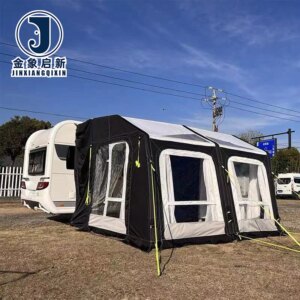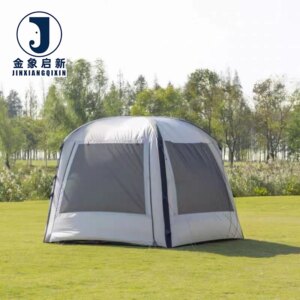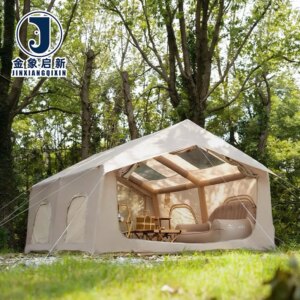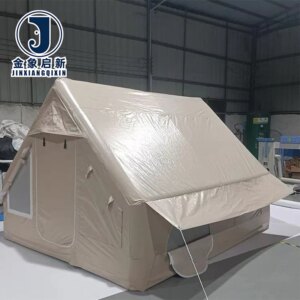
Coating Adhesion Mastery — Nearly 30 years of PVC coating process control ensures the bond between base fabric and membrane layer holds through repeated inflation cycles, thermal welding, and field stress without delamination.
Technical Specifications
| Parameter | Value |
|---|---|
| Product Type | PVC Coated Tarpaulin for Inflatable Tent |
| Core Material | PVC tarpaulin |
| Key Performance | Waterproof, UV-resistant (test basis not stated), tear-resistant |
| Customization Service | OEM & ODM (sample customization, pattern printing) |
| Facility Area | 9,180 m² |
| Production Lines | 3 full production lines |
| Processing Equipment | 36 sets of professional processing equipment |
| R&D Team Scale | 10 technicians |
| Standards & Certification | ISO 9001, ISO 14001, ISO 45001, CE |
Application Suitability
| Application | Exposure & Requirement |
|---|---|
| Commercial glamping dome and bubble tents | Continuous air pressure load, solar UV exposure, guest abrasion at entry points, repeated inflation and deflation cycles |
| Temporary event shelters and festival structures | Rapid deployment, wind load on inflated membrane, high foot traffic, multi-day outdoor weather exposure |
| On-site construction storage membranes | Dust and debris impact, ground moisture, temperature fluctuation across seasons, chemical residue from building materials |
What "Waterproof" Really Means When the Weld Line Is the Weak Point
A coated fabric is only as waterproof as its weakest seam, and most inflatable tent failures trace back to thermal weld adhesion, not the membrane itself.
Buyers routinely specify a PVC tarpaulin based on hydrostatic head figures for the panel fabric, then discover that the hot-air welded seams on the inflatable tubes split under sustained internal pressure or after a single season of thermal cycling. Coating weight and base fabric denier must be evaluated together with peel strength at the weld interface — a parameter that is rarely quoted but directly determines whether an Inflatable Tent Fabric manufacturer delivers material that survives real-world inflation loads or fails at the first stress concentration. [NEED_CITE: tensile and peel test methods for coated fabrics per ISO 1421]
Base Fabric Construction and Its Role in Inflatable Membrane Integrity
The tensile and tear behaviour of inflatable tent fabric starts with the polyester base weave. Denier and thread count govern how the fabric resists the biaxial stress generated by internal air pressure — a factor that distinguishes inflatable applications from static tent or awning use. Our PVC coated tarpaulin for inflatable structures is built on a base fabric selected to balance dimensional stability under constant inflation with sufficient flexibility for packing and transport.
Coating Weight, Adhesion, and the Thermal Weld Envelope
The PVC coating layer must bond to the base fabric strongly enough to withstand hot-air welding temperatures without blistering or separating. Coating method and weight per side directly influence the thermal weld window available to the fabricator — too thin a coat limits weld penetration, while excessive coat weight can cause run-out at the seam edge. An experienced Inflatable Tent Fabric manufacturer controls coating adhesion at every stage so the finished roll delivers a consistent weld result across the entire batch, not just on the sample panel.
Understanding GSM in Context: Why Weight Alone Is Not a Specification
Grams per square metre tells you how much material is present, but not how it is distributed between base fabric and coating. Two rolls with the same GSM can behave entirely differently during welding and inflation if one carries a heavier base fabric with a thinner coat while the other reverses the ratio. For inflatable tent production, the ratio matters because the coating layer is what melts to form the weld, and the base fabric is what carries the air-pressure load. Always request a material specification sheet that breaks down base fabric denier, coating weight, and total GSM rather than accepting a single figure. [NEED_CITE: relationship between GSM composition and weld peel strength in PVC coated fabrics]
The Hidden Cost of Specifying on Price Per Kilogram
When buyers select coated fabric based solely on cost per kilogram, the supplier has an incentive to reduce GSM by thinning the coating or dropping the base fabric denier. The roll arrives looking identical, but the weld temperature window narrows, the tear resistance drops at tube junctions, and the membrane becomes more susceptible to puncture during deployment. In inflatable tent applications, these shifts do not surface during factory assembly — they appear weeks later when a tube loses pressure under sun load or a seam creeps open at a stress point. Batch-to-batch GSM verification and peel strength testing before dispatch are the controls that prevent this outcome. [NEED_CITE: field failure analysis of inflatable structure membranes]
Why Technical Buyers Source This Coated Fabric Here
Our 10-technician R&D team develops pre-production samples that match your inflatable tent tube diameter, weld configuration, and target inflation pressure — not a generic tarpaulin sample.
Three full production lines with 36 sets of processing equipment provide the capacity to supply multiple container loads of roll stock with consistent coating weight and colour across every roll in the order.
Dedicated QA and QC at every production stage means raw material tensile strength, coating thickness, and adhesion are monitored in-process, not only at final inspection.
Pre-shipment inspection covers roll-by-roll GSM verification and colour comparison so that the fabric arriving at your cutting table matches the approved sample specification.
Pattern printing and OEM branding are handled in-house, allowing custom logo and graphic application without transferring the roll to a third-party printer and risking coating damage.
Documentation & Verification
- Material specification sheet stating base fabric denier, coating weight, and total GSM for the inflatable tent grade ordered
- UV resistance and performance test reports issued per batch where applicable
- Pre-production sample approval record with welded seam peel test results
- Pre-shipment inspection report with roll-by-roll GSM and colour check data
- ISO 9001, ISO 14001, ISO 45001, and CE certificates included with shipping documents
- Certificate of origin and customs documentation prepared per destination country requirements
Fabrication, Handling & Storage
- Hot-air weld temperature and speed must be calibrated to the specific PVC coating weight of this fabric — request recommended parameters before first production run
- Store rolls upright on pallets in a dry, shaded area to prevent flat-spot deformation of the coating surface
- Avoid dragging roll ends across concrete floors during unloading to protect the outer coating layer from abrasion
- Allow cold-stored rolls to acclimatise to workshop temperature before unrolling to prevent coating micro-cracking at low ambient conditions
- Clean the fabricated membrane with mild pH-neutral detergent — solvents may soften the PVC coating and reduce weld integrity
- Plan cutting layout to minimise transverse welds across inflatable tube panels, aligning seams with low-stress zones where possible
Before You Request a Quotation
Provide your inflatable tent tube diameter, target inflation pressure, and the climatic conditions the structure will face so we can recommend the appropriate base fabric denier and coating weight. If your destination market requires specific fire classification or UV performance levels, confirm the test standard your buyer or regulator specifies. Let us know whether you need rolls in stock width or custom slit widths, and whether OEM pattern printing is part of the project scope.
Frequently Asked Questions
Q: How do I verify the GSM of the rolls I receive matches the quotation?
A: We include a roll-by-roll GSM check in our pre-shipment inspection report. On receipt, you can verify by cutting a measured sample from the roll end and weighing it on a calibrated scale. Any deviation outside the agreed tolerance triggers a replacement protocol before your production line is affected.
Q: Which test standard supports your UV resistance claim?
A: UV resistance is available as a treatment option, and the specific test standard depends on the grade selected. We provide the test report corresponding to your chosen grade with the shipment. Confirm the UV performance level required by your end market before sampling so we match the correct additive package.
Q: Can you match a specific Pantone or RAL colour across multiple roll orders?
A: Yes. Our R&D team develops a colour-matched sample for your approval before bulk production. The approved colour reference is recorded and used for every subsequent batch, with roll-to-roll colour comparison included in pre-shipment inspection to maintain consistency across production runs.
Q: What welding parameters do you recommend for this PVC coated fabric?
A: Recommended hot-air temperature, speed, and pressure depend on the specific coating weight and base fabric denier of your selected grade. We provide a welding guideline with each sample so your production team can dial in settings before full-scale fabrication begins.
Q: What is the minimum order for a custom width or printed pattern?
A: Minimum order quantities vary depending on whether you require custom slit width, a specific colour run, or OEM pattern printing. Share your target dimensions and annual volume, and we will confirm the minimum along with lead time during the quotation stage.