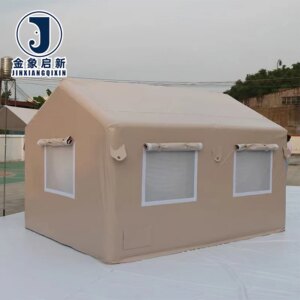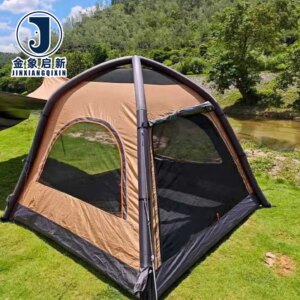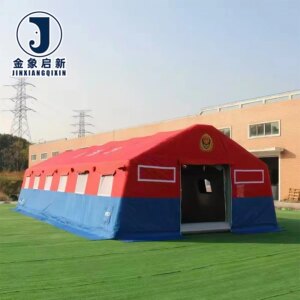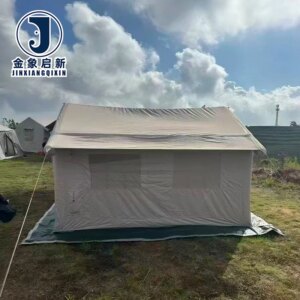
Deep Process Control Over Coating — PVC tarpaulin engineered through nearly 30 years of coating expertise, verified at every stage from base fabric selection to pre-shipment pressure testing for inflatable shelter applications.
Technical Specifications
| Parameter | Value |
|---|---|
| Product Type | Inflatable Tent |
| Core Material | PVC tarpaulin |
| Key Performance | Waterproof, UV-resistant (test basis not stated in source), tear-resistant |
| Tear Strength | 300N per ISO 13934-1 |
| Temperature Range | -20°C to 60°C |
| Construction | Single-layer |
| Customization Options | Dimensions, color, pattern printing, reinforcement locations |
| Quality Control | 24-hour pressure retention testing before shipment |
| Sample Lead Time | 7–10 business days |
| Certifications | ISO9001, ISO14001, ISO45001, CE |
Application Suitability
| Application | Exposure & Requirement |
|---|---|
| Commercial outdoor events | Rapid deployment, repeated inflation cycles, wind loading, UV exposure, crowd proximity abrasion |
| Temporary exhibition spaces | Indoor/outdoor transition, climate-controlled interiors, branding and pattern printing demands |
| Emergency response command centers | All-weather shelter, temperature extremes, immediate structural integrity, frequent relocation |
| Industrial site temporary facilities | Dust, chemical splash proximity, heavy equipment vibration, extended seasonal deployment |
| Four-season family camping | Sub-zero to high-heat temperature cycling, prolonged rainfall, ground moisture contact |
Why Coating Adhesion Matters More Than Fabric Weight for Inflatable Structures
Inflatable shelters fail at the coating-to-fabric interface long before the base yarn breaks.
Commercial operators sourcing PVC inflatable tent aftermarket supplier options often specify GSM as the primary quality gate, yet air-beam structures place cyclic peel stress on the coating bond every time the shelter is inflated, deflated, and folded for transport. A heavier fabric with poor adhesion will delaminate at the flex points within weeks of field use, while a correctly bonded lighter fabric maintains structural integrity across repeated deployment cycles. The distinction is invisible on the quotation sheet but becomes the difference between a shelter that survives its first season and one that requires mid-event replacement. [NEED_CITE: coating adhesion test methods for inflatable structural fabrics per ISO 2411]
Coating Bond Integrity Under Cyclic Inflation Stress
Single-layer PVC construction demands that the coating and base fabric behave as a unified membrane during every pressurization cycle. When an inflatable tent is deployed on a commercial event site, wind gusts create localized pressure spikes that flex the air-beam walls repeatedly. This flexing generates peel forces at the coating interface that a poorly bonded material cannot withstand. Our PVC inflatable tent aftermarket supplier production process controls coating weight and adhesion at the formulation stage, ensuring the membrane resists delamination under the specific stress profile of pneumatic structures.
Hydrostatic Resistance for Sustained Rainfall Exposure
Commercial shelters deployed across four seasons face prolonged rainfall events where water pressure builds against the fabric surface over hours or days. The PVC coating technology applied to this inflatable tent fabric achieves hydrostatic pressure resistance that maintains waterproof integrity through sustained precipitation. Unlike temporary fair-weather covers, this material is engineered for the continuous moisture exposure that emergency response centers and outdoor event venues experience during multi-day deployments in adverse weather conditions. [NEED_CITE: hydrostatic head testing standards for coated shelter fabrics]
Temperature Cycling Without Embrittlement or Softening
The validated temperature range of -20°C to 60°C addresses the two failure modes that compromise inflatable structures across seasonal transitions. At sub-zero temperatures, PVC compounds with insufficient plasticizer stability become brittle and crack when the air-beam flexes during inflation. At the upper threshold, coating softening reduces structural rigidity and allows air-beam walls to deform under wind load. This PVC inflatable tent aftermarket supplier material passes temperature cycling tests that confirm the compound maintains flexibility and dimensional stability across the full operating envelope.
How Tear Strength and Temperature Range Define Field Reliability
The 300N tear strength measured per ISO 13934-1 reflects the fabric’s resistance to tear propagation once a puncture or cut initiates. For inflatable tent structures, this is critical because air-beam walls operate under constant tension — a small puncture from site debris or handling damage can propagate rapidly if the base fabric lacks tear resistance. The ISO 13934-1 test method applies controlled force to a pre-cut specimen, measuring the load required to extend the tear through the coated fabric structure.
Temperature range specifications directly govern where and when the shelter can be safely deployed. The -20°C lower limit indicates the compound retains sufficient plasticizer mobility to prevent cold-cracking during inflation in winter conditions. The 60°C upper limit reflects the coating’s resistance to thermal softening under direct solar loading — a critical threshold since dark-colored inflatable structures in summer sun can exceed ambient air temperature substantially. Together, these parameters define the geographic and seasonal deployment envelope for commercial operators planning year-round shelter programs.
The Hidden Cost of Specifying Inflatable Fabric Without Weld Validation
Air-beam structures concentrate mechanical stress at welded seams, particularly at junction points where beams connect or where the structure anchors to the base. When PVC inflatable tent aftermarket supplier material is fabricated without validating weld parameters against the specific coating formulation, the seam becomes the weakest point in the structure. Field failures consistently occur at these welded junctions rather than in the field of the fabric, yet buyers frequently specify base fabric properties without requesting weld strength data. The result is a shelter that passes material inspection but fails structurally within its first inflation cycle under load. [NEED_CITE: seam strength requirements for inflatable structural membranes per ISO 1421]
Why Sourcing Validation Happens Before the Production Run
This PVC inflatable tent aftermarket supplier capability is built on production infrastructure that supports specification verification at every stage. The 9,180 m² facility operates 3 full production lines with 36 sets of professional processing equipment, providing the capacity to maintain consistent coating parameters across multi-roll orders. The 10-technician R&D team handles material selection, pattern printing specifications, and custom sizing — developing samples within 7–10 business days so buyers can validate tear strength, color accuracy, and weld behavior before committing to full production volumes. Every inflatable structure undergoes 24-hour pressure retention testing before shipment, confirming air-tight integrity under sustained inflation rather than relying on visual inspection alone. Dedicated QA and QC staff conduct full-process inspection at each production stage, with ISO9001, ISO14001, ISO45001, and CE certification supporting the documentation chain.
Documentation & Verification
- Material specification sheet stating base fabric, PVC coating composition, and color reference per batch
- Batch-specific inspection report covering waterproof rating, tensile strength, and UV resistance test results
- ISO9001, ISO14001, ISO45001, and CE certificates included with shipment documentation
- Pre-shipment pressure retention test record confirming 24-hour air-tight validation per unit
- Certificate of origin and customs documentation for cross-border inflatable tent fabric shipments
Fabrication, Handling & Storage
- Heat-weld air-beam seams using temperature and dwell time parameters matched to this PVC coating formulation
- Reinforce anchor points and beam junctions with additional PVC patches bonded to the single-layer construction
- Store rolls vertically on pallets to prevent compression creasing that weakens the coating at fold lines
- Allow fabric to acclimate above 10°C before unrolling and inflation in cold-weather deployment
- Clean with mild detergent only — solvent-based cleaners degrade the PVC plasticizer system
- Repair field punctures with compatible PVC adhesive patches applied to clean, dry surfaces
Specifying Your Inflatable Shelter Fabric Requirements
Provide your intended deployment environment and the seasonal temperature range the structure must withstand. Specify whether you require finished inflatable units or fabric by the roll for your own fabrication line. Confirm any fire-retardant or anti-static certification required by your local venue regulations or site safety standards. Indicate color matching requirements, pattern printing specifications, and whether pre-production samples are needed for weld parameter validation before bulk order release.
Frequently Asked Questions
Q: How do I verify the coating weight and GSM match the quotation when rolls arrive?
A: Request the batch-specific material specification sheet that documents base fabric weight and PVC coating weight separately. Upon receipt, cross-reference the roll packing list against these documented values. Our pre-shipment inspection records include measured GSM for each roll, providing a verification baseline before the material leaves the production facility.
Q: What UV-resistance test documentation is available for this inflatable tent fabric?
A: UV-resistance claims require a specific test method and exposure duration to be meaningful. Request the batch inspection report detailing the UV test standard applied and the results achieved. Confirm the expected outdoor service life for your specific climate zone and deployment pattern before specifying the material for long-term inflatable structures.
Q: How is welded seam integrity validated at air-beam flex points?
A: Every inflatable structure undergoes 24-hour pressure retention testing before shipment, which exercises welded seams under sustained inflation load. For custom beam geometries, request weld strength test data specific to your joint configuration. Reinforcement patches at junction points can be specified during the sample approval stage to address high-stress locations.
Q: What is the sample approval process for custom dimensions and color matching?
A: Submit your dimensional specifications, color reference, and pattern printing requirements to initiate sample development. Samples are produced within 7–10 business days for your evaluation of material properties, weld behavior, and visual accuracy. Full production begins only after written sample approval, ensuring the bulk order matches validated specifications.
Q: How is batch-to-batch color consistency controlled across multi-roll orders?
A: Each production batch references a documented color standard, and inspection records confirm visual consistency before shipment. For orders requiring multiple rolls installed side by side, specify this requirement during inquiry so that rolls from a single coating run are allocated to your order, minimizing any perceptible shade variation across the structure.