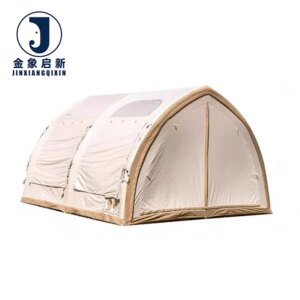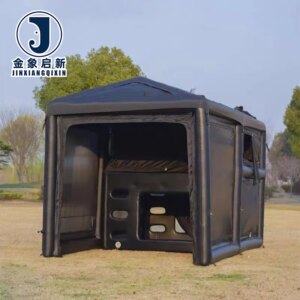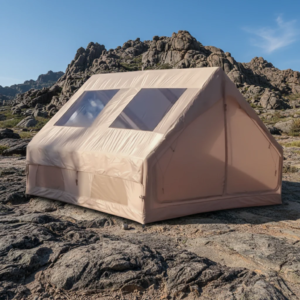
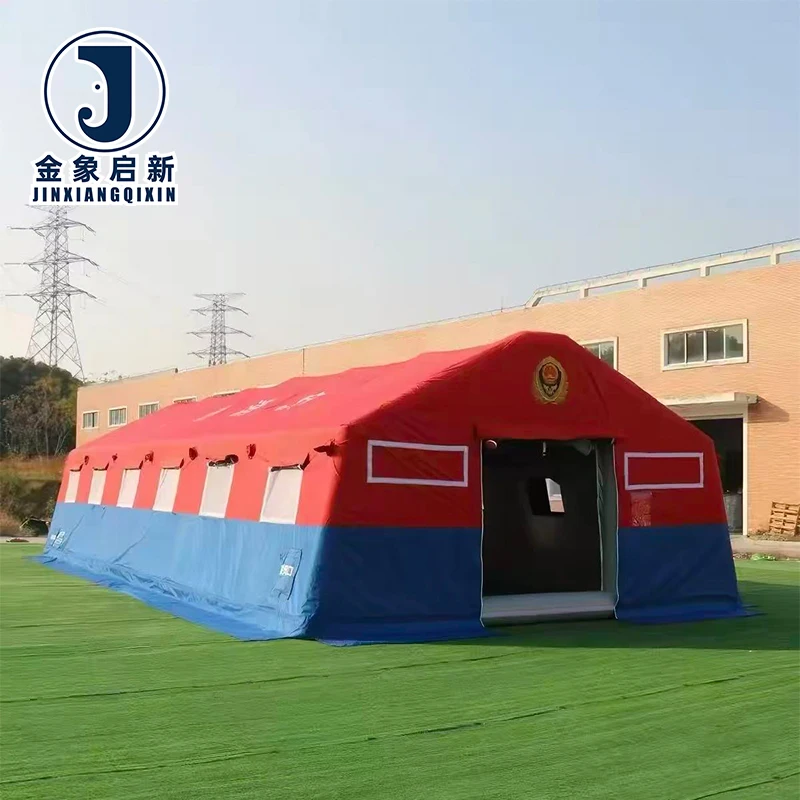
Coating Weight Control — Every batch of PVC inflatable tent fabric undergoes in-process verification of coating adhesion and GSM consistency before the roll leaves the line.
Technical Specifications
| Parameter | Value |
|---|---|
| Product Type | Inflatable Tent |
| Core Material | PVC tarpaulin |
| Waterproof | Yes (rating available on request) |
| UV-resistant | Available with UV treatment — confirm test basis for your market |
| Tear-resistant | Yes (test standard available on request) |
| Flame Retardant | Available in flame retardant grades — confirm the grade required for your market |
| Anti-Static | Available with anti-static treatment — confirm surface resistance specification |
| Product Form | Inflatable structure, single layer construction |
| Customization | OEM & ODM, sample customization, pattern printing, size adjustment |
| Standards | ISO 9001, ISO 14001, ISO 45001, CE |
Application Suitability
| Application | Exposure & Requirement |
|---|---|
| Disaster relief rapid deployment shelters | Immediate inflation, repeated pack-and-deploy cycles, field abrasion and weather exposure |
| Emergency response command centers | Extended occupancy, internal climate control, flame retardant compliance for personnel safety |
| Temporary construction site shelters | Dust, debris impact, equipment proximity, UV exposure during multi-month projects |
| Seasonal storage and mobile field bases | Ground moisture, wind loading on inflated membrane, temperature fluctuation |
| Inflatable structure manufacturing | Fabric weldability, airtight seam integrity, roll-to-roll batch consistency |
Why "Flame Retardant" Means Nothing Without a Grade Behind It
When sourcing PVC Inflatable Tent Fabric material coating technology for shelters that house personnel or equipment, a generic flame retardant claim on a quotation tells you nothing about compliance. The only useful flame retardant statement is one tied to a named standard and a test report traceable to the batch you receive.
I have reviewed quotations where the fabric is described as flame retardant, yet no grade, no standard reference, and no test report accompanies the shipment. For disaster relief shelters or emergency command centers, this gap is not a paperwork problem — it is a site safety and acceptance problem. Procurement teams at mining operations, military logistics units, and municipal emergency agencies all specify flame retardant grades tied to their local regulatory framework, and a shipment without documented compliance can be rejected at the gate [NEED_CITE: flame retardant classification systems for temporary shelters and membrane structures].
Base Fabric Denier and Weave Under Inflation Load
The structural integrity of an inflatable shelter depends on the PVC coated base fabric resisting biaxial tension once the internal air pressure is established. Denier and weave density of the underlying polyester scrim determine how the load distributes across warp and weft. A loosely woven base may allow the coating to carry disproportionate stress, leading to micro-cracking at flex points where the membrane bends during inflation and deflation. For PVC Inflatable Tent Fabric material coating technology, the relationship between scrim construction and coating adhesion is the first specification a technical buyer should examine.
Coating Method and Its Effect on Airtight Welds
The PVC coating must bond to the base fabric firmly enough to withstand the thermal cycle of hot-air or high-frequency welding. When the coating weight is applied through a controlled process with verified adhesion, the welded seam fuses coating-to-coating and creates a continuous airtight joint. If adhesion is weak, the weld line delaminates before the base fabric reaches its tensile limit — and the inflatable structure loses pressure at the exact point where structural demand is highest [NEED_CITE: weld peel strength testing for PVC coated fabrics per ISO 2411].
Reading GSM, Denier, and Coating Weight Together
GSM alone does not define the strength of PVC inflatable tent fabric. A heavier coating applied over a low-denier, open-weave scrim can produce a high GSM reading while delivering poor tear propagation resistance. The base fabric denier and thread count govern how a tear arrests once initiated, while the coating weight governs abrasion resistance, waterproofing continuity, and weld surface quality. A specification that lists all three values — GSM, denier, and weave density — gives a far more complete picture than any single number. Buyers evaluating material for single-layer inflatable structures should request all three and compare them against the inflation pressure and expected wind loading of the finished shelter.
What Happens When Specification Gaps Reach the Site
Colour variation between rolls in the same order becomes visible the moment two panels are welded side by side on an inflatable shelter — and the entire structure must be rejected or accepted as-is. A flame retardant grade that does not match the receiving market’s fire code delays project handover until replacement fabric arrives. Weld seams that fail under inflation load because the coating chemistry was inconsistent between batches turn a rapid-deployment shelter into a maintenance liability. These failures are not rare edge cases; they recur wherever material verification stops at the quotation stage [NEED_CITE: coated fabric batch consistency and weld failure analysis].
Why Technical Buyers Source This Fabric Here
Deep process control over PVC coating weight and adhesion means the coating parameters you approve at sample stage are the parameters maintained through production runs. Three full production lines and 36 sets of professional equipment support volume orders of PVC Inflatable Tent Fabric material coating technology without compressing lead times. A 10-person R&D team handles material selection, custom GSM formulation, and sample development within days rather than weeks. Dedicated QA and QC checkpoints at every production stage, with 100% inspection before shipment, catch coating inconsistencies before they ship. ISO and CE certification documentation accompanies every dispatch, and pre-shipment inspection records are available for buyer review.
Documentation & Verification
- Material specification sheet stating GSM, base fabric denier, and coating details per order
- UV and flame retardant test reports traceable to the production batch
- ISO 9001, ISO 14001, ISO 45001, and CE certificates included in shipment documentation
- Pre-shipment inspection record confirming visual and dimensional checks on every roll
- Certificate of origin and customs support documentation for international dispatch
Fabrication, Handling & Storage
- Hot-air weld temperature must match the PVC coating formulation to achieve airtight seams
- High-frequency welding suits single-layer inflatable panels where continuous seam integrity is critical
- Store rolls upright on pallets to prevent compression marks on the coated surface
- Allow cold-stored rolls to reach ambient temperature before unrolling to avoid coating micro-cracking
- Use PVC-compatible cleaners only; solvent-based agents may degrade the coating surface finish
- Pattern printing should be tested on a sample panel first to confirm ink adhesion to the specific coating grade
What to Include in Your Inquiry
Provide the inflation pressure and internal volume of the planned shelter so we can recommend the appropriate base fabric denier and coating weight. Specify the flame retardant grade and any anti-static surface resistance value required by your receiving market’s regulatory framework. Indicate whether you need fabric supplied by the roll for your own fabrication line, or whether you require finished inflatable structures with OEM sizing and pattern printing. Confirm the quantity, colour references, and target delivery window so we can align production scheduling.
Frequently Asked Questions
Q: How is the PVC coating weight verified and what GSM grades are available for inflatable structures?
A: Coating weight is monitored during production through in-process measurement and confirmed on the material specification sheet supplied with each order. Available GSM grades range from lightweight to heavy-duty, selected based on the inflation pressure, wind loading, and deployment frequency of your inflatable structure. We recommend submitting your performance requirements so we can match the appropriate coating weight and base fabric combination.
Q: What flame retardant grades apply to inflatable tent fabric across different markets?
A: Flame retardant requirements vary by jurisdiction and end-use — some markets reference DIN 4102 classifications, others specify NFPA 701 or local building codes for temporary structures. We supply PVC inflatable tent fabric in flame retardant grades and provide test reports matched to the batch. Confirm the specific standard your project requires at inquiry stage so we can align the formulation and documentation accordingly.
Q: How is UV treatment performance documented for PVC inflatable tent fabric?
A: UV treatment is applied during the coating process and its performance is documented through test reports that accompany the shipment. The test basis and exposure duration referenced in the report depend on the specific formulation selected for your order. Request the UV test documentation during the sampling phase to verify it meets your market’s outdoor exposure requirements before committing to full production.
Q: What are the weld and seam characteristics of single-layer inflatable PVC fabric?
A: Single-layer inflatable structures rely on coating-to-coating welds for airtight integrity. Our PVC coating formulation is designed to produce consistent hot-air and high-frequency welds when fabrication parameters match the material specification. We recommend running weld trials on sample panels before full production to confirm peel strength and seam continuity under your equipment settings.