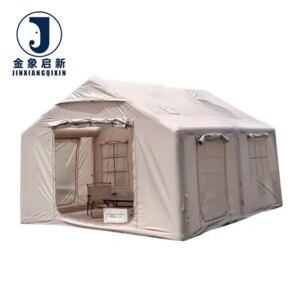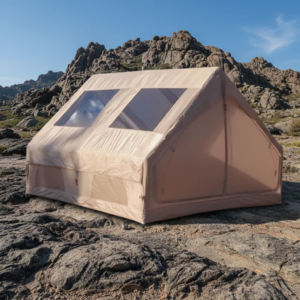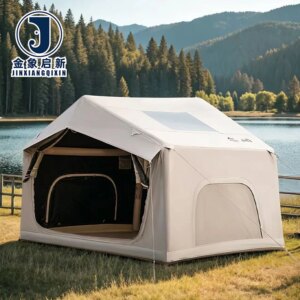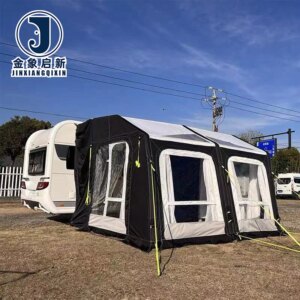
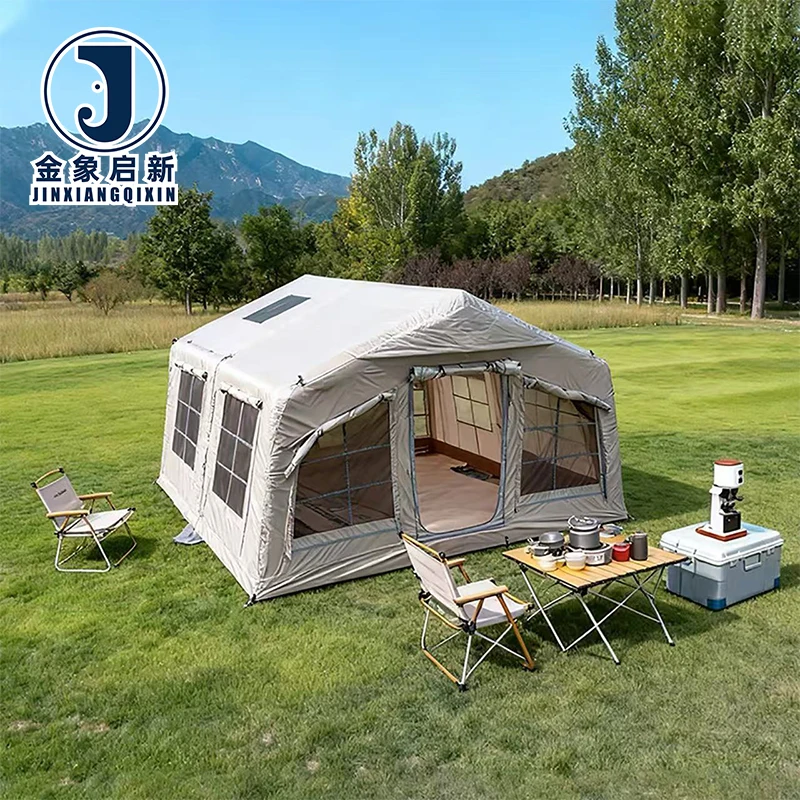
Coating Process Mastery — deep control over knife coating adhesion and PVC compound formulation ensures inflatable tent fabric performs consistently from the first weld to the final inflation cycle.
Technical Specifications
| Parameter | Value |
|---|---|
| Product Type | Inflatable Tent Fabric / Inflatable Tent |
| Core Material | PVC tarpaulin |
| Construction | Single-layer PVC tarpaulin |
| Season Rating | 4-season |
| Key Performance | Waterproof, tear-resistant |
| Fire-Retardant Treatment | Available in flame retardant grades — confirm the grade required for your market |
| Anti-Static Treatment | Available in anti-static grades — confirm the standard required for your site |
| UV-Resistant Treatment | Available with UV stabilisation — test basis to be confirmed per order |
| Opening Mechanism | Quick automatic opening (inflatable air-beam) |
| Pressure Testing | 24-hour pressure testing before shipment |
| Production Facility | 9,180 m² |
| Production Lines | 3 full production lines |
| Processing Equipment | 36 sets of professional equipment |
| R&D Team | 10 technicians |
| Customisation | OEM & ODM services (sample customisation, pattern printing, size adjustments, material thickness modifications) |
| Certifications | ISO 9001, ISO 14001, ISO 45001, CE |
Application Suitability
| Application | Exposure & Requirement |
|---|---|
| Commercial glamping resorts | 4-season weather cycling, sustained UV exposure, repeated inflation and deflation, guest-facing aesthetics |
| Outdoor event venues | Rapid deployment and teardown, wind loading on inflated beams, variable ground anchorage conditions |
| Temporary hospitality facilities | Continuous occupation across temperature swings, fire safety compliance for public assembly |
| Inflatable tent OEM manufacturing | High-frequency welding of roll stock, automated cutting lines, batch-to-batch colour and coating consistency |
What a Missing Fire-Retardant Certificate Costs a Glamping Project
Without a grade-stamped test report, the PVC inflatable tent fabric you specify cannot pass site inspection, regardless of what the quotation says.
Commercial glamping operators and event management companies regularly discover, at the commissioning stage, that the flame retardant claim on the PVC tarpaulin material supplied is unsupported by documentation acceptable to the local fire authority [NEED_CITE: fire safety classification standards for temporary structures and tensile membrane buildings]. Rejection at this point means full replacement, not a paperwork fix. The cost of downtime during peak season far outweighs the material price difference between compliant and non-compliant stock. Procurement specifications must name the exact standard — DIN 4102 B1, NFPA 701, or the locally mandated equivalent — and require the test report to travel with the roll.
Coating Weight and Its Direct Influence on Air-Beam Integrity
Inflatable tent structures depend entirely on the coated fabric’s ability to hold internal pressure across every welded seam. The PVC tarpaulin material used for air beams must balance coating thickness against base fabric flexibility: too little PVC compound and the surface becomes porous under sustained inflation; too much and the material stiffens, concentrating stress at fold points during transport. Knife coating, as opposed to dip or calender methods, allows precise control over compound deposition on each face of the base fabric, producing a uniform coating layer that high-frequency welding equipment can fuse predictably [NEED_CITE: high-frequency welding parameters for PVC-coated polyester fabrics].
Base Fabric Denier and Weave Density Under Inflation Load
When an inflatable tent is pressurised, the load is not distributed evenly — it concentrates at beam junctions, door frames, and anchorage points. The polyester base fabric’s denier and warp-weft density determine how well the material resists tear propagation at these stress zones. A higher denier yarn in the warp direction improves longitudinal tear resistance, while a tighter weave limits the distance a puncture can spread before the coating arrests it. For PVC inflatable tent fabric destined for 4-season glamping use, these base fabric variables are as critical as the coating formulation itself.
Reading the Specification Sheet Beyond the GSM Number
GSM tells you the total mass per square metre but reveals nothing about how that mass is distributed. Two PVC tarpaulin rolls can share the same GSM yet differ significantly in tensile and tear performance because one uses a heavier base fabric with a thinner coating while the other reverses that ratio. For inflatable tent manufacturing, the coating-to-substrate balance matters more than the headline weight: a coating-heavy sheet welds easily but tears more readily along the beam axis, while a base-heavy sheet resists tearing but demands higher welding energy and longer dwell times. Specifiers should request the base fabric weight and coating weight stated separately, along with tensile and tear values tested to a recognised standard such as ISO 1421, and cross-reference these against the inflation pressure the finished beam must sustain.
The Hidden Cost of Batch-to-Batch Colour Drift
Commercial glamping operators ordering replacement fabric or expanding a site often find that new rolls, while matching the Pantone reference on paper, display a visible colour shift once installed beside existing structures [NEED_CITE: colour measurement and delta-E tolerance standards for coated textiles]. This inconsistency originates from variations in pigment dispersion during compounding or slight shifts in coating oven temperature across production runs. For a hospitality-facing application where guest perception is part of the product, the cost of selective panel replacement to restore visual uniformity compounds the original material expense. Buyers should require a physical swatch from the production batch before full-roll dispatch and agree on a measurable delta-E tolerance.
Why Source Inflatable Tent Fabric Here
Coating adhesion and compound formulation are controlled in-house across three full production lines, meaning weld strength and surface consistency are managed at the source rather than outsourced.
A 10-technician R&D team develops samples within days, allowing OEM manufacturers to validate high-frequency welding parameters on actual PVC inflatable tent fabric before committing to bulk.
Every production stage carries dedicated QA and QC inspection, with 100% pre-shipment checks covering coating continuity, colour uniformity, and dimensional accuracy.
ISO 9001, ISO 14001, ISO 45001, and CE certifications are maintained and documentation packages are compiled per order, supporting regulatory submissions in export markets.
Custom widths, thickness modifications, and pattern printing are handled on the same lines as standard grades, ensuring the same process control applies whether the order is stock or fully specified.
Documentation & Verification
- Material specification sheet stating GSM, base fabric denier, coating weight, and colour reference per roll
- Test reports for flame retardant grade and UV stabilisation issued per batch where applicable
- 24-hour pressure test record on finished inflatable units confirming seam integrity before dispatch
- ISO 9001, ISO 14001, ISO 45001, and CE certificates compiled for procurement files
- Pre-shipment inspection record with weight verification against stated GSM
- Certificate of origin and customs documentation for cross-border roll shipments
Fabrication, Handling & Storage
- High-frequency welding power and dwell time must be calibrated to the specific PVC tarpaulin coating weight to avoid incomplete fusion or fabric scorching
- Single-layer construction allows flat-pattern cutting with minimal waste on automated CNC tables
- Finished rolls should be stored upright on pallets, away from direct sunlight, to prevent surface marking and edge deformation
- Cold-weather transport requires gradual unrolling at ambient temperature to prevent coating crack at fold lines
- Mild pH-neutral cleaners preserve the PVC surface finish without degrading flame retardant or anti-static additives
- Field repairs on air beams should use PVC-compatible adhesive patches matched to the coating formulation of the tent fabric
Before You Request a Quotation
Specify the inflation pressure your air-beam design requires and the lowest ambient temperature the structure will face, as these determine the minimum tensile and tear thresholds the PVC tarpaulin material must meet. Confirm the fire safety standard enforced at your project site so the correct flame retardant grade can be built into the compound from the start. State the roll width and annual volume you need, along with any colour or pattern printing requirements, so that production scheduling and batch consistency controls are aligned to your order profile.
Frequently Asked Questions
Q: How is GSM verified on arrival and what tolerance applies to inflatable tent fabric?
A: Each roll is weighed and measured before dispatch, and the recorded GSM is compared against the specification sheet. Industry practice allows a small percentage deviation, but inflatable tent fabric demands tighter control because coating weight directly affects weld strength and air retention. We supply the weight verification record with every shipment so your incoming inspection can confirm the match.
Q: What flame-retardant grade is available and does it meet my project’s fire safety standard?
A: Flame retardant treatment is available in multiple grades. The correct grade depends on the local building or temporary structure code at your site. Confirm the standard you need — such as DIN 4102, NFPA 701, or a national equivalent — at inquiry stage, and the matching grade with its test report will be included in the documentation package.
Q: How does high-frequency welding behaviour differ across coating weights?
A: Heavier coating layers typically weld at lower energy settings and shorter dwell times because the PVC compound melts more readily. Thinner coatings demand higher power input to achieve full fusion through to the base fabric interface. We supply sample rolls so you can dial in welding parameters on your own equipment before committing to bulk PVC tarpaulin material orders.
Q: What test basis supports the UV resistance claim for prolonged outdoor exposure?
A: UV stabilisation is available with additive packages selected for the target climate. The test basis — such as xenon arc exposure per ISO 4892 or a specified number of kilolangle-hours — must be agreed at order stage so the correct compound is formulated and the corresponding test report is issued per batch.
Q: How is batch-to-batch colour consistency controlled across multiple rolls?
A: Pigment batches are weighed and mixed under controlled conditions, and a physical swatch from each production run is compared against the approved colour reference. A delta-E tolerance is agreed before production, and any roll falling outside the range is held for review. This ensures PVC inflatable tent fabric arrives visually matched across your entire order.