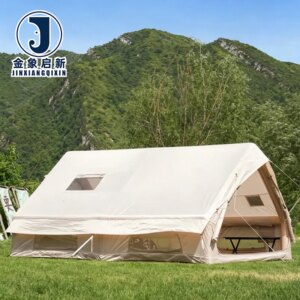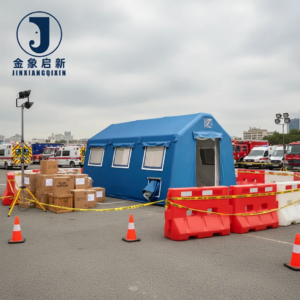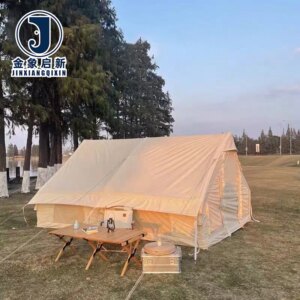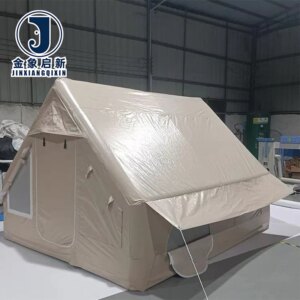
Specialist Fabric Engineering — three full coating lines with 36 sets of professional equipment supporting material development for PVC inflatable tent fabric from base weave selection through to finished roll dispatch.
Technical Specifications
| Parameter | Value |
|---|---|
| Product Type | Inflatable Tent |
| Core Material | PVC waterproof fabric |
| Key Features | UV resistant (test basis not stated — confirm with supplier), waterproof, quick automatic opening |
| Product Forms | Single Layer Construction, Extended Type |
| Season Rating | Four-season design |
| Flame Retardant Grade | Not stated in source — confirm the grade required for your market |
| Weight (GSM) | Not stated in source — request material specification sheet before order |
| Base Fabric Denier | Not stated in source — request denier and weave data before order |
| Coating Method | Not stated in source |
| Certification | ISO 9001, ISO 14001, ISO 45001, CE |
| Customization | OEM & ODM support, material selection, design modifications, pattern printing |
Application Suitability
| Application | Exposure & Requirement |
|---|---|
| Temporary site offices at construction projects | Continuous sun and rain exposure, frequent inflation and deflation cycles, wind load on membrane surfaces |
| Equipment storage during outdoor operations | Permanent moisture contact, ground-level debris abrasion, UV degradation of stored materials if fabric fails |
| Mobile command centers for industrial events | Rapid deployment requirement, repeated transport and setup, branding visibility on outer surface |
| Emergency response shelters for infrastructure maintenance | Extreme weather deployment, temperature fluctuation, structural integrity under inflation pressure |
| On-site material storage | Long-duration UV exposure, water pooling risk on horizontal surfaces, puncture from stacked goods |
| Temporary workspace in remote industrial locations | No mains power for climate control, four-season temperature swings, limited repair facilities on site |
What "UV Resistant" Means Without a Test Report Behind It
A UV claim without a documented test basis leaves your inflatable shelter exposed to accelerated degradation in the field.
When a technical buyer specifies PVC inflatable tent fabric for a construction site office or emergency shelter, the UV treatment claim on the data sheet is often the first thing checked — and the last thing verified. I have seen coated fabric arrive on site with a UV resistant label, only for the surface to chalk and the coating to embrittle within months of continuous sun exposure. Without a stated test method — whether QUV accelerated weathering per ASTM G154 or natural xenon arc exposure — the buyer has no basis to compare one supplier’s UV treatment against another. The consequence is not cosmetic. Chalking precedes micro-cracking, and micro-cracking in an inflatable membrane leads to air leakage that compromises the entire structure. [NEED_CITE: accelerated weathering test methods for PVC coated fabrics]
Base Fabric and Coating Weight Determine Structural Behaviour
The single layer construction of this PVC inflatable tent fabric means the base fabric denier and the PVC coating weight must work together to hold inflation pressure without excessive material thickness. A lighter base fabric reduces pack weight for transport to remote sites but may allow the coating to stretch unevenly under internal pressure, creating stress concentrations at the panel seams. The coating composition — plasticiser type, filler loading, and adhesion promoter — governs how the material behaves when the inflatable beams flex during wind gusts or temperature-driven pressure changes. Specifying the base fabric denier and coating formulation up front avoids discovering mid-project that the material is too stiff at low temperature or too soft in direct summer sun.
Welding Behaviour and Seam Integrity
Inflatable shelters depend entirely on welded seams holding internal air pressure over extended periods. The PVC inflatable tent fabric must accept hot air or high-frequency welding without the coating burning through or delaminating from the base weave. Coating thickness and plasticiser migration rate both influence the welding window — too narrow a window and the fabricator scrapes high rejection rates on the production floor. Requesting a welding parameter recommendation from the supplier before committing to a bulk order saves costly trial-and-error during the first production run. [NEED_CITE: high-frequency welding parameters for PVC coated textiles]
Reading the Specification Sheet Beyond the Headline GSM
Coated fabric specifications are often reduced to a single GSM figure, but for inflatable tent applications the relationship between base fabric construction and coating weight matters far more than total mass alone. A PVC coated inflatable fabric with a high-denier base and lighter coating will tear differently than one with a low-denier base and heavy coating, even at identical GSM. The base fabric weave density — ends and picks per centimetre — controls how a puncture propagates into a tear. Coating adhesion strength, measured as peel resistance between the PVC layer and the base yarns, determines whether the material delaminates at the weld line before the fabric itself fails. Surface finish also plays a functional role: a glossy surface sheds dust and rain more effectively in exposed site conditions, while a matte surface may accept printed branding with better ink adhesion for command centre identification. Understanding these interactions lets the technical buyer match the material to the inflation pressure, deployment frequency, and climatic zone of the end application.
The Hidden Cost of Specifying on Price Alone
When procurement decisions reduce PVC coated inflatable fabric to the lowest cost per square metre, the failures that follow rarely show up until the structure is inflated in the field. A material that is lighter than the quoted GSM will stretch beyond its elastic limit under inflation pressure, causing permanent deformation of the beam profile. A coating with insufficient plasticiser stability will stiffen in cold weather, making the inflatable beams brittle and prone to cracking during deployment. I have seen heavy-grade coated rolls fail at the weld line because the coating formulation was incompatible with the fabricator’s welding equipment — a failure mode that has nothing to do with GSM and everything to do with coating chemistry. [NEED_CITE: common failure modes in PVC coated inflatable membrane structures]
Why Technical Buyers Source Inflatable Fabric Here
Deep process control over coating weight and adhesion comes from nearly 30 years focused on PVC coated fabric, meaning the inflatable tent material leaving the line carries consistent coating thickness from the first metre to the last in a production run. The 10-person R&D team handles material selection and sample development, so when a fabricator needs a specific plasticiser system for cold-climate deployment or a particular surface finish for ink adhesion, the formulation is adjusted before bulk production rather than after a failed trial. Dedicated QA and QC inspection at every production stage with 100 percent pre-shipment checking catches GSM drift, coating adhesion drop, and surface defects before the rolls are packed. Three full production lines and 36 sets of equipment provide the capacity to fulfil container-load orders with reliable on-time delivery, avoiding the project delays that occur when a single-line supplier falls behind schedule. OEM and ODM customisation — including pattern printing, custom sizing, and design modification — is handled in-house rather than outsourced, keeping lead times short and accountability clear.
Documentation & Verification
- Material specification sheet stating coating weight, base fabric denier, and weave density per roll
- UV treatment test report with stated test basis — request before placing order
- ISO 9001, ISO 14001, ISO 45001, and CE certificates available per batch
- Pre-shipment inspection record with batch quality data and coating adhesion results
- Roll packing list with net weight, gross weight, and roll dimensions for customs clearance
- Certificate of origin and customs documentation support for cross-border shipment
Fabrication, Handling & Storage
- Hot air welding temperature and speed settings must match the PVC coating plasticiser system to avoid delamination at seam joints
- Store rolls horizontally on padded racks to prevent permanent creasing in the single layer construction fabric
- Avoid dragging cut panels across abrasive surfaces — the waterproof PVC coating can be scored by sharp ground debris
- Allow material to acclimatise to workshop temperature before welding, as cold PVC coated inflatable fabric welds inconsistently
- Use PVC-compatible adhesive for field repairs, matching the plasticiser type in the original coating formulation
- Plan cutting layout to minimise offcut waste, accounting for the available roll width and the panel geometry of the inflatable beam design
Start Your Specification Enquiry
Provide the target market and end-use environment so the material can be matched to the correct UV and temperature performance requirements. Specify the required roll width, colour, and whether pattern printing or branding is needed on the outer surface. Confirm whether you need raw roll stock for your own fabrication line or finished cut panels, and request a material sample with full documentation before committing to a production order.
Frequently Asked Questions
Q: How do I verify the actual GSM of the fabric when it arrives?
A: Request a material specification sheet stating the quoted GSM before ordering. On receipt, cut a measured sample from each roll and weigh it against the stated value. Our pre-shipment inspection records include per-roll weight data, so any discrepancy between the quoted specification and the delivered material can be identified and addressed before the fabric enters your production line.
Q: What test basis supports the UV resistant treatment claim?
A: The UV resistant treatment is listed as a feature of this PVC inflatable tent fabric, but the specific test method and exposure duration are not stated in the current source documentation. Request the UV test report with stated test basis from the supplier before placing your order, particularly if the inflatable shelter will be deployed in high-UV climates for extended periods.
Q: What welding method is recommended for this PVC inflatable tent fabric?
A: Hot air welding and high-frequency welding are both standard for PVC coated inflatable structures. The optimal welding temperature, speed, and pressure depend on the specific coating formulation and plasticiser system used. Request welding parameter recommendations from the supplier along with a material sample, and run test welds to confirm seam peel strength before starting full production.
Q: Can I request pattern printing or custom branding on the fabric?
A: OEM and ODM customisation includes pattern printing and design modifications. Provide your artwork files, colour references, and print area dimensions during the enquiry stage. A printed sample will be developed for your approval before bulk production, ensuring colour accuracy and ink adhesion meet the requirements of your inflatable shelter application.
Q: What is the minimum order for custom sizing or material specifications?
A: Custom sizing and material specifications are handled through the OEM and ODM process. Minimum order quantities vary depending on the level of customisation — whether it is a custom colour match, a specific base fabric denier, or a printed design. Confirm your exact requirements during the enquiry to receive a quotation with the applicable minimum and lead time.