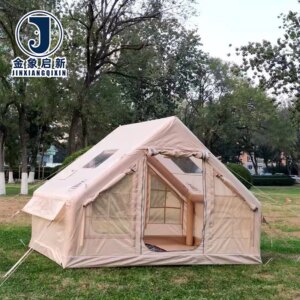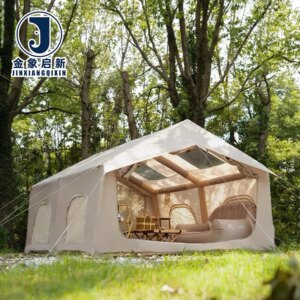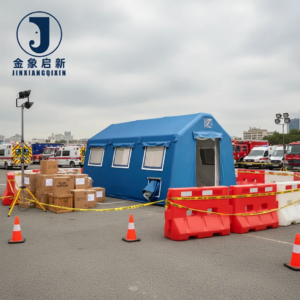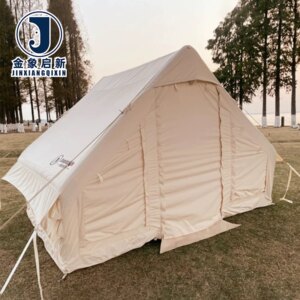
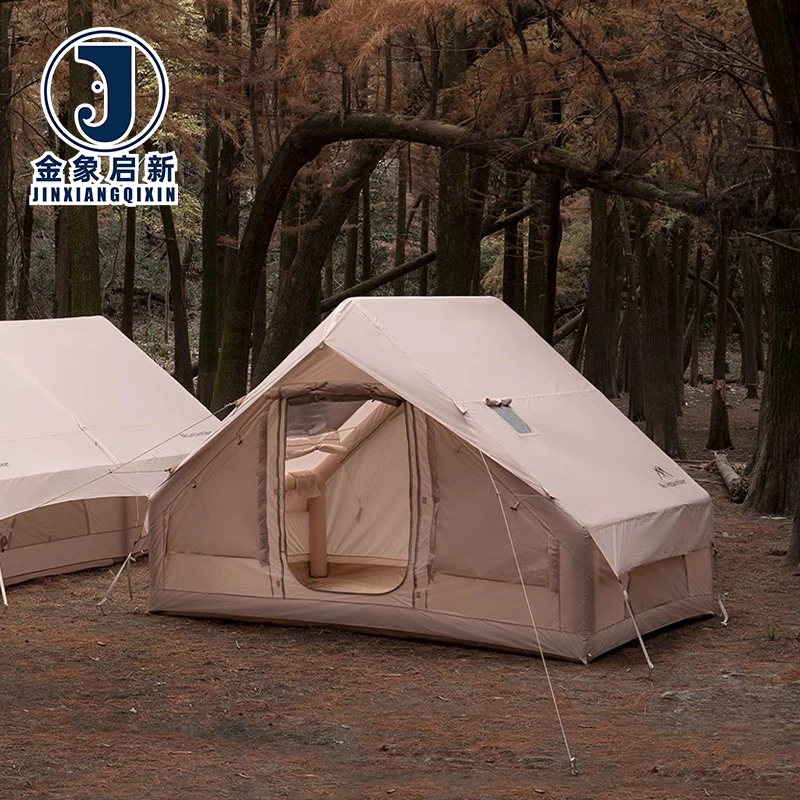
Process Control Depth — Three dedicated production lines and 36 sets of coating equipment maintain consistent PVC compound weight and base fabric adhesion across every roll of inflatable tent fabric we produce.
Technical Specifications
| Parameter | Value |
|---|---|
| Product Type | Inflatable Tent Fabric |
| Core Material | PVC tarpaulin |
| Key Performance Features | Waterproof, UV-resistant (test basis not stated), tear-resistant, fire-retardant (grade not stated), anti-static (standard not stated) |
| Season Rating | Four-season |
| Opening Mechanism | Quick automatic opening (inflatable) |
| Customization Service | OEM & ODM — sample customization, pattern printing, material selection, product design |
| Production Facility Area | 9180 square meters |
| Production Lines | 3 full production lines |
| Processing Equipment | 36 sets of professional processing equipment |
| R&D Team Scale | 10 technicians |
| Certifications | ISO9001, ISO14001, ISO45001, CE |
Application Suitability
| Application | Exposure & Requirement |
|---|---|
| Outdoor event and exhibition facilities | Repeated inflation cycles, public foot traffic, wind load, rapid setup and teardown |
| Mobile field stations and temporary workforce accommodations | Continuous outdoor deployment, weather cycling, interior climate control retention |
| Emergency response shelters for industrial operations | Immediate deployment, structural stability under adverse conditions, repeated relocation |
Why Fire-Retardant Claims Without a Grade Leave Inflatable Structures Uninsurable
Fire-retardant inflatable tent fabric must carry a grade that matches the jurisdiction where the structure will operate.
When an inflatable tent is erected at a commercial event or on a construction site, local fire marshals and insurance assessors ask for a specific classification — not a generic claim. We have seen entire deployments halted at inspection because the fabric supplier quoted "flame retardant" without naming the standard behind it [NEED_CITE: fire classification requirements for temporary membrane structures per local building codes]. An inflatable camping tent operating as a workforce accommodation in a mining camp or as an exhibition dome in a European city faces different regulatory thresholds, and custom inflatable tent PVC material ordered without specifying the target grade arrives as a compliance gamble rather than a verified asset.
Coating Weight and Adhesion Under Repeated Inflation
Every time an inflatable tent is pressurized, the PVC coating and the base fabric experience a combined tensile and shear load at the seam junction. The inflatable tent fabric manufacturer must control both the coating weight applied during production and the bond strength between compound and substrate, because any inconsistency compounds across inflation cycles. Our R&D team specifies coating parameters matched to the structural load profile of inflatable air-beam geometry, ensuring that the coating does not delaminate at flex points where the tube bends during pressurization.
Weld Integrity at Air-Beam Junctions
Inflatable tent structures concentrate stress at the junction where tube segments meet and where anchor points transfer load to the ground. Hot-air or high-frequency welding must produce a bond that matches or exceeds the base fabric tensile capacity [NEED_CITE: weld strength testing methods for PVC coated fabrics per ISO 1421]. When weld strength falls short, the seam fails before the fabric does — typically at the moment the structure is under full internal pressure and carrying its maximum wind load. Our production lines incorporate in-process weld verification at each junction type to catch bond weakness before the unit leaves the factory floor.
What the Specification Parameters Actually Control
Waterproof construction in PVC tarpaulin depends on continuous coating coverage across the full fabric width, with particular attention to selvedge edges where coating thickness tends to thin. Tear resistance is governed by the base fabric denier and weave density working together — a heavier coating alone cannot compensate for an open weave that allows tear propagation along the warp or weft. Fire-retardant performance, where specified, requires compound-level additive integration during coating rather than a surface spray that degrades after cleaning or UV exposure [NEED_CITE: DIN 4102 fire classification methodology for coated textile building membranes]. Anti-static treatment relevant to mining or aviation ventilation environments must be confirmed against the standard required on your project specification, as threshold resistivity values differ between industries.
What Specification Mismatches Cost on Site
Inflatable tent fabric ordered without confirming the target fire-retardant grade may pass your internal review but fail at the municipal inspection stage, forcing a full structure replacement mid-event or mid-project. Batch-to-batch coating weight variation shows up when two units from the same order are erected side by side and the fabric stiffness differs visibly at the air-beam curves. Weld parameters calibrated for a different compound formulation produce seams that hold during factory pressure testing but separate after repeated field inflation cycles [NEED_CITE: weld failure modes in PVC inflatable structures under cyclic pressure loading]. UV degradation without verified treatment manifests as surface chalking and loss of flexibility, shortening service life unpredictably.
Sourcing Directly From the Coating Line
Our 10-technician R&D team handles material selection, pattern printing, and custom sizing specifically for inflatable tent applications, developing samples within days rather than weeks. Three full production lines with 36 sets of professional processing equipment give us capacity to run large-volume inflatable tent fabric orders with consistent batch characteristics across every roll. Dedicated quality assurance at every production stage means coating weight, adhesion strength, and weld integrity are checked in-process rather than sampled after the fact. One hundred percent pre-shipment inspection includes pressure testing and waterproof verification on completed inflatable units. We hold ISO9001, ISO14001, ISO45001, and CE certifications covering the production facility, providing the audit trail that commercial and industrial buyers need for their compliance documentation.
Documentation & Verification
- Material specification sheet stating base fabric, coating type, and applicable treatment details for each inflatable tent order
- UV resistance and fire-retardant test reports provided upon request with grade and standard identified
- Pre-shipment inspection record including batch-specific pressure test and waterproof verification results
- ISO9001, ISO14001, ISO45001, and CE certificates covering the manufacturing facility
- Roll packing list and certificate of origin for international shipment documentation
Fabrication, Handling & Storage
- Hot-air welding temperature and speed must match the PVC compound formulation used in your inflatable tent fabric batch
- Store rolls vertically in climate-controlled space to prevent permanent creasing of the coated surface
- Use compatible PVC adhesive and primer for field repairs to maintain coating bond integrity at patch edges
- Avoid dragging fabric across abrasive ground during deployment to protect the waterproof coating layer
- Confirm cleaning agent compatibility with any fire-retardant or anti-static treatment before routine washing
Preparing Your Inflatable Tent Fabric Inquiry
Share the intended deployment environment, expected inflation cycle frequency, and any fire safety classification required in your target jurisdiction. Let us know whether you need roll stock for your own fabrication line or fully finished inflatable units with air-beam welding completed at our facility. Specify any pattern printing, colour matching, or custom sizing requirements so our R&D team can begin sample development immediately.
Frequently Asked Questions
Q: How do I verify the fire-retardant grade against my market’s requirements for inflatable structures?
A: Provide the specific standard or classification your local authority requires — such as DIN 4102, NFPA 701, or a national building code reference — and we will confirm whether our compound formulation meets that grade. Test reports identifying the exact classification achieved are supplied with each order where fire-retardant treatment is specified.
Q: What UV treatment test basis applies and what outdoor service life should I expect?
A: UV-resistant formulation is integrated at the compound level during coating production. We supply test data on request for the specific UV exposure standard relevant to your deployment region. Continuous outdoor service life depends on local irradiance levels and maintenance practice, so we recommend confirming expected duration against your operational environment.
Q: What does the OEM/ODM customization process look like for inflatable tent fabric?
A: Our 10-technician R&D team handles sample customization, pattern printing, material selection, and product design. After you share application requirements and dimensional specifications, we develop samples for your approval before full production. Custom sizing, colour, and printed branding are accommodated across our three production lines.
Q: How is batch-to-batch consistency maintained across multi-unit inflatable tent orders?
A: Each production run undergoes in-process quality checks on coating weight, adhesion strength, and colour reference. One hundred percent pre-shipment inspection verifies that every unit meets the specification established during sample approval. Batch-specific inspection records are available against your order reference for traceability across deployments.