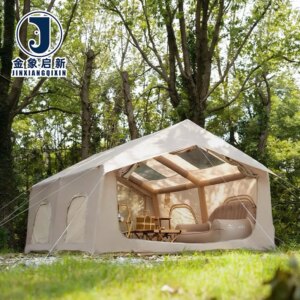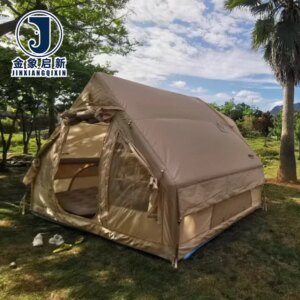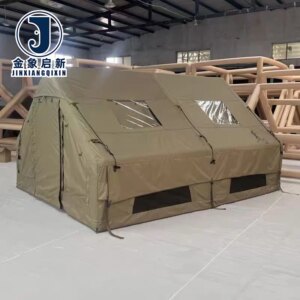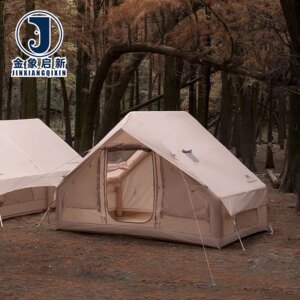
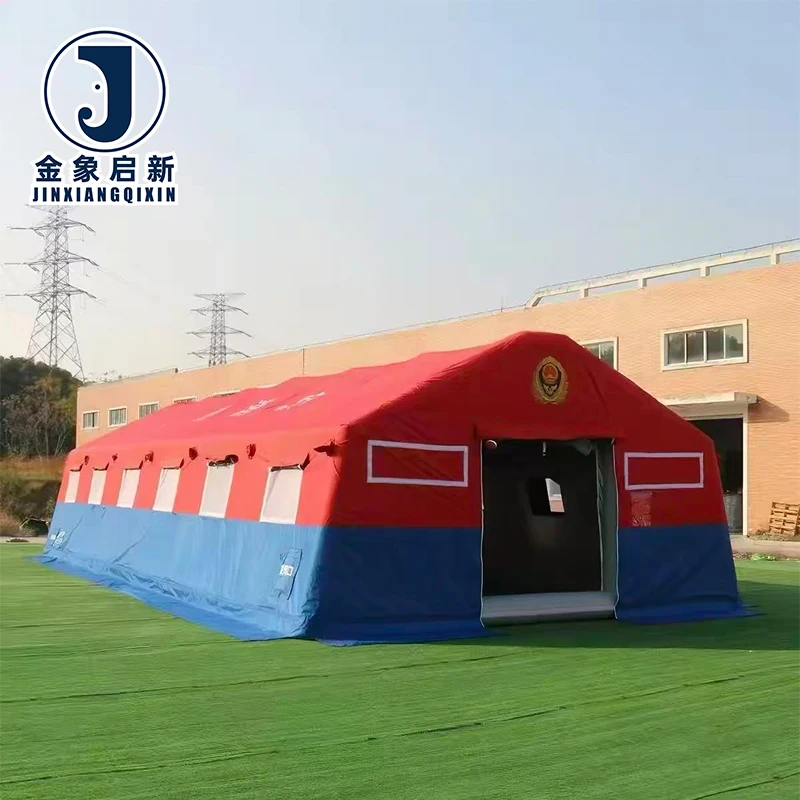
Process-Controlled Coating — Every roll of PVC tarpaulin for inflatable structures is checked for coating adhesion and airtight beam integrity before leaving the factory, ensuring fabricators receive material that performs consistently under inflation pressure.
Technical Specifications
| Parameter | Value |
|---|---|
| Product Type | Inflatable Tent |
| Core Material | PVC Tarpaulin |
| Waterproof Rating | 3000mm |
| Construction | Single Layer |
| Design Classification | Four-Season, Extended Type |
| Deployment Method | Quick Automatic Opening |
| Customization Service | OEM & ODM (size adjustments, color customization, logo printing) |
| Quality Control System | Full-Process Inspection with Dedicated QA & QC Staff |
| Standards | CE, ISO 9001, ISO 14001, ISO 45001 |
| Flame Retardant Grade | Available in flame retardant grades — confirm the grade required for your market |
| UV Treatment | UV-resistant formulation (test basis not stated — request report for your climate zone) |
Application Suitability
| Application | Exposure & Requirement |
|---|---|
| Disaster relief emergency shelters | Rapid deployment, sustained rain and wind exposure, repeated inflation cycles, ground moisture contact |
| Temporary storage facilities at construction sites | UV exposure across four-season temperature swings, abrasion from site traffic, dust and debris accumulation |
| Mobile command centers for infrastructure projects | Extended inflation periods, internal climate variation, frequent electrical and HVAC pass-throughs requiring cut-outs |
| Emergency response units for utility maintenance | Cold-weather deployment, high-wind environments, short-notice transport and repeated setup-teardown |
| Medical shelter structures | Hygienic interior surface, waterproof envelope integrity, rapid inflation for triage and field hospital use |
Why Coating Adhesion Matters More Than GSM for Inflatable PVC Tent Fabric
The airtight beam is only as reliable as the bond between PVC coating and base fabric.
Inflatable tent structures place a demand on coated fabric that flat tarpaulins never encounter. Each beam must hold internal pressure continuously, meaning the PVC coating must resist delamination at the exact points where the fabric bends, folds during storage, and stretches under inflation. I have seen heavy-grade coated rolls fail at the weld line — not because the fabric tore, but because the coating separated from the base weave under cyclic pressure loading [NEED_CITE: tensile and peel adhesion test methods for coated fabrics per ISO 2411]. When sourcing Inflatable PVC Tent Fabric, a high GSM figure alone tells you nothing about whether the coating will stay bonded through hundreds of inflation cycles.
Coating Method and Airtight Beam Integrity
The PVC coating applied to this Inflatable PVC Tent Fabric is formulated to maintain adhesion to the base fabric under the cyclic stress of inflation and deflation. Airtight beams require a coating that bonds uniformly across the entire fabric surface — any thin spot or adhesion weakness becomes the starting point for a slow leak. The single-layer construction means there is no secondary membrane backing up the primary envelope, making consistent coating coverage essential for holding pressure across extended deployment periods.
Waterproof Envelope Performance Under Field Conditions
The 3000mm waterproof rating on this Inflatable PVC Tent Fabric reflects the coating’s ability to resist water penetration under sustained hydrostatic head pressure. In disaster relief and construction site scenarios, the tent envelope faces driving rain, pooling water at ground contact points, and condensation differentials between interior and exterior surfaces. The four-season design classification indicates the material maintains its waterproof barrier across temperature extremes rather than becoming brittle in cold conditions or softening excessively in heat [NEED_CITE: hydrostatic head test method for coated textiles per ISO 14268].
Reading the Specs That Actually Predict Inflatable Performance
The 3000mm waterproof rating does not exist in isolation — it is the direct result of coating weight, PVC formulation chemistry, and how thoroughly the coating penetrates the base fabric weave. A heavier coating layer generally provides a higher hydrostatic barrier, but only if the base fabric denier and weave density are matched to support that coating weight without creating stiffness that cracks at fold lines. For inflatable beam construction, the relationship between coating adhesion strength and base fabric construction determines whether the beam holds pressure or develops micro-delaminations that bleed air over time. The single-layer design concentrates all structural and waterproof demands onto one coated surface, so specifying the correct base fabric and coating combination is critical. UV-resistant formulation in this PVC grade addresses the polymer degradation that occurs during prolonged outdoor exposure, helping the material retain tensile properties and coating flexibility across seasonal temperature cycles.
What Happens When Inflatable Fabric Specs Are Misunderstood
Ordering Inflatable PVC Tent Fabric based on price per kilogram without verifying coating adhesion data leads to field failures that are expensive to diagnose. A beam that loses pressure gradually over hours is often traced back to coating delamination at the weld zone — the heat from welding weakens an already marginal bond between coating and base fabric. Fabricators then face warranty claims and replacement costs that far exceed the original material savings. Batch-to-batch inconsistency in coating weight compounds the problem: one roll welds cleanly while the next produces brittle seams that crack during the first inflation test [NEED_CITE: thermal welding parameters and seam strength for PVC coated fabrics].
Why Fabricators Source This Material Here
Nearly 30 years of focused coated fabric production gives the manufacturing team direct control over PVC formulation and coating weight — the two variables that determine whether an inflatable beam holds pressure reliably. Three full production lines and 36 sets of professional equipment support the roll volumes that tent manufacturers need for batch production without splitting orders across multiple suppliers. A 10-person R&D team handles material selection and sample development, allowing fabricators to test weld parameters and beam prototypes before committing to a production run. Dedicated QA and QC inspection at every production stage means coating consistency is verified roll by roll, not just sampled from the first meter of a batch. Full-process inspection with 24-hour pressure retention checks on finished inflatable structures confirms that the fabric performs as an airtight envelope, not just as a flat sheet.
Documentation & Verification
- Material specification sheet stating base fabric denier, coating weight, and PVC formulation type
- Waterproof performance test report per batch confirming the 3000mm hydrostatic rating
- UV resistance and flame retardant test reports where applicable, referencing stated standards
- ISO and CE certificates with batch traceability for project compliance documentation
- Pre-shipment inspection record with roll-to-roll coating consistency verification
- Certificate of origin and customs support documentation for international shipments
Fabrication, Handling & Storage
- Set welding temperature and dwell time specifically for this PVC coating weight to achieve airtight beam seams without scorching
- Store rolls vertically on pallets to prevent flat-spot creases that weaken the coating at fold lines during inflation
- Allow cold-stored rolls to reach ambient temperature before unrolling to avoid cracking the PVC coating in low conditions
- Use compatible PVC adhesive for field patch repairs on the single-layer construction to maintain waterproof continuity
- Plan cut layouts to minimize transverse seams across inflatable beam paths, reducing potential leak points
- Clean surfaces with non-solvent cleaners to preserve the UV-resistant PVC formulation and avoid coating degradation
What to Include in Your Inquiry
Specify the inflatable beam diameter and operating pressure your tent design requires, along with the deployment climate range — this determines the coating formulation and base fabric density needed. Confirm your target market’s fire safety classification so the correct flame retardant grade can be quoted with supporting test documentation. Provide your annual roll consumption estimate and preferred widths so production scheduling aligns with your fabrication timeline. Request a sample roll to validate welding parameters on your equipment before placing a bulk order.
Frequently Asked Questions
Q: How do I verify the PVC coating weight and base fabric denier when rolls arrive?
A: Each shipment includes a material specification sheet stating the coating weight, base fabric denier, and weave construction. You can verify coating weight by cutting a measured sample, separating the coating from the base fabric using a controlled solvent method, and weighing each component. Discrepancies should be reported against the pre-shipment inspection record supplied with your order.
Q: What test standards confirm UV resistance for prolonged outdoor inflatable structure use?
A: UV resistance claims must be backed by test reports referencing recognized exposure standards applicable to your market. Request the specific test report for the batch you are purchasing. Different climate zones require different exposure durations, so confirm that the test duration matches the expected service conditions of your inflatable tent installations.
Q: What welding parameters produce reliable airtight beam seams on this PVC grade?
A: Welding temperature, pressure, and dwell time depend on the specific coating weight and your hot-air or high-frequency welding equipment. Request a sample roll to run weld trials on your machines before production. The R&D team can provide starting parameters based on the coating formulation, which you then fine-tune for your seam geometry.
Q: Are flame retardant grades available with certification for specific markets?
A: Flame retardant grades are available, and the applicable grade depends on the fire safety classification required in your target market. When you specify the standard needed — such as regional building code classifications — the quotation will include the corresponding test report and certification documentation for compliance submission.