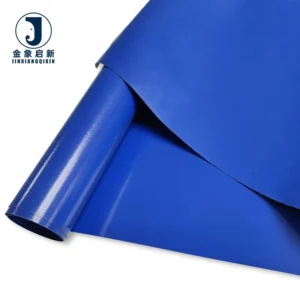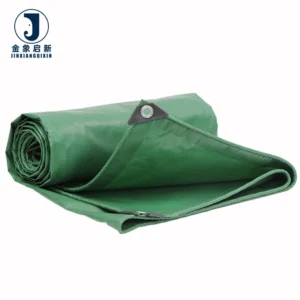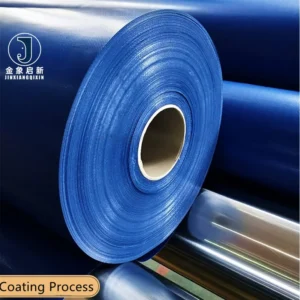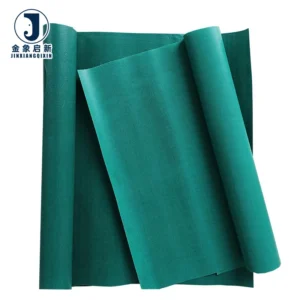
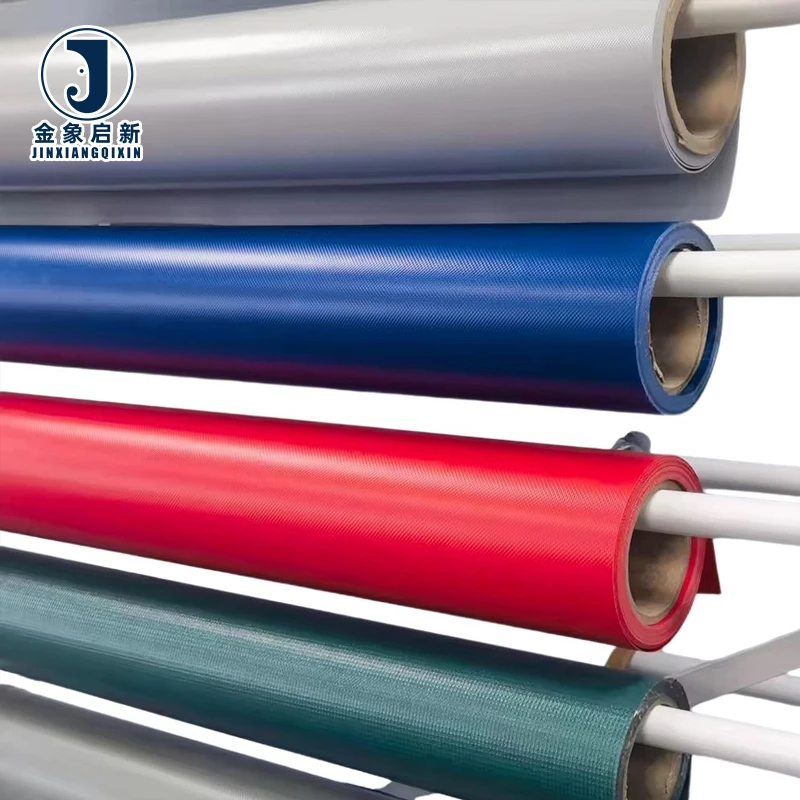
Coating Adhesion Control — Every roll of 1000D PVC tarpaulin roll undergoes in-process coating weight verification across the full production run to ensure the bond between base fabric and PVC layer holds under structural tension.
Technical Specifications
| Parameter | Value |
|---|---|
| Product Type | PVC Coated Tarpaulin |
| Base Fabric Denier | 1000D |
| Coating Material | PVC |
| Light Blocking | Blackout |
| UV Treatment | Anti-UV (test basis not stated in source — confirm grade required) |
| Flame Retardant | Available (grade not stated — confirm M2 / B1 / NFPA 701 / DIN 4102 as needed) |
| Mildew Resistance | Antibacterial and mildew proof |
| Oil & Stain Resistance | Yes |
| Chemical Resistance | Acid and alkali resistant |
| Temperature Resistance | High temperature and cold resistant |
| Anti-Oxidation | Yes |
| Flexibility | Highly flexible, crack resistant |
| Self-Cleaning | Yes |
| Welding Compatibility | HF welding, hot air welding, sewing |
| Tensile Strength | Rated excellent (standard not stated — request test report) |
| Tear Strength | Rated excellent (standard not stated — request test report) |
| Peeling Resistance | Rated excellent (standard not stated — request test report) |
Application Suitability
| Application | Exposure & Requirement |
|---|---|
| Event exhibition shade tents | Direct sunlight, high foot traffic, complete light blocking for interior environment control |
| Tensile membrane structures | Sustained wind load, structural tension at anchor points, long-term UV and thermal cycling |
| Stadium architectural canopies | Large span tension, weather exposure from all angles, fire code compliance for public venues |
| Airport hangar covers | Fuel and chemical exposure, wide temperature swings, strict flame-retardant requirements |
| Portable storage structures | Abrasion from stored goods, repeated assembly and disassembly, puncture resistance at frame contact points |
| Shade systems and shading installations | Continuous solar exposure, colour stability over time, weld seam integrity under flex |
What "Anti-UV" Means When No Test Standard Is Named
Specify the UV test duration or standard before approving a roll order — a claim without documentation is a liability on any tensile or shade structure.
Technical buyers sourcing PVC blackout tent fabric 1000D for outdoor architectural applications frequently receive material described simply as "anti-UV" with no reference to xenon arc exposure hours, a recognised standard such as ISO 4892-2, or a regional weathering protocol. When the coating degrades prematurely under sustained solar load, the failure is traced back to insufficient stabiliser loading in the PVC formulation. For shade structures and tensile canopies that must perform through multiple seasons of direct exposure, the absence of a documented UV test result turns a material specification into a guess. [NEED_CITE: ISO 4892-2 laboratory weathering methods for plastics and coated fabrics]
How Coating Formulation Drives Blackout Performance
The blackout property in this PVC tarpaulin roll is achieved through the coating composition itself, not an applied film or secondary layer. When the PVC compound is formulated with light-blocking additives during the coating stage, the result is complete opacity through the full material thickness — light cannot penetrate even when the fabric is stretched under structural tension on a tensile frame. This matters for event and exhibition tents where interior lighting control is part of the design specification, and for storage structures where UV-sensitive goods are kept behind the membrane.
Welding Behaviour Across Joining Methods
This 1000D PVC coated fabric supports three joining paths: high-frequency welding, hot air welding, and industrial sewing. Each method interacts differently with the coating chemistry. HF welding relies on dielectric heating of the PVC layer to fuse overlapping seams at the molecular level, producing a bond that matches or exceeds the base fabric strength. Hot air welding offers fabricators more control over heat input on thicker coating weights, while sewing provides mechanical joining where field conditions do not permit thermal methods. The PVC formulation must remain thermally responsive across all three methods without surface scorching or delamination at the coating-to-fabric interface. [NEED_CITE: thermal joining methods for PVC coated technical textiles]
Base Fabric Denier and Structural Load Response
The 1000D polyester base fabric sets the mechanical baseline for this material. Denier — the mass in grams of 9,000 metres of yarn — determines how much load each yarn in the weave can carry before elongation or rupture. On tensile structures where the membrane is pre-stressed across cables or frames, the 1000D yarn distributes point loads from anchors and fixings across a wider area of the weave. Tear propagation resistance depends on both yarn denier and the density of the warp-and-weft construction: a tighter weave arrests a tear initiated at a cut edge or puncture point before it travels across the panel. Coating adhesion to this base fabric prevents the PVC skin from peeling away under cyclic wind loading, which would otherwise expose the yarns to moisture and abrasion.
The Cost of Unverified Material Claims
When a roll arrives with a coating weight lighter than the quotation stated, the shortfall shows up first at the weld line. Seams that should fuse into a continuous joint instead pull apart because the PVC layer is too thin to sustain a proper thermal bond. On shade structures spanning several metres, this means re-fabricating entire panels at the installation site. Similarly, colour variation between rolls in the same order becomes visible only after the panels are seamed side by side on a tensile canopy — by which time the material is already cut, welded, and installed. Batch inconsistency in coating thickness also means UV stabiliser distribution varies roll to roll, so some panels degrade faster than others in the same structure. [NEED_CITE: pre-shipment inspection practices for coated textile rolls]
Why Technical Buyers Source This Fabric Here
Three full production lines with 36 sets of professional equipment give this facility the capacity to run large-volume PVC tarpaulin roll orders with consistent coating parameters throughout. A 10-person R&D team handles material selection, sample development, and custom formulation adjustments before production begins — critical when a project demands a specific flame-retardant grade or colour match. Every roll undergoes dedicated QA/QC at each production stage, with 100% inspection before shipment rather than batch sampling. Sample development for custom width, colour, or treatment requirements is completed within days, allowing fabricators to verify the material against their welding setup and design specifications before committing to a bulk order. Documentation — including material specification sheets, test reports for UV and flame-retardant grades where applicable, and pre-shipment inspection records — travels with every shipment.
Documentation & Verification
- Material specification sheet stating 1000D base fabric, coating type, and blackout classification per roll
- UV resistance and flame-retardant test reports included where grades are specified at order stage
- Pre-shipment inspection record confirming coating consistency and colour match across all rolls
- ISO and CE certificates with scope covering PVC coated fabric production
- Roll packing list with individual roll dimensions and weight for receiving verification
Fabrication, Handling & Storage
- HF weld settings should be calibrated to the PVC coating thickness — test on offcuts from each roll before joining structural seams
- Hot air welding temperature must remain stable to avoid scorching the blackout coating layer on this 1000D fabric
- Store rolls horizontally on pallets to prevent permanent creasing of the PVC coating surface
- Unroll cold-weather deliveries indoors and allow the 1000D PVC tarpaulin roll to reach workshop temperature before cutting
- Use PVC-compatible cleaners only — solvent-based agents may attack the self-cleaning surface treatment
- Plan panel layout to minimise cross-direction seams, which carry higher stress on tensile structures
Requesting a Material Quote
Share your application type, structural span dimensions, and the environmental exposure conditions at the installation site. If your market requires a specific flame-retardant grade such as M2, B1, NFPA 701, or DIN 4102, state this at inquiry so the correct formulation is quoted. Indicate your preferred roll width, annual volume, and whether you need sample rolls for weld testing before bulk commitment.
Frequently Asked Questions
Q: How is the 1000D denier verified and how does it relate to GSM and tensile strength?
A: Denier is the yarn mass per fixed length and is independent of coating weight. A 1000D base fabric can be coated to different GSM levels depending on the application. Request a material specification sheet that lists base fabric denier, coating method, and total GSM separately so you can verify each element against the delivered roll.
Q: What test standard supports the anti-UV claim on this blackout tent fabric?
A: The anti-UV treatment is available but the specific test duration or standard should be confirmed at inquiry. Request a test report referencing a recognised method such as ISO 4892-2 xenon arc exposure before approving the roll order for outdoor tensile or shade structure use.
Q: Which flame-retardant grades are available and how are they documented?
A: This PVC tarpaulin roll can be produced in flame-retardant grades including M2, B1, NFPA 701, or DIN 4102 — specify which your project or market requires. A test report matching the stated grade is supplied with the shipment documentation when confirmed at order stage.
Q: What are the differences between HF, hot air, and sewing for structural seams?
A: HF welding fuses the PVC coating at the molecular level for the strongest seam on this 1000D fabric. Hot air welding gives more control on thicker coatings. Sewing provides mechanical joining where thermal methods are impractical. Test each method on roll offcuts to confirm seam integrity under your structural load conditions.
Q: How is batch-to-batch colour and coating consistency controlled across rolls?
A: Every roll receives 100% inspection before shipment, with coating weight and colour checked individually. A pre-shipment inspection record documents the results per roll. Request this document to verify consistency when multiple rolls of PVC blackout tent fabric 1000D are seamed together on a single installation.