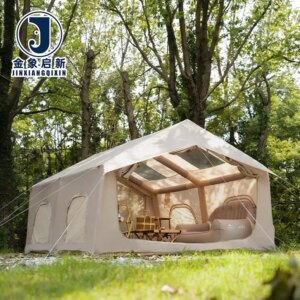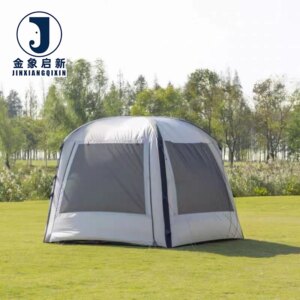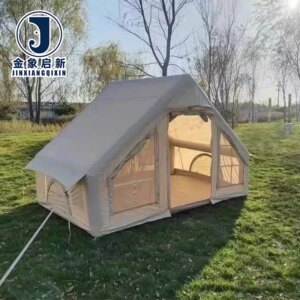
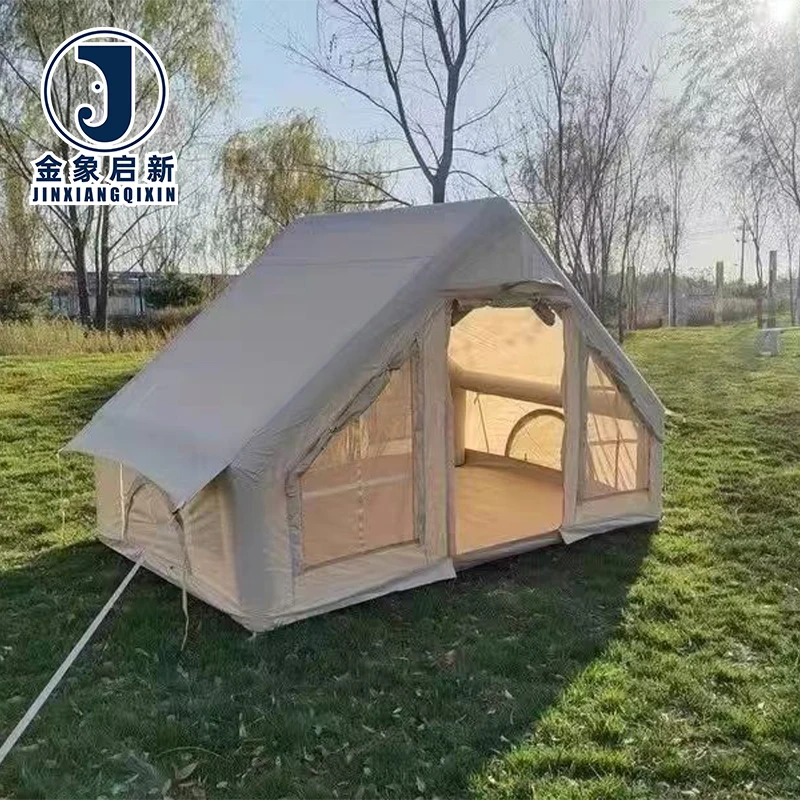
Precision coating control — Every roll of PVC inflatable tent fabric undergoes 100% inspection against stated GSM and coating weight before dispatch, verified by dedicated QA at each production stage.
Technical Specifications
| Parameter | Value |
|---|---|
| Product Type | Inflatable Tent |
| Core Material | PVC Tarpaulin |
| Waterproof Performance | Fully waterproof coated construction |
| UV Resistance | UV-resistant treatment available — confirm test basis required for your market |
| Fire Retardancy | Fire-retardant grades available — confirm the grade required for your market |
| Anti-Static | Anti-static treatment available — confirm surface resistance standard for your application |
| Tear Resistance | Tear-resistant PVC-coated construction |
| Product Form | Inflatable structure with quick automatic opening mechanism |
| Customisation | OEM & ODM: sample development, pattern printing, material selection, product design |
| Certifications | ISO9001, ISO14001, ISO45001, CE |
Application Suitability
| Application | Exposure & Requirement |
|---|---|
| Emergency disaster relief shelters | Rapid deployment, all-weather waterproofing, fire safety compliance on temporary sites |
| Remote construction site command centres | Extended UV exposure, wind loading on inflatable frames, temperature fluctuation |
| Mobile workshop and field operation enclosures | Abrasion from equipment movement, repeated inflation cycles stressing welded seams |
| Equipment storage shelters in construction zones | Permanent outdoor exposure, water ingress prevention, structural rigidity under inflation pressure |
Why "Fire-Retardant" on Inflatable Tent Fabric Means Nothing Without a Grade
A test report tied to a recognised standard is the only evidence that matters on site.
Sourcing managers regularly receive PVC inflatable tent fabric labelled as fire-retardant, only to discover during site safety audits that the supplier cannot produce a test certificate matching the local building or mining code. The cost is not the fabric — it is the halted operation, the re-inspection, and the emergency re-order. When inflatable shelters serve as command centres or medical stations, the compliance gap becomes a liability issue, not a procurement footnote [NEED_CITE: fire classification standards for temporary structures and inflatable shelters].
Coating Weight and Adhesion Determine Inflatable Structural Integrity
PVC inflatable tent fabric relies on the coating bond to the base fabric for its air-holding performance. The coating method and weight directly control how well the material resists delamination under repeated inflation and deflation cycles. When coating adhesion is inconsistent, the first failure appears at welded seams where inflation pressure concentrates. A specification sheet stating coating material, method and weight — not just total GSM — gives fabricators the data they need to set heat-welding parameters correctly for PVC inflatable tent fabric structures.
Base Fabric Construction and Tear Propagation Under Inflation Load
The denier and weave density of the base fabric govern how a puncture or cut propagates once the inflatable structure is pressurised. A loose weave allows a small tear to travel rapidly along the warp or weft, compromising an entire air chamber. Tighter weave construction with higher denier yarns restricts tear spread, which is critical for inflatable shelters deployed in mining or construction zones where sharp equipment contact is routine [NEED_CITE: tensile and tear test methods for coated fabrics per ISO 1421].
Reading the Specification Sheet Beyond Total GSM
Total GSM combines base fabric weight and coating weight into a single number, but two fabrics with identical GSM can perform very differently. A heavier base fabric with lighter coating gives higher tensile strength but may sacrifice weld integrity. A heavier coating on a lighter base improves waterproofing yet reduces tear resistance at stress points. Understanding the split between base fabric and coating weight allows technical buyers to match PVC inflatable tent fabric to the specific inflation pressure and environmental load their structure will face. Surface finish — glossy or matte — also affects cleaning behaviour and the adhesion of printed branding on emergency shelter exteriors.
The Hidden Cost of Specifying on Price Per Roll Alone
When procurement decisions rest on roll price without verifying coating weight, the inflatable shelter may fail at the weld line during its first deployment in high wind. Coating that is lighter than the stated GSM cannot sustain the heat-weld temperature needed for a full-strength seam, and the joint separates before the fabric itself reaches its tear limit. Batch-to-batch colour variation across rolls in a single order creates visible mismatch once the shelter is erected — a problem that surfaces only on site, where replacement lead times are measured in weeks, not days [NEED_CITE: coating weight verification and weld strength correlation in PVC tarpaulin].
Why Technical Buyers Source PVC Inflatable Tent Fabric Here
Deep process control over coating weight and adhesion means the GSM on your specification sheet is the GSM that arrives on the roll. Three full production lines and 36 sets of professional processing equipment support consistent batch output, so colour and coating thickness hold across every roll in your order. The 10-person R&D team handles material selection, pattern printing and custom sizing — delivering pre-production samples within days rather than weeks. Dedicated QA/QC runs at every production stage with 100% pre-shipment inspection, so you receive a documented inspection record, not a promise.
Documentation & Verification
- Material specification sheet stating GSM, base fabric denier, coating material and method for each roll
- Test reports for UV resistance and flame-retardant grade matched to your market requirement
- ISO and CE certificates supplied with every shipment
- Pre-shipment inspection record documenting coating weight and colour check per roll
- Roll packing list with net weight and roll dimensions for container planning
- Certificate of origin and customs documentation included for international dispatch
Fabrication, Handling & Storage
- Set heat-weld temperature to match the PVC coating weight stated on your specification sheet
- Reinforce inflation valve mounting points with additional PVC patches matching the base fabric denier
- Store rolls horizontally on padded racks to prevent permanent creasing in the coated surface
- Allow fabric to reach ambient temperature before unrolling in cold conditions to avoid coating crack
- Use PVC-compatible cleaners only — solvent-based products degrade the plasticiser in the coating
- Plan cutting layout to minimise transverse welds across the inflation chamber axis
What We Need From Your Enquiry
Provide your target deployment environment — climate zone, wind load expectation, and whether the inflatable structure will serve as a shelter, storage unit or command centre. Confirm the fire-retardant grade or anti-static standard required by your local safety code. Specify whether you need rolls in stock widths or custom dimensions, and indicate your annual volume so we can align production scheduling. If pattern printing or colour matching is part of the design, share your reference files for sample development.
Frequently Asked Questions
Q: How can I verify the GSM and coating weight of inflatable tent fabric when it arrives?
A: Request the material specification sheet before dispatch, which states GSM, base fabric denier and coating weight. On receipt, cut a measured sample from the roll and weigh it to confirm total GSM. A 100% pre-shipment inspection record is provided with every order, documenting verified weight per roll.
Q: Which fire-retardant grade should I specify for inflatable emergency shelters?
A: The required grade depends on your target market and application — M2, B1 per DIN 4102, or NFPA 701 are common references. Confirm the exact standard with your local fire safety authority before ordering, and request the corresponding test report with your shipment documentation.
Q: What anti-static standard applies to inflatable shelters used on mining sites?
A: Mining and industrial sites typically require surface resistance within a defined range to prevent static discharge near combustible atmospheres. Specify the standard your site safety plan references, and request a test report confirming the PVC inflatable tent fabric meets that surface resistance threshold.
Q: How do welded seams hold up under repeated inflation and deflation cycles?
A: Weld strength depends on correct temperature settings matched to the coating weight. When heat-weld parameters align with the PVC coating specification, the seam reaches strength comparable to the parent fabric. Incorrect settings cause the weld to delaminate before the fabric itself fails at tear points.
Q: Can I order custom widths, colours or printed branding with reasonable minimums?
A: OEM and ODM services cover custom width, colour matching and pattern printing. The 10-person R&D team develops pre-production samples within days for your approval. Minimum order quantities vary by specification — share your requirements for a quotation covering lead time and roll configuration.