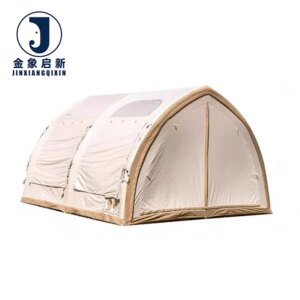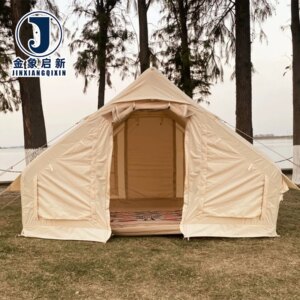
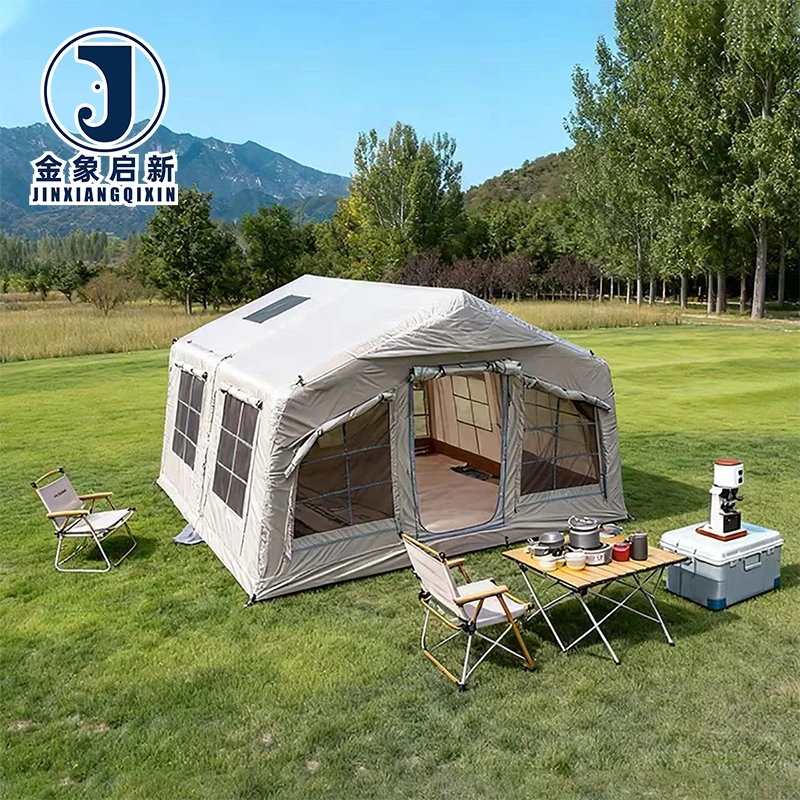
Coating Process Control — nearly 30 years of focused PVC coating experience ensures consistent adhesion and weight distribution across every roll of inflatable tent fabric shipped.
Technical Specifications
| Parameter | Value |
|---|---|
| Product Type | Inflatable Tent |
| Core Material | PVC tarpaulin |
| Structure | Single-layer PVC tarpaulin |
| Waterproofing | Fully waterproof coated construction |
| UV Resistance | UV-resistant additives integrated (test basis available on request) |
| Fire Retardancy | Fire-retardant treatment available — confirm grade required for your market |
| Anti-Static | Anti-static treatment available — confirm standard required for your site |
| Tear Resistance | Tear-resistant construction |
| Season Rating | 4-season |
| Opening Mechanism | Quick automatic opening (inflatable) |
| Customization | OEM & ODM: size adjustments, pattern printing, material thickness modifications |
| Certifications | ISO 9001, ISO 14001, ISO 45001, CE |
Application Suitability
| Application | Exposure & Requirement |
|---|---|
| Commercial glamping resorts | Year-round weather exposure, guest safety compliance, UV degradation under continuous sun, wind load on inflated structure |
| Outdoor event venues | Rapid deployment cycles, repeated inflation and deflation, temporary fire code compliance, crowd proximity safety |
| Temporary hospitality facilities | Seasonal reinstallation, transport abrasion between sites, waterproof integrity under rainfall, surface cleanliness for guest-facing use |
| Rapid-deployment outdoor shelters | Quick automatic opening requirement, structural integrity under inflation pressure, certified material documentation for site approval |
Why Coating Adhesion Matters More Than GSM for Inflatable Tent Fabric
A heavier fabric that delaminates at the weld is lighter than useless — it is a liability at the exact point the structure depends on sealed seams.
When buyers specify PVC inflatable tent fabric by GSM alone, they often discover after delivery that the coating separates from the base fabric under inflation pressure. The membrane flexes continuously while pressurised, and every welded joint experiences peel forces that a poorly bonded coating cannot withstand. I have reviewed field reports where inflatable structures failed not because the fabric tore, but because the coating lifted from the base weave at the heat-welded seam [NEED_CITE: tensile and peel adhesion test methods for coated fabrics per ISO 1421]. The base fabric denier, weave density, and coating method together determine whether the weld line holds as long as the membrane itself.
Base Fabric and Coating Interaction Under Inflation Pressure
The structural behaviour of an inflatable tent depends entirely on the membrane material maintaining airtight integrity under sustained internal pressure. When selecting PVC inflatable tent fabric, the base fabric denier and weave density govern tensile and tear strength, while the coating method and weight determine waterproof consistency and flex durability. A knife-coated single-layer construction embeds the PVC compound directly into the base weave, producing higher peel adhesion at welded seams compared to laminated alternatives.
Fire Retardancy and UV Additives in Commercial Deployments
Commercial glamping and event operators require documented fire-retardant performance that matches their local regulatory framework. Fire-retardant and anti-static treatments are integrated into the PVC compound during coating — available in grades matched to destination market requirements, with test reports provided for the specific batch shipped [NEED_CITE: fire classification standards for temporary membrane structures]. UV-resistant additives are compounded into the coating to extend service life under prolonged sun exposure, critical for four-season resort installations where the fabric remains inflated for months without seasonal removal.
How GSM, Coating Weight, and Base Fabric Density Interact
GSM alone does not predict performance because it conflates base fabric mass with coating mass. Two PVC tarpaulin rolls can share the same stated GSM while differing substantially in tensile strength if one uses a denser, higher-denier base fabric with a thinner coating and the other uses a lighter base with a heavier coating layer. The base fabric carries the structural load — its denier and threads per centimetre in warp and weft directions determine how the material resists tearing under wind gusts and inflation pressure. The coating provides waterproofing, UV shielding, and the surface chemistry needed for reliable heat welding. Specifying both parameters independently, rather than relying on GSM as a single number, prevents the mismatch where a fabric meets the weight requirement but fails the strength requirement at the seam.
The Hidden Cost of Batch-to-Batch Colour Inconsistency
When multiple rolls are ordered for a single glamping project or event installation, colour variation between rolls becomes immediately visible once panels are installed side by side. This is not a cosmetic complaint — it signals inconsistent coating formulation across the batch, which can correlate with variation in UV additive concentration and fire-retardant loading [NEED_CITE: quality control standards for colour consistency in coated textile production]. A batch where one roll tests to the required fire-retardant grade while another falls marginally short creates a compliance gap that site inspectors will identify during documentation review. Pre-shipment inspection covering colour reference, coating weight verification, and test report alignment per roll eliminates this risk before dispatch.
Why Procurement Verification Matters for Inflatable Membrane Fabric
Jinxiang operates three full production lines with 36 sets of processing equipment and a 10-technician R&D team handling material selection and sample development. Every roll undergoes dedicated QA/QC at each production stage, with 100% inspection before shipment — coating weight is verified against the stated specification, and colour consistency is checked roll-to-roll within each order. Samples for custom size, colour, and pattern confirmation are developed within days before bulk production begins, allowing buyers to verify material properties against their specific glamping or event requirements. Production operates under ISO 9001, ISO 14001, ISO 45001, and CE frameworks, with full traceability from raw material to finished roll.
Documentation & Verification
- Material specification sheet confirming GSM, base fabric construction, coating type, and colour reference per batch
- Test reports for UV resistance and fire-retardant grades matched to destination market regulatory standards
- Pre-shipment inspection record documenting coating adhesion, weld seam integrity, and colour consistency
- Roll packing list with batch traceability for each unit shipped
- Certificate of origin and customs documentation for international procurement
Fabrication, Handling & Storage
- Heat welding parameters should be adjusted to the specific PVC coating weight and single-layer construction before production runs begin
- Store rolls upright on pallets in a dry, shaded environment to prevent surface deformation and coating compression marks
- Unroll and allow the PVC tarpaulin to acclimatise before cutting in cold conditions to avoid cracking at fold lines
- Use compatible PVC-based adhesives for field repairs, matching the coating chemistry of the single-layer membrane
- Plan panel cutting layout to minimise welded seams across high-stress inflation zones of the tent structure
What We Need to Specify Your Order Accurately
To provide a precise material recommendation, share your application scenario — whether the inflatable tent fabric will serve a permanent glamping installation or a portable event structure that undergoes repeated setup cycles. Specify the fire-retardant grade and any anti-static standard required by your local authority or venue operator. Confirm whether you need rolls in standard width for your own fabrication line, or finished panels cut and welded to your tent design, along with colour references and any pattern printing requirements. Request a sample roll or panel for your own testing before committing to bulk production.
Frequently Asked Questions
Q: What GSM and base fabric construction are recommended for 4-season commercial inflatable tent use?
A: The recommended specification depends on your site wind load, inflation pressure, and expected deployment duration. Both the base fabric denier and the coating weight must be evaluated together — GSM alone does not determine structural adequacy. Request a material specification sheet that states each parameter independently, and we will develop a sample matched to your engineering requirements.
Q: Can fire-retardant and UV test reports be provided for the specific batch being shipped?
A: Yes. Fire-retardant and UV-resistance test reports are generated per production batch and referenced to the specific rolls in your order. Confirm the regulatory standard required by your destination market — such as the applicable national fire code for temporary structures — so the correct grade is tested and documented before shipment.
Q: Is custom width, colour, or pattern printing available for OEM tent manufacturers buying by the roll?
A: Custom width, colour matching, and pattern printing are available through the OEM/ODM programme. Samples are developed within days for your approval before bulk production begins. Roll-to-roll colour consistency is verified during pre-shipment inspection to ensure uniform appearance across your entire order.
Q: How is seam weld integrity tested, and what is the failure point relative to the fabric itself?
A: Welded seams are tested for peel adhesion to confirm the coating does not delaminate from the base fabric at the joint. The target is for the weld line to match or exceed the tear strength of the membrane itself. Test results are documented in the pre-shipment inspection record for each batch.
Q: What documentation ships with each roll for compliance and traceability?
A: Each shipment includes a material specification sheet, batch-specific test reports where applicable, a pre-shipment inspection record, roll packing list with batch numbers, certificate of origin, and customs support documentation. All records are cross-referenced to your purchase order for full traceability.