Precision Coating Control — Nearly three decades of PVC coating process mastery applied to aviation-grade thermal insulation layers, ensuring consistent GSM and adhesion across every PCA ducting production run.
Technical Specifications
| Parameter | Value |
|---|---|
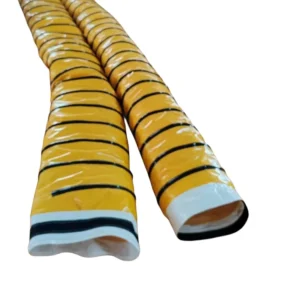
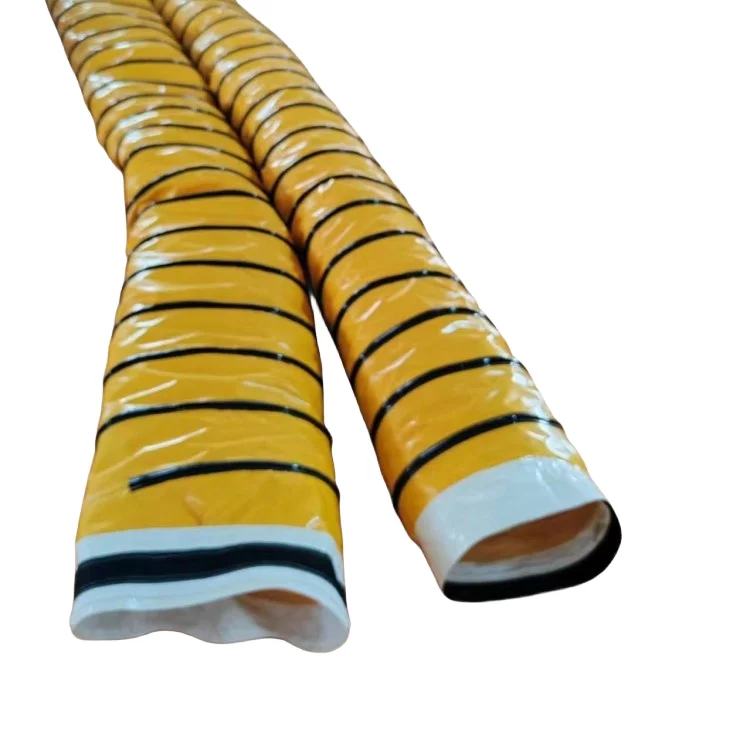
| Product Type | Aircraft PCA Hose (Pre-Conditioned Air Duct) |
| Diameter | 12 Inch |
| Base Material | PVC coated cloth with fabric-reinforced layer |
| Insulation Layer | Built-in aluminum foil bubble film |
| Temperature Range | -30°C to 150°C |
| Connection Type | Zipper and Velcro link |
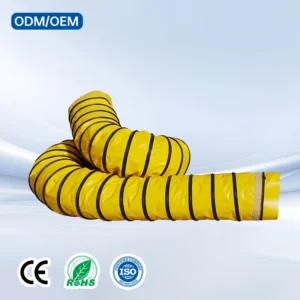
| Outer Layer Color | Yellow-black alternating (high visibility) |
| Flame Retardant Grade | Available in flame retardant grades — confirm the grade required for your market |
| Anti-Static | Available in anti-static grades — confirm the certification required for your airport compliance |
| Standards | ISO, CE (company level — confirm product-specific certification) |
| Customization MOQ | 100 units (Logo, Pattern, Outer Packaging) |
Application Suitability
| Application | Exposure & Requirement |
|---|---|
| Airport apron PCA unit to aircraft cabin connection | Extreme temperature differential airflow, outdoor UV and weather exposure, frequent handling and repositioning |
| Hangar ventilation for aviation maintenance contractors | Continuous warm or cool air circulation, mechanical abrasion from floor contact, compact storage between jobs |
| Ground support equipment manufacturer integration | Dimensional compatibility with mobile air supply outlets, repeated folding and deployment cycles, high-visibility safety compliance |
Why "Flame Retardant" Means Nothing Without a Grade Behind It
Material specification sheets must state the exact fire classification to pass airport safety audits.
Procurement teams regularly receive ducting labeled as flame retardant with no underlying test standard referenced. On airport aprons where aviation ground support equipment operates near fuel handling zones, this gap between claim and evidence creates compliance risk during regulatory inspections [NEED_CITE: fire classification standards for aviation ground support ventilation ducting]. A 12 Inch Flexible PCA Air Duct for Aviation Cooling deployed without verifiable fire performance documentation can halt operations until replacement stock arrives. Technical buyers need the test basis — not the marketing claim — before approving a batch for airside deployment.
Multi-Layer Construction for Thermal Transfer Integrity
The Aircraft PCA Hose combines a PVC coated cloth outer shell with a fabric-reinforced structural layer and an internal aluminum foil bubble film insulation barrier. This construction addresses the core challenge of pre-conditioned air delivery: maintaining the temperature differential between the PCA unit output and the aircraft cabin interface across the full ducting length. The PVC exterior provides mildew and water resistance suited to continuous outdoor apron exposure, while the aluminum foil bubble film layer limits thermal bleed-through during both cooling and heating operations.
Rapid Deployment Through Modular Connection Design
Zipper and Velcro link connections allow ground handling crews to assemble, extend, and disconnect sections without tools or additional hardware. The high-visibility yellow-black alternating outer coloring serves a functional safety purpose on busy aprons where vehicle traffic and equipment movement require immediate visual identification [NEED_CITE: airport apron safety visibility requirements for ground support equipment]. When operations conclude, the flexible PVC construction folds compactly for storage inside equipment bays or transport vehicles.
Reading the Specification Sheet Beyond Diameter
The -30°C to 150°C temperature range defines the operational boundaries for both pre-conditioned cooling air and heated airflows. Buyers evaluating Aircraft PCA Hose options should cross-reference this range against the maximum and minimum output temperatures of their specific PCA units under peak load conditions. The 12-inch diameter must match the outlet flange dimensions of the ground unit and the aircraft cabin air supply interface — even minor mismatches cause airflow restriction and pressure loss at connection points. The PVC coated cloth base fabric and its reinforcement layer determine how well the ducting resists mechanical damage from dragging, kinking, and compression under equipment weight on the apron surface.
The Hidden Cost of Underspecified Insulation Layers
Ducting that lacks adequate thermal insulation forces PCA units to work harder and longer to deliver air at the target cabin temperature, increasing energy consumption and equipment wear [NEED_CITE: thermal efficiency losses in uninsulated or poorly insulated aviation air ducting]. On aprons where summer surface temperatures exceed ambient air readings significantly, an insulation layer that degrades or compresses over repeated folding cycles loses its bubble film structure and thermal resistance. Batches where the aluminum foil layer is inconsistently bonded create localized hot or cold spots that ground crews identify only after installation and operational testing.
Why Source Aviation Ducting Through This Facility
Deep process control over PVC coating weight and adhesion, developed across nearly 30 years of coated fabric production, ensures the outer shell maintains integrity through repeated apron deployment cycles. Three full production lines and 36 sets of professional equipment support bulk order volumes for fleet-scale replacement programs without compromising delivery schedules. The 10-person R&D team handles diameter adjustments, connection type modifications, and custom branding requirements with sample development completed within days. Dedicated QA/QC inspection at every production stage, with 100% pre-shipment checks, catches dimensional deviations and connection integrity issues before dispatch [NEED_CITE: pre-shipment inspection protocols for coated fabric aviation products]. ISO and CE certified manufacturing processes provide the compliance foundation that aviation procurement departments require in supplier documentation.
Documentation & Verification
- Material specification sheet stating PVC coating weight, base fabric denier, and aluminum foil insulation composition
- Temperature performance test data verifying the -30°C to 150°C operational range for both cooling and heating cycles
- Fire-retardant and anti-static test reports where applicable, matched to airport-specific compliance requirements
- Pre-shipment inspection record confirming 12-inch diameter, zipper and Velcro connection integrity, and color consistency
- Certificate of origin and customs documentation for international airport equipment procurement channels
Fabrication, Handling & Storage
- Heat welding parameters must account for the PVC coated cloth base and aluminum foil insulation layer to avoid delamination at seam points
- Zipper and Velcro connection zones require reinforced stitching through the fabric-reinforced layer to withstand repeated mating cycles
- Fold the ducting along natural crease lines to preserve the aluminum foil bubble film structure and avoid permanent compression damage
- Store in dry, shaded conditions to protect the yellow-black high-visibility PVC outer layer from premature UV degradation before deployment
- Clean PVC exterior surfaces with mild detergent solutions only — solvent-based cleaners degrade the coating and reduce water resistance
- Inspect connection hardware after each operational cycle and replace worn Velcro sections before they compromise the air seal
Requesting a Quotation for Aviation Ducting
Provide the specific aircraft models and PCA unit makes in your fleet so the diameter and connection configuration match your existing interfaces. Confirm the fire-retardant or anti-static classification required by your airport authority’s airside safety regulations before sample approval. Specify whether you need roll-form fabric for in-house fabrication or fully assembled duct sections with zipper and Velcro connections installed. Indicate your annual replacement volume and whether custom branding or outer packaging is required for your ground support equipment inventory.
Frequently Asked Questions
Q: What fire-retardant or anti-static certifications are available for aviation ducting compliance?
A: Fire-retardant and anti-static grades are available depending on market requirements. We supply material specification sheets and test reports where applicable. Buyers should confirm the exact classification their airport authority mandates — such as specific aviation fire safety standards — so the correct grade is specified before production begins.
Q: How is the insulation performance tested for extreme apron temperature variations?
A: The aluminum foil bubble film insulation layer is designed to maintain thermal resistance across the stated -30°C to 150°C range. Testing evaluates insulation integrity under temperature cycling conditions representative of apron environments. Buyers with specific thermal efficiency targets should request performance data matched to their local climate and PCA unit output specifications.
Q: Can the duct diameter and length be customized for specific aircraft models?
A: The standard 12-inch diameter suits many narrow-body and wide-body aircraft PCA interfaces, and custom diameters are available for specific models. The R&D team develops samples within days once the aircraft interface dimensions and connection requirements are provided. Minimum order quantities apply to customized configurations.
Q: What is the expected service life under continuous UV and weather exposure on the apron?
A: The PVC coated cloth outer layer provides mildew and water resistance suited to extended outdoor apron exposure. Actual service duration depends on local UV intensity, handling frequency, and storage conditions between uses. Buyers operating in high-UV regions should discuss UV treatment options during the specification phase.
Q: How do you ensure batch consistency for high-visibility outer layer coloring?
A: The yellow-black alternating color pattern is controlled through coating process parameters maintained across production runs. Pre-shipment inspection verifies color consistency before dispatch. Buyers requiring matched coloring across multiple orders should reference previous batch numbers when reordering to maintain visual uniformity across their fleet.