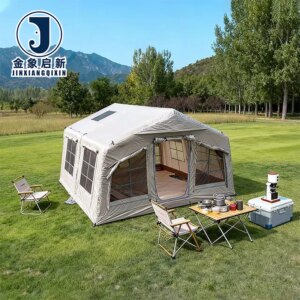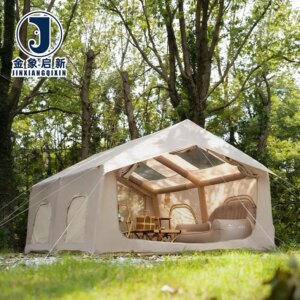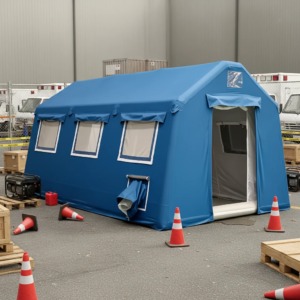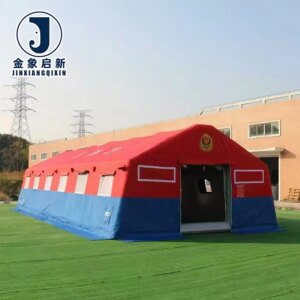
Material Process Control — Coating weight and adhesion are managed through dedicated lines and in-process QA, giving specifiers reliable batch-to-batch consistency for inflatable tent fabric orders.
Technical Specifications
| Parameter | Value |
|---|---|
| Product Type | Inflatable Tent Fabric |
| Core Material | Oxford Waterproof Fabric |
| Waterproof Rating | ≥10,000mm H2O |
| Waterproof Durability | 5000 cycles of water pressure testing |
| Temperature Range | -30°C to 70°C |
| UV Treatment | UPF 50+ (test basis not stated in source) |
| Tensile Strength | ≥300N/5cm (test standard not stated in source) |
| Tear Strength | ≥150N (test standard not stated in source) |
| Construction | Single Layer |
| Capacity | 4-6 Person |
| Dimension Tolerance | ±2cm |
| Material Thickness Tolerance | ±0.1mm |
| Key Features | Automatic Opening, Four-Season Design, Extended Type |
| Customization Service | OEM & ODM, sample customization, pattern printing |
| Standards | ISO 9001, ISO 14001, ISO 45001, CE |
Application Suitability
| Application | Exposure & Requirement |
|---|---|
| Construction site temporary shelter | Continuous UV and rain exposure, rapid deployment, wind loading on inflated frame |
| Logistics mobile storage | Abrasion from loading and unloading, moisture ingress protection for goods |
| Emergency preparedness structures | Immediate inflation, four-season temperature swings, prolonged outdoor storage before use |
| Outdoor industrial events | High foot traffic, weather unpredictability, visual consistency across multiple units |
| Temporary workspace in remote locations | Extreme temperature variance, limited on-site repair capability, transport abrasion |
What "UPF 50+" Actually Means Without a Test Standard Behind It
A UV rating on a data sheet only protects your project when the test method is named and reproducible.
Specifiers sourcing inflatable tent fabric frequently encounter UV claims stated as a single number with no reference to the laboratory protocol used to derive it. This creates a gap between what the quotation promises and what a site inspector can verify upon delivery. When an inflatable structure fails prematurely in high-altitude or desert deployment, the root cause often traces back to additive packages that were never tested under the spectral conditions the fabric will actually face. [NEED_CITE: ISO 105-B02 or AATCC 16 methods for UV degradation testing of coated textiles]
Coating Integrity Under Inflation Pressure
Inflatable tent fabric operates under constant internal air pressure, meaning every square metre of coated Oxford material carries a sustained mechanical load that static shelters never experience. The coating must adhere to the base fabric without micro-cracking as the structure flexes under wind gusts or temperature-driven pressure changes. Single-layer construction concentrates all waterproofing and structural responsibility onto one coated interface, making the bond between Oxford weave and coating compound the most critical junction in the entire assembly.
Thermal Boundaries for Four-Season Deployment
A stated temperature range of -30°C to 70°C defines the operational envelope where the coating remains flexible at the low end and does not soften or tack at the high end. Below the lower threshold, PVC-based coatings tend to embrittle, and inflation stress concentrates at fold lines and welded seams. Above the upper boundary, the surface can become tacky, attracting particulate contamination and reducing light transmission if the structure uses translucent panels. [NEED_CITE: low-temperature impact test methods for PVC coated fabrics per DIN EN 1876-1]
Reading the Strength Numbers in Context
Tensile strength at ≥300N/5cm and tear strength at ≥150N indicate how the Oxford base fabric resists both uniform stretching load and localised propagation of a cut or nick. For inflatable structures, tear resistance matters more than tensile because inflation loads distribute evenly across the membrane, whereas a single puncture from site debris or transport handling initiates a tear path. The relationship between base fabric denier, weave density, and coating penetration depth determines whether a nick stays localised or runs across a panel. The absence of a named test standard in the current data means these figures should be confirmed against the test method your market requires — such as ISO 1421 for tensile or ISO 13937 for tear — before finalising a bulk specification.
The Specification Gaps That Surface After Delivery
Buyers who approve a sample made from one production batch and then receive bulk rolls from another often discover colour drift that becomes visible only when adjacent panels are inflated side by side. Welded seams on inflatable tent fabric fail most frequently where the inflation load creates repeated flex cycles, and if the heat-sealing temperature was set for a different coating formulation, the bond line degrades before the fabric itself does. GSM discrepancies between quotation and arrival mean the fabric is lighter than specified, which directly reduces both the air-holding capacity of the inflatable beam and the overall rigidity of the deployed structure. [NEED_CITE: common failure modes in welded seams of coated technical textiles]
Why Specifiers Place Repeat Orders Here
Nearly 30 years of focused coated-fabric production means the process variables that affect inflatable tent fabric — coating weight, oven temperature, line speed — are managed from institutional experience rather than trial and error. Three full production lines with 36 sets of professional equipment provide the capacity to run bulk roll orders without splitting production across different machines that may introduce subtle variation. A 10-person R&D team handles material selection and sample development, so custom width, colour, or pattern printing requests move from inquiry to physical sample within days rather than weeks. Dedicated QA/QC at every production stage, with 100% inspection before shipment, catches GSM and colour deviations before the rolls leave the facility. ISO 9001, ISO 14001, ISO 45001, and CE certifications cover the management systems behind these production controls.
Documentation & Verification
- Material specification sheet stating Oxford base fabric type, coating compound, colour reference, and waterproof rating
- Test report for UV resistance citing the specific test method used to derive the UPF value
- ISO 9001, ISO 14001, ISO 45001, and CE certificates covering production facility management systems
- Pre-shipment inspection record with batch-specific GSM, tensile, and tear data per roll
- Roll packing list with gross and net weight per roll for container loading verification
- Certificate of origin and customs documentation for destination-country import compliance
Fabrication, Handling & Storage
- Heat-seal temperature and dwell time must match the Oxford coating formulation — request the recommended welding window before fabrication
- Store rolls vertically or on wide-diameter cores to prevent permanent creasing in the single-layer Oxford construction
- Inflate test panels after welding to verify seam integrity before committing to full production runs
- Use compatible PVC-based repair adhesive for field patches on the Oxford waterproof coating surface
- Allow cold-stored rolls to reach ambient temperature before unrolling to avoid coating micro-cracking
- Plan panel cutting layout to minimise off-cuts from the available roll width, especially on extended-type tent designs
Moving from Inquiry to Confirmed Specification
Tell us the deployment environment your inflatable structures will face — altitude, typical temperature range, and expected wind loading — so we can align the coating formulation and Oxford base fabric weight to the actual mechanical and thermal demands. If your destination market has specific fire-classification or UV-test-method requirements, state the standard by name so our R&D team can reference it during sample development. Confirm whether you need rolls for your own fabrication line or finished cut-and-welded panels, and indicate your annual volume to determine production scheduling.
Frequently Asked Questions
Q: How do I confirm the GSM and coating weight when the rolls arrive?
A: We supply a pre-shipment inspection record showing measured GSM and coating weight for each roll in your order. On arrival, you can cross-check using a standard fabric scale and compare against the stated values. Any deviation outside the agreed tolerance is flagged before dispatch through our 100% inspection protocol.
Q: What UV test method should I specify for outdoor inflatable structures?
A: The UV treatment is currently listed as UPF 50+, but the test basis is not stated. We recommend specifying either ISO 105-B02 or AATCC 16 depending on your market, and we will produce samples treated and tested to that method so you have a verifiable report tied to the fabric batch.
Q: Which tensile and tear test standards apply to inflatable tent fabric?
A: The current data cites ≥300N/5cm tensile and ≥150N tear without naming the test standard. For inflatable structures, ISO 1421 for tensile and ISO 13937 for tear are widely accepted. Confirm the standard your project requires so we can align testing accordingly.
Q: How does batch-to-batch colour consistency work across multiple rolls?
A: Each production run uses matched coating batches with in-process colour checks. Our pre-shipment inspection includes a colour-comparison step against the approved reference. If your order spans multiple production runs, specify that all rolls must fall within the same Delta-E tolerance band.
Q: What lead time applies to custom width, colour, or pattern printing?
A: Custom specifications require sample development first, which our R&D team typically completes within days. Once you approve the sample, bulk production lead time depends on order volume and current line scheduling. Confirm your required width, colour reference, and quantity early to lock your production window.