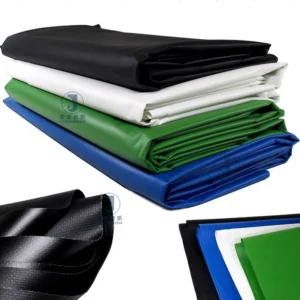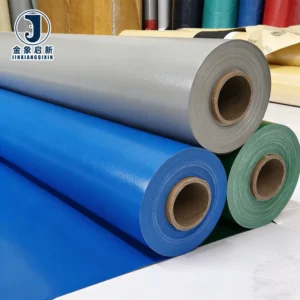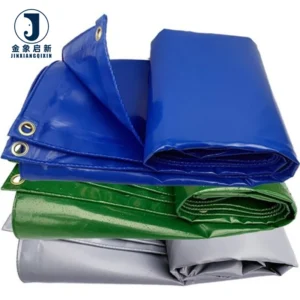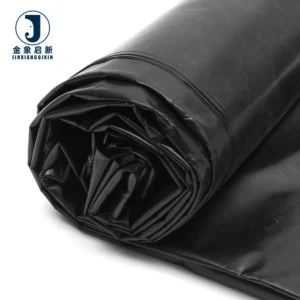
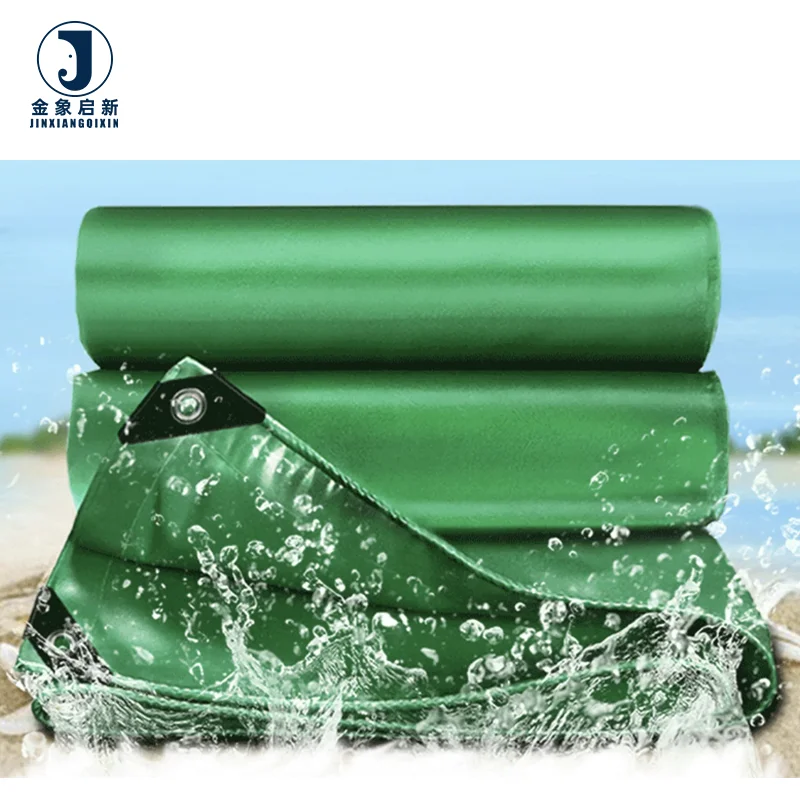
Coating Adhesion Control — every roll is coated using matched laminated or hot-melt technology to maintain peel strength at the weld line, verified at production stage before dispatch.
Technical Specifications
| Parameter | Value |
|---|---|
| Product Type | PVC Coated Tarpaulin Roll |
| Material | PVC + High-strength polyester mesh fabric |
| Coating Technology | Laminated technology & Hot-melt coating technology |
| Weight Options | 250GSM / 300GSM / 350GSM / 400GSM / 420GSM / 450GSM / 500GSM / 550GSM / 560GSM / 600GSM / 650GSM / 680GSM / 750GSM / 950GSM / 1000GSM |
| Total Thickness Options | 0.32mm / 0.35mm / 0.4mm / 0.45mm / 0.5mm / 0.65mm |
| Base Fabric Denier | 500D×500D / 500D×1000D / 840D×840D / 1000D×1000D / 2000D×2000D |
| Weave Density | 15×15 / 18×18 / 18×25 / 20×20 / 23×24 / 30×17 / 30×30 |
| Roll Size | 2m width × 75m length / 2.1m width × 50m length |
| Color Options | Blue / Red / Yellow / Light blue / Grey (Customizable) |
| Key Features | Cold crack resistance, anti-mildew, anti-static treatment (grade not stated), waterproof, UV resistant (test basis not stated), flame retardant (grade not stated) |
| Service Life | 3-7 years under normal use (source claim — no test basis provided) |
Application Suitability
| Application | Exposure & Requirement |
|---|---|
| Truck curtain cover | Constant flexing at fold points, road debris abrasion, UV exposure, weld seam integrity under tension |
| Tent and awning fabric | Prolonged sun exposure, wind-driven rain, repeated erection and dismantling stress on seams |
| Fish tank and pool liner | Permanent water contact, hydrostatic pressure, puncture risk from substrate irregularities |
| Cargo ship cover | Salt-laden air, heavy weather, prolonged UV exposure, tie-down point stress |
| Liquid storage tank | Chemical contact with stored liquid, seam watertightness, ground abrasion beneath |
| Push and pull tent | Repeated mechanical folding, abrasion at frame contact points, seasonal UV load |
Why GSM Alone Does Not Tell You How Strong This Fabric Is
The base fabric denier and mesh density determine real-world tensile and tear behaviour — GSM without these values leaves you guessing what you are actually buying.
I have watched fabricators specify a PVC coated tarpaulin roll purely on weight, only to discover on the cutting table that two rolls at the same GSM handle completely differently because the base fabric construction was swapped. A 500GSM roll woven from 500D×1000D yarn at 20×20 density will tear and stretch very differently from a 500GSM roll made with 840D×840D at 18×18. The coating adds weight, but the polyester mesh underneath carries the mechanical load. [NEED_CITE: relationship between base fabric denier and tear strength in PVC coated polyester fabrics per ISO 1421]
Technical buyers who rely on GSM as the sole procurement metric routinely receive material that meets the scale but fails at the weld line or flexes too easily in service. This PVC coated tarpaulin roll range maps every weight option to its specific denier and mesh count so you can evaluate the full construction.
How Laminated and Hot-Melt Coating Affect Fabric Performance
The coating method chosen for a PVC coated tarpaulin roll directly controls how the PVC layer bonds to the polyester mesh. Laminated technology bonds pre-formed PVC film to the base fabric under heat and pressure, producing a smooth surface with consistent coating thickness across the roll. Hot-melt coating applies molten PVC directly to the mesh, allowing the compound to penetrate the yarn interstices for stronger mechanical anchorage. Fabricators working with high-frequency welding often prefer hot-melt construction because the deeper coating penetration supports cleaner, more consistent weld seams.
Base Fabric Denier and the Tearing Envelope
Denier defines the thickness of each individual polyester yarn in the warp and weft. A 1000D×1000D construction uses heavier yarns in both directions, yielding higher baseline tear resistance than 500D×500D at the same mesh count. When a puncture or cut initiates in the field, the tear must propagate through successive yarns — heavier denier yarns absorb more energy before breaking. For applications like truck side curtains or tensioned tent structures where local damage is likely, selecting a higher denier from the PVC coated tarpaulin roll range reduces the risk of a small cut becoming a full panel failure. [NEED_CITE: tear propagation mechanics in woven coated fabrics per DIN 53363]
Reading the Grade Matrix: Weight, Denier and Density Together
The grade matrix ties every GSM option to a specific base fabric denier and weave density. At the lighter end, 250GSM sits on 500D×500D yarn at 20×20 mesh — a tight weave with finer yarns, suited to applications where drape and flexibility matter more than ultimate tear load. Moving through the range, 500GSM is available in three distinct constructions: 840D×840D at 18×18 for a balance of weight and tear resistance, 500D×1000D at 20×20 where the heavier weft yarn resists crosswise stress, and an enforced 1000D×1000D at 20×20 for maximum mechanical performance at that weight class. At the upper end, 1000GSM on 1000D×1000D at 30×30 delivers the densest weave in the range, concentrating more yarn crossings per unit area for applications demanding both tensile and tear margins. The thickness options from 0.32mm to 0.65mm track with the coating weight applied over each base construction. Selecting a PVC coated tarpaulin roll grade means choosing the intersection of these three parameters — not weight alone.
What Happens When the Wrong Grade Reaches the Weld Line
Fabricators who specify solely on price per kilogram often discover the cost downstream. A roll with lighter base fabric than expected will produce weld seams that fail before the body of the fabric does — the coating melts and bonds, but the underlying mesh lacks the tensile continuity to hold the joint under flex load. I have seen finished truck covers returned from the field with seams peeling apart at the fold lines while the main panels remained intact. Colour inconsistency between rolls compounds the problem when panels from different rolls are welded side by side, producing visible shade bands across the finished product. [NEED_CITE: weld seam failure modes in PVC coated polyester tarpaulins under cyclic flex loading]
Why Fabricators Source PVC Coated Tarpaulin Roll Stock Here
Three full production lines with dedicated coating stations allow laminated and hot-melt runs to be scheduled independently, preventing cross-contamination between coating methods. Each roll passes through in-process QA checks on coating weight and adhesion before it is wound, so the GSM quoted is the GSM produced. A ten-person R&D team develops custom colour matches and sample rolls within days rather than weeks, letting fabricators confirm weld parameters before committing to volume. The grade matrix is held in stock across multiple denier and density combinations, reducing the need to accept a substitute construction to meet a deadline. Pre-shipment inspection verifies weight, colour and coating integrity roll by roll, not by batch sampling.
Documentation & Verification
- Material specification sheet listing GSM, base fabric denier, mesh density and coating method per roll
- UV and flame retardant test reports provided where applicable — confirm required grade before specifying
- ISO and CE certificates available on request for compliance submissions
- Pre-shipment inspection record with individual roll weight verification against stated GSM
- Roll packing list with net weight and roll count matching container loading plan
Fabrication, Handling & Storage
- Set high-frequency welder dwell time to suit coating method — hot-melt and laminated coatings respond differently to heat input
- Allow roll to acclimatise to workshop temperature before unrolling to prevent cold crack damage at low temperatures
- Store rolls upright on pallets to avoid flat spots that distort the polyester mesh and affect downstream cutting accuracy
- Match sewing thread weight to base fabric denier — heavier denier constructions require thicker thread for balanced seam strength
- Use compatible PVC-based repair adhesive for field patching to maintain coating continuity on waterproof applications
- Plan cutting layout around roll width of 2m or 2.1m to minimise offcut waste and transverse weld seams
Requesting a Specification Match
Share the end-use application, expected mechanical and environmental exposure, and any market-specific compliance requirements such as fire classification or anti-static standards. Specify the coating method preference — laminated or hot-melt — along with target GSM, denier and colour. Let us know whether you need rolls at stock width and length or custom dimensions, and whether sample rolls are required to validate weld and fabrication parameters before volume commitment.
Frequently Asked Questions
Q: How can I verify the GSM and base fabric construction on delivery?
A: Each shipment includes a material specification sheet stating the GSM, base fabric denier, mesh density and coating method. Cross-check by weighing a cut sample of known area against the stated GSM, and confirm denier by examining the yarn thickness under magnification. Pre-shipment inspection records document weight verification roll by roll before dispatch.
Q: What is the difference between laminated and hot-melt coating for welding performance?
A: Laminated coating bonds a pre-formed PVC film to the mesh, giving a uniform surface that welds consistently at standard high-frequency settings. Hot-melt coating penetrates the mesh more deeply, producing stronger mechanical adhesion that can require adjusted welder power and dwell time. We recommend running sample welds on both constructions to determine optimal machine settings for your fabrication process.
Q: Can I get flame retardant or anti-static treatment on any grade in this range?
A: Flame retardant and anti-static treatments are available across the PVC coated tarpaulin roll range, but specific grades and test standards must be confirmed against your market requirements. Request the applicable test report before specifying — the grade required for building interiors differs from that required for mining ventilation or transport applications.
Q: How is colour consistency maintained when I order multiple rolls?
A: Colour is matched to a reference standard at the compounding stage, and rolls within a single production run are coated from the same batch. Pre-shipment inspection includes a visual comparison of adjacent rolls under controlled lighting. For projects where multiple rolls will be installed side by side, specify that all rolls must come from the same production batch to minimise shade variation.
Q: What documentation accompanies a roll stock shipment?
A: Each shipment includes a material specification sheet per roll, ISO and CE certificates on request, pre-shipment inspection records, a detailed roll packing list with count and weight, and a certificate of origin. UV and flame retardant test reports are supplied where the specified grade has been tested to a published standard.