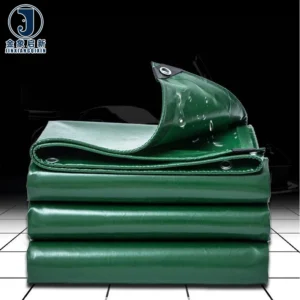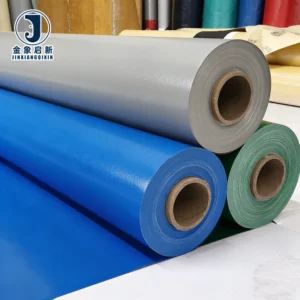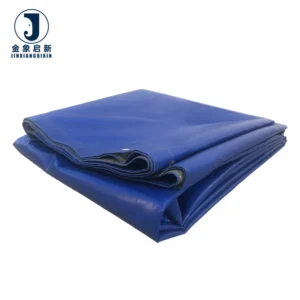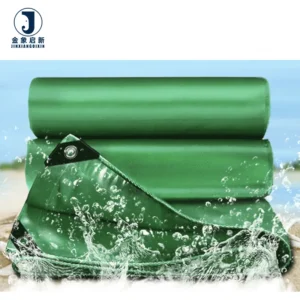
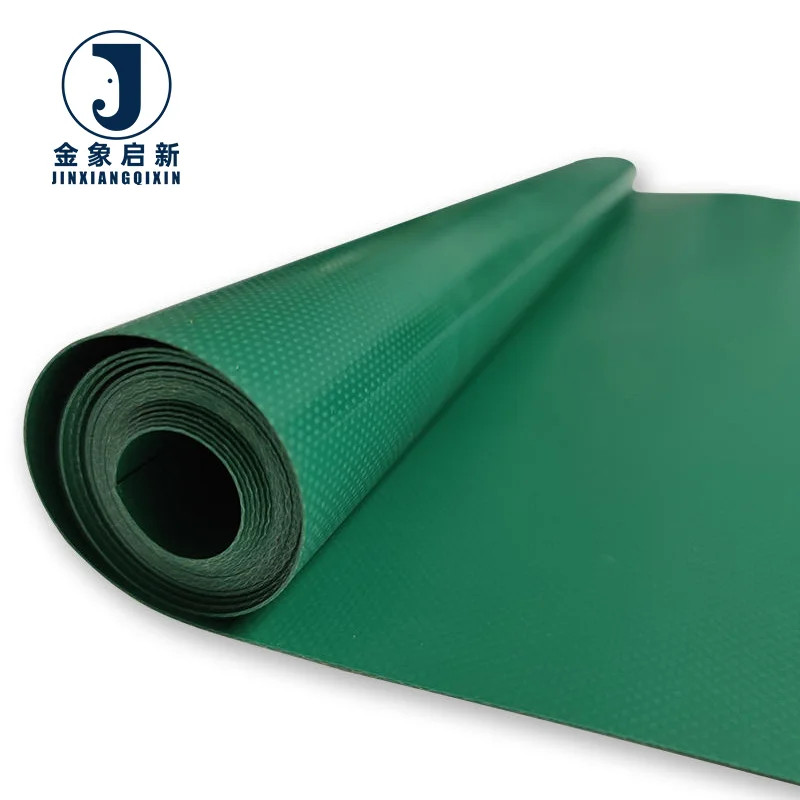
Coating weight discipline — every PVC coated tarpaulin roll shipswith a pre-shipment GSM verification record matched to the specification sheet.
Technical Specifications
| Parameter | Value |
|---|---|
| Product Type | PVC Coated Tarpaulin Roll Knife Coated |
| Base Fabric | Polyester |
| Yarn Count Options | 500D×840D / 500D×1000D / 1000D×1000D / 1000D×1300D / 1300D×1300D / 1000D×2000D |
| Mesh Density | 20×20 / 30×19 / 30×15 |
| Weight Range | 350 / 400 / 420 / 500 / 600 / 650 / 750 / 900 GSM |
| Thickness Range | 0.29 mm – 0.65 mm |
| Tensile Strength (Warp) | 1650 N – 3900 N (grade-dependent, test basis not stated) |
| Tensile Strength (Weft) | 1600 N – 3500 N (grade-dependent, test basis not stated) |
| Brittle Temperature | ≤ −50 °C to −60 °C |
| Softening Temperature | ≥ 80 °C |
| Melting Point | 212 °C |
| Density Parameter | 1.15 – 2.00 g/cm³ |
| Tensile Strength (Material) | 50 – 80 MPa (test basis not stated) |
| Edge Finishing | High-temperature heat-sealed seamless edge wrapping |
| Eyelet Options | 3 cm enlarged aluminum alloy buttonhole |
| Rope | 5 mm thick, single continuous length without splicing |
| Corner Reinforcement | Reinforced corners on all sides |
| Key Features | Waterproof, water resistant, flame retardant (grade not stated), anti-UV (test basis not stated) |
| Packaging | Roll packing / bale packing / carton |
| Certifications | ISO, CE |
Application Suitability
| Application | Exposure & Requirement |
|---|---|
| Truck side curtains and trailer covers | Constant flexing at load points, road abrasion, UV exposure, high-frequency tension cycles |
| Awning and tent fabric | Permanent outdoor weathering, wind uplift load, seasonal deployment stress |
| Tension and membrane structures | Sustained biaxial tension, thermal expansion cycles, weld seam integrity |
| Machine and equipment covers | Contact with lubricants and coolants, repeated folding and handling |
| Balcony and window rainproof covers | Vertical water run-off, wind-driven rain, long-term UV exposure |
| Garden furniture and plant covers | Condensation trapping, soil contact, moderate puncture risk |
Why the Denier Number on Your Quotation Might Not Match What Arrives
The base fabric construction defines actual load capacity — not the headline GSM printed on the invoice.
A technical buyer specifying PVC coated tarpaulin roll material for a side curtain or membrane structure often discovers that two rolls quoted at the same GSM behave very differently under tension. The reason sits inside the weave: a 1000D×1000D base at 20×20 density carries load through thicker individual yarns, while a 500D×840D base at 30×19 density distributes force across more intersecting points. Both can be coated to the same total weight, yet their tear propagation resistance and weld-line behaviour diverge sharply once installed. [NEED_CITE: tensile and tear test methods for coated fabrics per ISO 1421]
How Yarn Count and Mesh Density Govern Real-World Performance
When selecting PVC coated tarpaulin roll material, the yarn count and mesh density together determine how load transfers through the base fabric. A higher denier yarn resists individual strand breakage under point loads, while a tighter mesh count spreads stress across more intersections before a tear propagates. This is why a 1300D×1300D fabric at 20×20 density shows markedly higher warp and weft tensile readings than a 500D×1000D at 30×15, even when both receive the same coating weight. For fabricators cutting and welding rolls into finished covers, understanding this relationship prevents under-specifying for high-flex applications.
Coating Method and Its Effect on Weld Integrity
Knife coating applies PVC in controlled layers directly onto the polyester base, forcing compound into the weave interstices rather than sitting on the surface. This produces higher peel strength between coating and base fabric compared to laminated alternatives, which matters most at the heat-welded seams where flex load concentrates. When a side curtain flexes at the buckle point or a membrane structure deflects under wind, the weld line experiences peel forces that can separate a poorly bonded coating long before the base fabric reaches its tensile limit. [NEED_CITE: peel strength test methods for PVC coated polyester fabrics]
Reading the Specification Sheet Beyond the GSM Figure
GSM alone tells you total weight per square metre but not how that weight is distributed between base fabric and coating. A 650 GSM roll built on 1000D×1000D yarn at 0.55 mm thickness has a different structural character than a 650 GSM roll on 500D×840D yarn at a thinner profile with heavier surface coating. The former offers superior tear resistance and puncture tolerance; the latter may deliver better surface smoothness for printing. Tensile strength values across the grade range — from 1650 N to 3900 N in the warp direction — reflect this interplay of yarn mass, weave density, and coating contribution rather than weight alone.
What Happens When Roll Stock Specifications Are Misread
A fabricator who selects roll stock based on GSM without checking the underlying denier and density risks weld failures at flex points. The coating may be thick enough to meet weight targets while the base fabric remains too light for the cyclic loading a truck curtain endures daily. Similarly, specifying flame retardant treatment without confirming the grade against local fire safety standards can result in rejected installations — the material carries the additive, but the test report does not match the jurisdiction’s classification requirement. Colour variation between rolls in the same order compounds the problem when panels are installed side by side on a visible structure. [NEED_CITE: common causes of coated fabric field failures in transport and membrane applications]
Why Technical Buyers Source This PVC Coated Tarpaulin Roll Material Here
Three full production lines and 36 sets of professional equipment support bulk roll output with consistent coating weight across the run. A 10-person R&D team develops material samples within days, allowing specification of denier, density, GSM, and surface treatment before production commitment. Dedicated QA/QC operates at every stage — base fabric incoming inspection, in-process coating weight checks, and 100% pre-shipment verification against the quoted specification. Nearly 30 years of coating process control means the relationship between yarn selection, coating formulation, and finished roll performance is documented rather than assumed.
Documentation & Verification
- Material specification sheet stating exact GSM, base fabric denier, weave density, and coating weight per roll
- Test reports for UV and flame retardant grades supplied against specific batch and grade where applicable
- Pre-shipment inspection record confirming GSM, tensile values, and colour match against the purchase order
- ISO and CE certificates with scope covering coated fabric manufacture
- Roll packing list with individual roll weights and dimensions for container loading verification
- Certificate of origin and customs documentation for international shipment
Fabrication, Handling & Storage
- Heat-weld PVC coated tarpaulin roll material using temperature and dwell time matched to the specific GSM grade to avoid coating burn-through on lighter weights
- Reinforce eyelet positions with additional PVC patches, as the 3 cm aluminum alloy buttonholes concentrate load into the base fabric at tie-down points
- Store rolls horizontally on racking to prevent flat-spotting on the outer wrap, which creates permanent crease lines visible after unrolling
- Allow cold-stored rolls to reach ambient temperature before unrolling to prevent cracking at the brittle threshold of −50 °C
- Use mild detergent without solvents for cleaning, as aggressive chemicals can degrade the PVC surface and affect the anti-UV treatment layer
- Plan cutting layouts to maximise yield from the roll width, reducing the number of welded seams in the finished panel
What to Include in Your Enquiry
Provide the end-use application and the primary exposure conditions — flex frequency, wind load, UV intensity, or chemical contact — so that the correct denier and GSM grade can be recommended. State any fire safety classification required by your market, as flame retardant grades must be matched to specific test standards. Indicate whether you need roll stock only or finished cut sizes with edge finishing, eyelets, and reinforcement, along with the target colour reference and annual volume.
Frequently Asked Questions
Q: How do I choose the right GSM and denier for my application?
A: GSM indicates total weight but does not define structural strength alone. For high-flex applications such as truck side curtains, select a higher denier base fabric such as 1000D×1000D with a matching GSM to ensure tear resistance at weld points. For static covers or awnings, a lighter denier at the same GSM may suffice. Share your application details so we can recommend the appropriate grade combination.
Q: Can you confirm the flame retardant grade meets my market’s fire code?
A: Flame retardant treatment is available in multiple grades. We supply the test report tied to the specific batch and grade produced. Confirm the fire safety classification your jurisdiction requires — such as B1, M2, or NFPA 701 — and we will match the formulation and provide the corresponding documentation before production.
Q: How is batch-to-batch colour consistency controlled across rolls?
A: Colour is matched against a reference standard at the coating stage, with in-process checks during the production run. Rolls within a single order are produced consecutively to minimise variation. If your installation places panels side by side, request the pre-shipment colour inspection record to verify consistency before dispatch.
Q: What are the available widths and MOQ for custom specifications?
A: Stock widths and standard GSM grades are available with lower minimums. Custom widths, colours, and functional treatments such as specific flame retardant grades require a longer lead time and a production minimum tied to the coating line batch size. Submit your required width and annual volume for a specific quotation.
Q: How does coating adhesion affect heat welding during fabrication?
A: Knife-coated construction forces PVC into the polyester weave interstices, producing higher peel strength than laminated alternatives. This means welded seams resist separation under flex load. Adjust weld temperature and dwell time to the specific GSM grade — heavier grades require more energy input to achieve full fusion without degrading the coating surface.