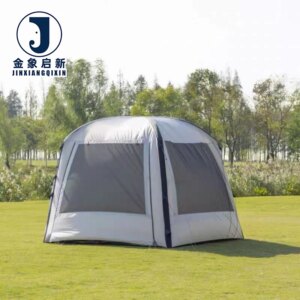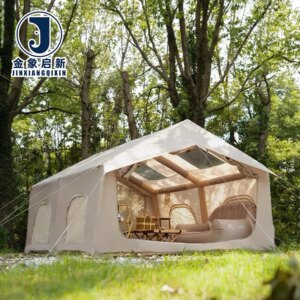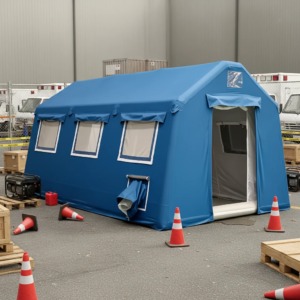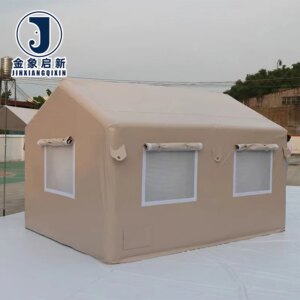
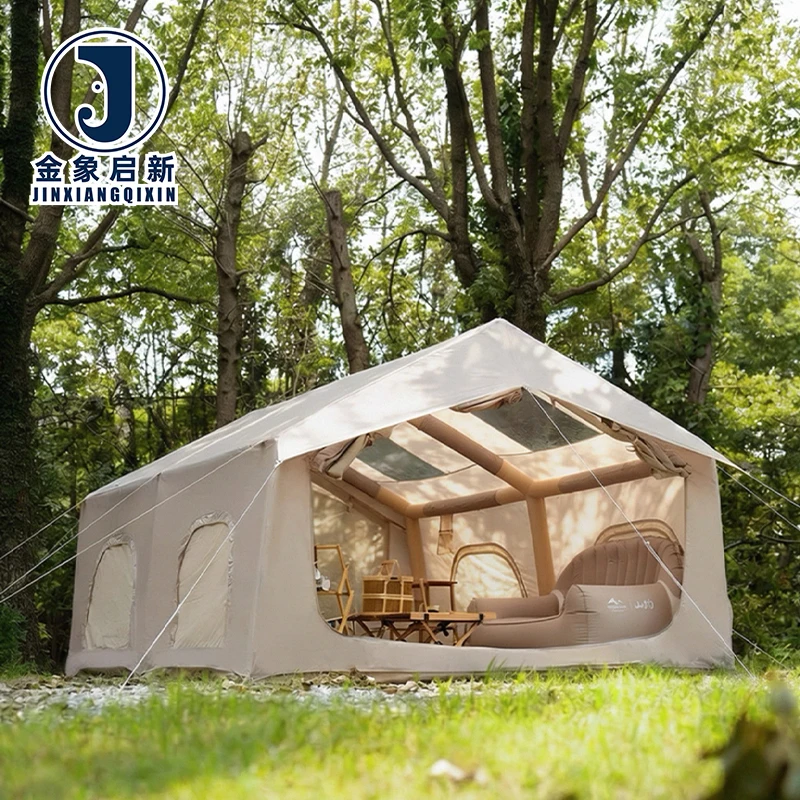
Process-controlled coating — Nearly 30 years focused on PVC coated fabric ensures consistent adhesion between the base fabric and coating layer, directly impacting inflatable tent performance in the field.
Technical Specifications
| Parameter | Value |
|---|---|
| Product Type | Inflatable Tent Fabric |
| Core Material | PVC Tarpaulin |
| Product Form | Single Layer Inflatable Tent |
| Waterproof | Yes |
| UV-Resistant | Yes (test basis not stated in source) |
| Tear-Resistant | Yes (grade not stated in source) |
| Flame Retardant | Yes (grade not stated in source) |
| Anti-Static | Yes (standard/surface resistance not stated in source) |
| Customization | Sample customization, pattern printing, OEM & ODM services |
| Quality Control | Full-process QA & QC inspection |
| Certifications | ISO 9001, ISO 14001, ISO 45001, CE |
Application Suitability
| Application | Exposure & Requirement |
|---|---|
| Emergency response command centers at construction sites | Extended outdoor UV exposure, rapid inflation cycles, structural tension on welded seams |
| Temporary storage facilities for disaster relief supplies | Permanent moisture contact, load-bearing stress on roof panels, potential chemical contact from stored goods |
| Equipment maintenance shelters in remote locations | Abrasion from wind-driven particulates, thermal cycling between day and night, field repair requirements |
| Rapid deployment field stations for infrastructure inspection | Transport handling stress, repeated folding and unfolding, exposure to varied climates |
What Happens When "Flame Retardant" Has No Grade Behind It
An inflatable shelter fails a fire inspection on site because the fabric certificate does not match the local building code requirement.
Purchasing inflatable tent fabric with a generic flame-retardant claim creates a compliance gap that often surfaces only at the project inspection stage. A PVC Inflatable Tent Fabric manufacturer must be able to state which test standard the treatment meets and provide batch-traceable documentation. Without that traceability, the entire shelter installation risks rejection, rework, or forced replacement after deployment [NEED_CITE: fire safety classification standards for temporary structures by region].
Coating Weight and Base Fabric Density as a System
The tensile and tear performance of inflatable tent material depends on the interaction between base fabric denier, weave density, and coating weight — not on any single parameter in isolation. A heavier coating does not compensate for a loosely woven base, and a tight weave without adequate coating penetration leads to delamination under repeated inflation pressure. When sourcing PVC inflatable tent fabric, request the complete material specification sheet showing base fabric construction alongside coating method and applied weight so that the relationship between these variables is clear before production begins.
Weld Line Integrity in Inflatable Structures
Inflatable tents concentrate mechanical stress at every welded seam, particularly at junctions where air tubes meet the main body panel. The coating formulation and its adhesion to the base fabric determine whether the weld holds under cyclic pressurisation or fails prematurely at the heat-affected zone. Hot-air welding parameters must be matched to the specific PVC compound used [NEED_CITE: hot-air welding temperature profiles for PVC coated polyester]. Material suppliers should provide recommended welding temperature, speed, and pressure settings validated against their own coating formulation to prevent seam failure in finished inflatable shelters.
Reading the Specification Sheet Beyond GSM
GSM alone tells you how much material is present per square metre but reveals nothing about how that weight is distributed between base fabric and coating. Two fabrics at the same GSM can behave entirely differently if one uses a higher-denier yarn with a lighter coat while the other uses finer yarn with a heavier coat. The base fabric denier and thread count govern tear propagation resistance, while the coating weight governs waterproofing, UV shielding, and surface abrasion resistance. For inflatable tent applications, the balance between these two components determines whether the material survives repeated inflation and deflation without cracking at fold lines or delaminating at stressed panels. Available in flame retardant grades — confirm the grade required for your market.
The Hidden Cost of Inconsistent Colour Between Rolls
When a large inflatable structure order spans multiple rolls and those rolls arrive with visible shade variation, the installed panels show banding once inflated side by side. This forces the buyer into a difficult choice: accept a cosmetically compromised installation or reject the batch and face project delays. Batch-to-batch colour control must be managed through standardised pigment dosing and verified against a reference swatch before each production run ships. Without this discipline, the cost of re-ordering and re-deploying far exceeds any savings from the original purchase [NEED_CITE: colour consistency measurement methods for coated textiles].
Why Source PVC Inflatable Tent Fabric Here
Three full production lines and 36 sets of processing equipment support bulk roll output without sacrificing the coating consistency that inflatable structures demand. A 10-person R&D team handles material selection, sample development, and custom pattern printing, allowing buyers to validate performance before committing to volume production. Dedicated QA and QC staff inspect every production stage, with 100% pre-shipment verification against the agreed specification. ISO 9001, ISO 14001, ISO 45001, and CE certifications underpin the management system. Samples for custom requirements are typically developed within days, shortening the evaluation cycle for new inflatable tent projects.
Documentation & Verification
- Material specification sheet stating base fabric denier, coating method, and applied weight for each roll
- Test reports for UV resistance and flame-retardant grades, traceable to batch
- Pre-shipment inspection record confirming GSM, colour, and coating adhesion per roll
- Certificate of origin and customs documentation for international inflatable tent fabric shipments
Fabrication, Handling & Storage
- Hot-air welding temperature and speed must match the specific PVC coating compound to prevent seam delamination
- Store rolls vertically on pallets to avoid flat-spot compression marks on the coated surface
- Allow cold-stored rolls to reach ambient temperature before unrolling to prevent coating crack at fold lines
- Use mild pH-neutral cleaners on the PVC surface to preserve the coating finish and any applied treatments
- Plan panel cutting layout to minimise welded seams in high-stress zones of the inflatable structure
Preparing Your Inflatable Tent Fabric Enquiry
Provide the intended deployment environment, expected inflation frequency, and any fire safety or anti-static compliance requirements for your target market. Specify the roll width, colour references, and whether printed branding is needed on the outer surface. Confirm whether you require raw roll stock or pre-cut panels, and indicate your annual volume so that production scheduling and batch consistency can be planned accordingly.
Frequently Asked Questions
Q: What base fabric denier and coating weight options are available for inflatable tent applications?
A: The base fabric denier and coating weight are selected based on the structural demands of your inflatable design, including inflation pressure and panel span. Request a material specification sheet that states both values so you can evaluate tear resistance and coating durability together rather than relying on GSM alone.
Q: Which flame-retardant grades can be supplied, and what test standards do they meet?
A: Flame-retardant treatment is available in multiple grades suited to different regional fire safety codes. Confirm the specific test standard required for your market — such as DIN 4102, NFPA 701, or local building regulations — so that the correct grade is applied and documented with a batch-traceable test report.
Q: How is batch-to-batch colour consistency controlled across rolls for large inflatable structure orders?
A: Colour consistency is managed through standardised pigment formulation and verified against an approved reference swatch before each production run. Rolls within a single order are produced under matched dosing parameters to minimise shade variation that would be visible once panels are installed side by side.
Q: What are the hot-air welding and seam recommendations for PVC inflatable tent fabric?
A: Welding temperature, speed, and pressure must be matched to the specific PVC coating formulation used on the fabric. Request the supplier’s recommended welding parameters validated against their coating compound to ensure seam integrity under repeated inflation cycles and structural stress at tube junctions.