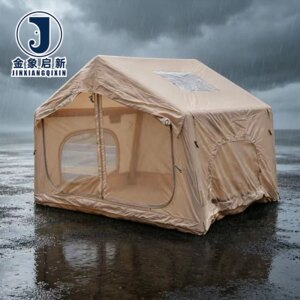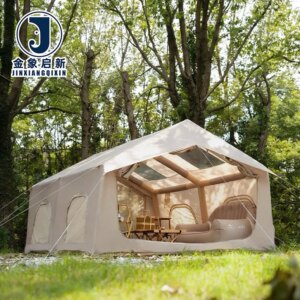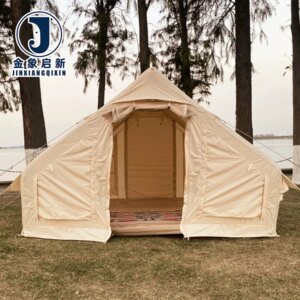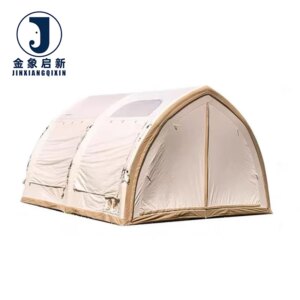
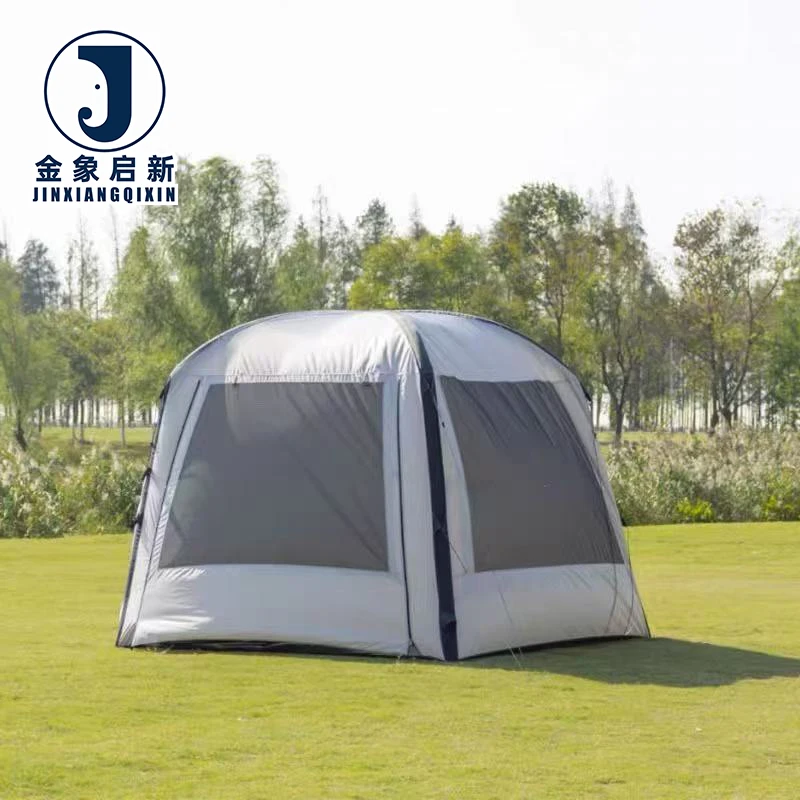
Precision Coating Control — Our 10-person R&D team validates coating adhesion and base fabric stability before every production run, ensuring consistent PVC inflatable tent performance across repeated inflation cycles.
Technical Specifications
| Parameter | Value |
|---|---|
| Product Type | PVC Inflatable Glamping Tent |
| Core Material | PVC tarpaulin |
| Capacity | 6-person |
| Season Rating | Four-season |
| Opening Mechanism | Automatic opening |
| Construction | Single-layer PVC |
| Key Features | Waterproof, tear-resistant |
| Fire Retardancy | Available in flame retardant grades — confirm the grade required for your market |
| UV Resistance | Available with UV-resistant treatment — request test basis for your exposure conditions |
| Anti-Static | Available in anti-static grades — specify the standard applicable to your site |
| Customization | OEM & ODM sample customization, pattern printing |
| Quality Standards | ISO 9001, ISO 14001, ISO 45001, CE |
Application Suitability
| Application | Exposure & Requirement |
|---|---|
| Commercial glamping campsites | Continuous UV exposure, seasonal temperature swings, guest turnover demanding rapid inflation and deflation |
| Outdoor hospitality and resort setups | Long-term weathering, wind loading on inflated structure, frequent cleaning and surface maintenance |
| Event infrastructure and festivals | Rapid deployment cycles, transport abrasion, short-duration high-visibility branding requirements |
| Industrial temporary shelters | Dust, chemical exposure, fire safety compliance on regulated work sites |
| Remote tourism operations | Extreme temperature fluctuation, limited repair facilities, extended outdoor service between storage periods |
Why "Waterproof" on the Label Does Not Guarantee a Dry Interior
A waterproof PVC inflatable tent depends on seam integrity under cyclic inflation pressure, not just coating continuity on the flat sheet.
Most fabric leaks do not originate from the coated surface. They appear at welded joints and valve seats where repeated pressurisation flexes the material beyond the coating’s bond strength. When the PVC inflatable tent fabric is specified by weight alone, without verifying coating adhesion and weld peel strength, operators discover water ingress during the first heavy rain after several inflation cycles [NEED_CITE: tensile and peel test methods for coated fabrics per ISO 1421]. Specifying PVC inflatable tent fabric by verified coating weight, base fabric construction, and documented weld testing closes this gap before the first tent reaches the campsite.
Base Fabric Density Determines More Than Weight
The structural behaviour of PVC inflatable tent fabric under internal pressure depends on the denier and weave density of the polyester base, not the total GSM alone. A heavier coating can mask a loosely woven base that stretches unevenly during inflation, creating stress concentrations at seam lines. Technical buyers evaluating PVC inflatable tent fabric should request base fabric specifications — yarn denier, warp and weft count per centimetre — alongside the finished weight to confirm the material will hold shape through hundreds of pressurisation cycles without progressive deformation.
Coating Adhesion and the Weld Line Problem
When inflated structures flex under wind load, the weakest point is typically where two panels are joined. If coating adhesion to the base fabric is insufficient, the weld itself may hold while the coating delaminates adjacent to the seam, creating a slow leak path that is difficult to diagnose in the field. Our PVC inflatable tent production process controls coating weight and curing temperature at each stage, and 24-hour inflation testing before shipment reveals delamination or weld weakness before the product leaves the factory [NEED_CITE: DIN 4102 fire classification and material test standards for building and temporary structures].
Reading the Specification Sheet Beyond GSM
A single GSM figure tells you the combined weight of base fabric and coating, but it does not distinguish between a heavy base with thin coating and a light base loaded with filler. For inflatable tent applications, the coating must be thick enough to seal the weave completely while maintaining flexibility at low temperatures. Knife-coated PVC delivers a more uniform layer with stronger mechanical bonding to the yarn compared to simple dip or calender methods, which directly affects how the material behaves when folded, transported, and re-inflated repeatedly. Anti-UV and flame retardant treatments can be incorporated during the coating stage — buyers should confirm the specific test standard their market requires before placing an order.
The Hidden Cost of Specifying on Price per Kilogram
When PVC inflatable tent fabric is selected primarily on unit cost, the compromise usually appears in coating thickness or base fabric density. Lighter coating reduces waterproofing reliability and accelerates UV degradation of the underlying yarn. Looser base weave lowers tear resistance, meaning a small puncture from transport handling can propagate rapidly under inflation pressure. Operators replacing failed tents mid-season absorb costs far exceeding the initial material saving, particularly when guest bookings are disrupted and temporary alternative accommodation must be arranged at short notice [NEED_CITE: common failure modes in inflatable membrane structures under cyclic loading].
What Makes This PVC Inflatable Tent Fabric Reliable
Deep process control over coating weight and adhesion is maintained across three full production lines, ensuring roll-to-roll consistency that fabricators depend on when cutting and welding multiple panels to identical dimensions. A dedicated 10-technician R&D team develops custom samples within days, adjusting material thickness, colour, and surface finish to match your project specification before bulk production begins. Every production run passes through staged QA and QC checkpoints, with 100 percent pre-shipment inspection including a sustained inflation leak test to confirm seam and valve integrity. OEM and ODM services cover pattern printing, size adjustments, and thickness modifications — each validated by sample before order confirmation. ISO 9001, ISO 14001, and CE certifications are maintained as active management systems, not displayed certificates.
Documentation & Verification
- Material specification sheet stating GSM, base fabric denier and weave density, and coating composition
- UV stability and flame retardant test reports issued against the specific grade supplied
- ISO 9001 and CE certificates referenced to the active management system scope
- Batch-specific pre-shipment inspection record including 24-hour inflation leak test results
- Roll packing list with net weight, gross weight, and roll identification for traceability
- Certificate of origin and customs documentation prepared per destination country requirements
Fabrication, Handling & Storage
- Set hot-air welding temperature to match the PVC coating thickness to avoid scorching or incomplete bonding
- Reinforce valve seat areas with additional PVC patches to distribute inflation stress evenly across the single-layer construction
- Store rolls horizontally on pallets to prevent permanent creasing that weakens the coating at fold lines
- Allow cold-stored PVC inflatable tent fabric to reach ambient temperature before unrolling to prevent low-temperature cracking
- Use mild detergent and soft cloth for cleaning; avoid solvents that dissolve the PVC coating surface
- Keep spare PVC patches and compatible adhesive on site for field repair of minor punctures between guest turnover
What to Include in Your Enquiry
To specify the correct PVC inflatable tent fabric for your operation, share your typical deployment climate, expected inflation cycle frequency, and any fire safety or anti-static standards your jurisdiction mandates. If you require custom colours, printed branding, or non-standard dimensions, provide artwork files and target quantities so we can confirm feasibility and develop a matched sample. Indicate whether you need finished tent units or raw fabric rolls for your own fabrication line, and note any third-party inspection requirements before shipment.
Frequently Asked Questions
Q: How do I verify the GSM of inflatable tent fabric matches the quotation when the roll arrives?
A: Request a pre-shipment inspection record that documents the measured weight per square metre for each roll in your batch. Upon receipt, cut a measured sample from the roll edge and weigh it on a calibrated scale. Any discrepancy beyond normal tolerance should be flagged before fabrication begins.
Q: Which fire-retardant grade should I specify for commercial glamping tents?
A: The required grade depends on your local jurisdiction and whether the structure is classified as temporary or semi-permanent. Common standards include B1 per DIN 4102, M2, and NFPA 701. Confirm the applicable standard with your local authority before ordering, and request a test report specific to the batch supplied.
Q: How is UV resistance tested, and what does it mean for outdoor service life?
A: UV resistance is evaluated through accelerated weathering tests that simulate prolonged sun exposure on the PVC coating. Request the specific test method and exposure duration documented in the test report. Actual field performance depends on local solar intensity, altitude, and seasonal variation.
Q: Why do welded seams sometimes fail before the fabric itself?
A: Weld failure typically results from incorrect temperature settings, insufficient pressure during joining, or coating adhesion that is too weak for the inflation flex cycle. Our 24-hour inflation test before shipment is designed to expose seam weakness under sustained pressure before the product leaves the factory.
Q: Can the tent dimensions and branding be customised without affecting fire-retardant compliance?
A: Custom sizes, colours, and pattern printing are available through our OEM and ODM service. Fire-retardant treatment is applied during the coating stage, so dimensional changes do not affect compliance. However, any additional printed inks or adhesives must also meet the specified fire standard — confirm this during sample approval.