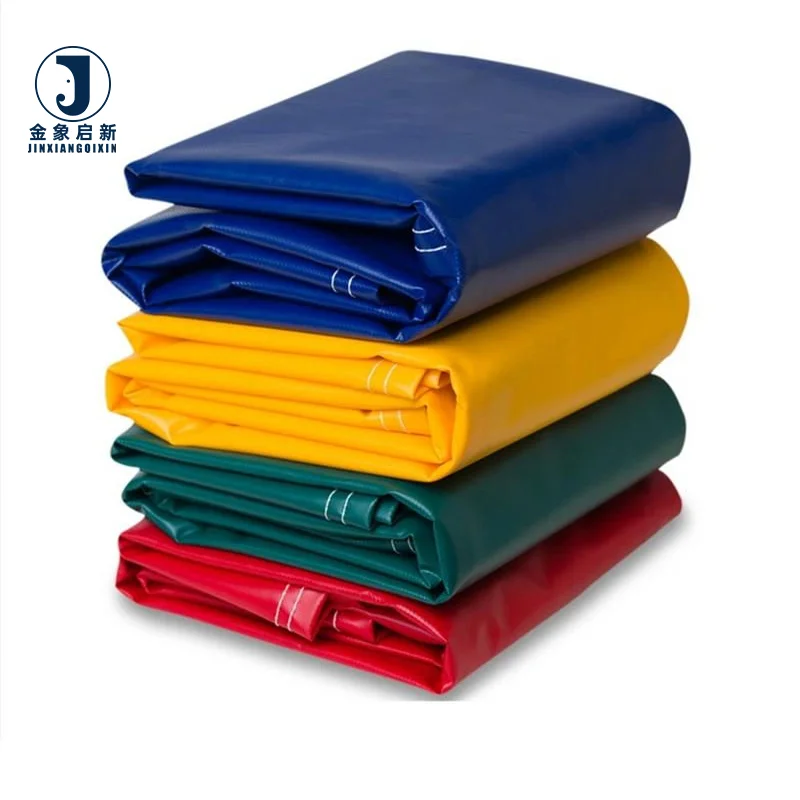
Precision Coating Control — Three full production lines with 36 sets of equipment deliver verified GSM consistency across every roll of PVC coated tarpaulin, ensuring what you specify is what arrives at your facility.
Technical Specifications
| Parameter | Value |
|---|---|
| Product Type | PVC Coated Tarpaulin |
| Material Composition | Polyester Base Fabric + Double-Sided PVC Coating |
| Weight Range | 350gsm – 900gsm (multiple grades available) |
| Yarn Count Options | 500D840D / 500D1000D / 1000D1000D / 1000D1300D / 1300D1300D / 1000D2000D |
| Thickness Range | 0.29mm – 0.65mm |
| Weave Density | 2020 to 3019 |
| Warp Tensile Strength | 1650N – 3900N |
| Weft Tensile Strength | 1600N – 3500N |
| Coating Method | High frequency hot melt, Hot air |
| Surface Finish | Smooth, leather-like texture |
| Key Features | Waterproof, Fire Retardant (grade not stated — confirm required grade), Anti UV (test basis not stated — request test report), Anti Mildew, Heavy Metal Free, Self Clean |
| Welding Methods | High frequency hot melt, Hot air, Sewing |
| Printing Capability | Customized pattern and branding |
| Edge Finishing | Heat sealed seamless edge wrapping with reinforced corners |
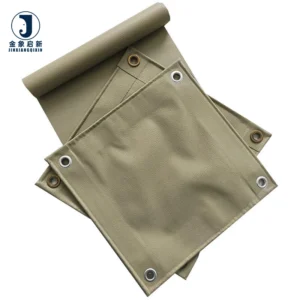
| Eyelet Specification | 3cm enlarged aluminum alloy buttonhole |
| Temperature Resistance | Brittle ≤ -50~-60°C, Softening ≥ 80°C, Melting 212°C |
| Certification | ISO, CE (specific certificate numbers not stated in source) |
Application Suitability
| Application | Exposure & Requirement |
|---|---|
| Truck and trailer side curtains | Constant flexing at fold points, road debris abrasion, prolonged UV exposure, weather cycling |
| Outdoor event tents and awnings | Extended sun exposure, wind uplift tension, rain pooling, rapid deployment and takedown wear |
| Construction site protection | Impact from falling debris, chemical splash from building materials, moisture penetration prevention |
| Inflatable and membrane structures | Internal air pressure loading, continuous tensile stress, sealed seam integrity under flex |
| Pallet and equipment covers | Warehouse dust and moisture barrier, forklift handling abrasion, long-term storage protection |
PVC Coated Tarpaulin Material Properties and Coating Technology: What the Specification Sheet Does Not Tell You
The weight per square meter printed on a quotation means nothing if the coating-to-fabric adhesion fails under field stress.
Technical buyers reviewing PVC coated tarpaulin material properties and coating technology often focus on GSM as the primary quality indicator. Yet two fabrics at identical weight can perform completely differently once fabricated and installed. A heavier coat does not compensate for poor base fabric density or weak coating adhesion. The failure point in most coated fabric applications is not the body of the material but the interface between the PVC layer and the polyester substrate, or the welded seam where two panels meet under load [NEED_CITE: tensile and tear test methods for coated fabrics per ISO 1421].
Base Fabric Denier Determines What the Coating Cannot Fix
The polyester base fabric is the structural skeleton of every PVC coated tarpaulin. The denier options — ranging from 500D840D up to 1000D2000D — define how much tensile and tear load the yarn system can absorb before the PVC coating is even considered. A 1300D1300D yarn system with 2020 weave density delivers substantially higher warp and weft tensile values than a 500D840D alternative at 3019 density. No amount of coating thickness compensates for undersized base yarns when the fabric encounters point loads from grommets, tie-downs, or structural clamps.
Coating Method and Adhesion Define Fabrication Outcomes
High frequency hot melt and hot air welding are the two primary joining methods for PVC coated tarpaulin. The coating formulation and its bond to the base fabric determine whether a welded seam reaches the full tensile capacity of the parent material. When coating adhesion is inconsistent between rolls, identical welding parameters produce different peel strength results, leading to seam failures that appear random but are actually systematic [NEED_CITE: peel strength testing methods for PVC coated polyester fabrics]. Buyers sourcing multiple rolls for a single project must verify batch-to-batch adhesion consistency, not just roll weight.
Reading GSM, Thickness, and Density as an Integrated System
PVC coated tarpaulin material properties and coating technology cannot be understood through any single parameter in isolation. GSM reflects total weight but does not distinguish between base fabric contribution and coating contribution. A 600 GSM fabric with a heavy coating and light base will tear more easily than a 580 GSM fabric with a denser polyester substrate. Thickness values from 0.29mm to 0.65mm across the range correlate with both yarn size and coating weight, but the weave density — whether 2020 or 3019 — determines how that thickness translates to puncture resistance and flex endurance. The density parameter of 1.15-2.00g per cubic centimeter reflects the compound PVC formulation, and variations within this range affect the hand feel, drape, and low-temperature flexibility of the finished roll.
The Cost of Overlooking Coating Adhesion Data
When coating adhesion is not verified before fabrication, welded seams become the weakest link in the assembly. The PVC layer delaminates from the polyester base at the heat-affected zone adjacent to the weld, and the seam opens under loads the fabric body would easily withstand. This failure mode is particularly common at flex points on truck side curtains and at corner reinforcements on tent structures [NEED_CITE: coating adhesion failure modes in PVC polyester laminates]. The root cause is rarely the welding equipment — it is inconsistency in the coating-to-substrate bond strength between production batches.
Why Source This PVC Coated Tarpaulin Here
The coating process is controlled across three full production lines equipped with 36 sets of professional equipment, giving capacity for large-volume roll orders without splitting production across different machines. A dedicated 10-person R&D team handles custom width, color matching, and pattern printing development, delivering samples within days rather than weeks. Quality control operates at every production stage with 100 percent pre-shipment inspection, catching GSM deviations and surface defects before rolls are packed. The facility’s coating formulation control ensures that stated weight and treatment levels are verified against physical test samples, not theoretical calculations. PVC coated tarpaulin material properties and coating technology are backed by ISO and CE documentation to support customs clearance and site compliance requirements.
Documentation & Verification
- Material specification sheet listing yarn count, weave density, coating weight, and total GSM for each roll
- Test reports for fire retardant and anti UV grades confirming the classification level achieved
- Pre-shipment inspection record verifying roll weight and surface quality against order specification
- Certificate of origin and customs documentation supporting international shipment clearance
Fabrication, Handling & Storage
- Set hot air welding temperature based on the specific GSM grade to avoid coating delamination at seam edges
- Position 3cm aluminum alloy eyelets with reinforced corner patches to distribute point loads across the base fabric
- Store rolls horizontally on padded racks to prevent permanent creasing in the PVC coating surface
- Allow cold-weather rolls to reach above the softening temperature of 80°C before unrolling and cutting
- Use non-solvent cleaners compatible with the smooth leather-like surface finish to preserve coating integrity
Requesting a Quotation That Matches Your Application
Provide the end-use environment and mechanical loads so we can recommend the correct denier, weave density, and GSM combination from the range. Specify any fire retardant classification required by your local building or transport regulations, along with target roll width and annual volume. If custom color or printed branding is needed across multiple rolls, confirm the Pantone or RAL reference and whether batch color matching is critical to your installation.
Frequently Asked Questions
Q: How do I verify that the GSM stated on the quotation matches what arrives?
A: Each roll undergoes weight verification against the stated GSM during pre-shipment inspection. Request the inspection record before dispatch to confirm the actual measured values. The material specification sheet documents base fabric weight and coating weight separately so you can verify the total composition matches your specification.
Q: What fire retardant grades are available and how are they tested?
A: Fire retardant treatment is available in multiple grades — confirm the specific classification required for your market and application, such as B1 per DIN 4102 or equivalent. Test reports documenting the achieved grade are supplied upon request to support site inspections and regulatory submissions.
Q: Can custom colors be matched consistently across a multi-roll order?
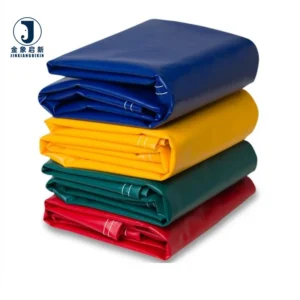
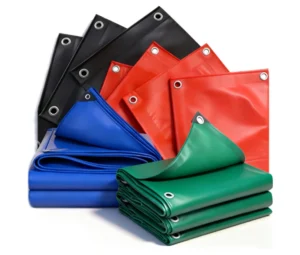
A: Color matching across multiple rolls is supported through controlled PVC coating formulation and in-process inspection. Provide your Pantone or RAL reference early in the sampling stage so the production team can calibrate the compound. Roll-to-roll color consistency is verified visually and instrumentally before shipment.
Q: What welding method works best for this PVC coated tarpaulin?
A: Both high frequency hot melt and hot air welding are suitable, with the optimal choice depending on seam geometry and production speed requirements. Request a sample roll to conduct weld trials on your equipment, verifying peel strength at the heat-affected zone before committing to full production runs.
Q: How does base fabric denier affect tear resistance in the field?
A: Higher denier yarns — such as 1000D2000D or 1300D1300D — provide substantially greater resistance to tear propagation compared to lighter options like 500D*840D. The weave density works together with denier to determine how effectively a puncture or cut is contained before it spreads under load.