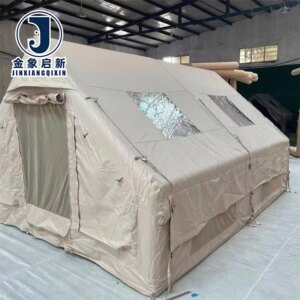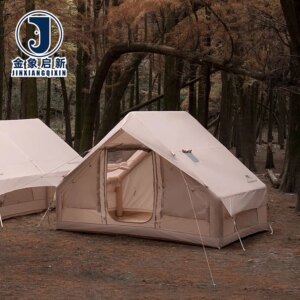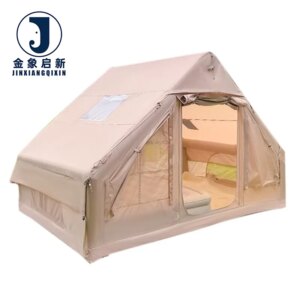
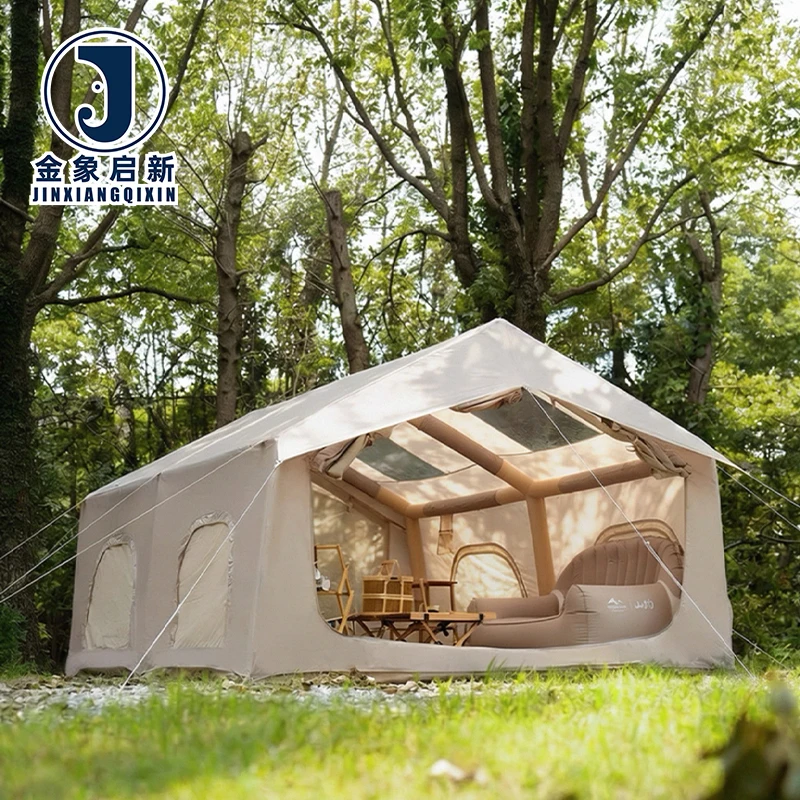
Precision Coating Control — three full production lines with 36 sets of professional equipment maintaining strict coating weight tolerances on every PVC inflatable tent fabric roll, ensuring batch-to-batch adhesion and consistency from sample to shipment.
Technical Specifications
| Parameter | Value |
|---|---|
| Product Type | Inflatable Tent |
| Core Material | PVC Tarpaulin |
| Product Form | Single Layer Inflatable Tent |
| Waterproof Performance | Fully waterproof coated construction |
| UV Resistance | UV-resistant (test basis not stated in source) |
| Tear Resistance | Tear-resistant coated fabric construction |
| Fire-Retardant Treatment | Fire-retardant (grade not stated in source) |
| Anti-Static Treatment | Anti-static (standard not stated in source) |
| Standards & Certifications | ISO 9001, ISO 14001, ISO 45001, CE |
| Customization | Sample customization, pattern printing, OEM & ODM services |
| Quality System | Full-process QA/QC with dedicated on-site inspectors |
Application Suitability
| Application | Exposure & Requirement |
|---|---|
| Emergency response command centers at construction sites | Continuous outdoor weather exposure, rapid inflation and deflation cycles, structural stability under wind load |
| Temporary storage facilities for disaster relief supplies | Constant moisture contact, UV exposure, frequent relocation and re-inflation |
| Equipment maintenance shelters in remote locations | Abrasion from equipment movement, dust and debris ingress, temperature fluctuation |
| Rapid deployment field stations for infrastructure inspection | Repeated packing and unfolding, transport vibration, variable climate conditions |
When "Fire-Retardant" on Paper Fails at the Site Gate
PVC inflatable tent fabric supplied with fire-retardant claims but no test report creates immediate compliance risk the moment a safety officer requests documentation.
A fire-retardant claim without a verifiable grade and matching test standard is a procurement liability, not a material specification. Technical buyers and fabricators specifying inflatable structures for mining, tunnelling or construction sites face a recurring problem: the quotation states flame resistance, but the roll arrives without the batch-specific test report required to pass a site safety audit. This gap between documentation and delivery forces project delays, rejected shipments, or last-minute re-sourcing under emergency timelines [NEED_CITE: fire safety compliance documentation requirements for temporary industrial structures]. The inflatable tent fabric material and coating technology must align with the fire classification standard enforced in the target market before an order is placed.
Base Fabric Architecture and Coating Weight Relationship
The mechanical behaviour of PVC inflatable tent fabric depends on the interaction between base fabric denier, weave density and the PVC coating weight applied to each surface. Heavier coating alone does not guarantee higher tensile strength; the yarn count and weave pattern of the polyester base determine how load distributes across the inflated tube structure. When evaluating inflatable tent fabric material and coating technology, buyers should request a specification sheet that documents both the base fabric construction and the coating weight independently, rather than relying on GSM as a single combined figure. This separation allows fabricators to predict how the fabric will behave under inflation pressure and flex stress at tube junctions.
Welded Seam Integrity at Inflation Stress Points
Inflatable tent structures concentrate mechanical stress at tube junctions, valve ports and anchor points where the fabric must flex repeatedly during inflation and deflation cycles. The PVC coating must maintain strong adhesion to the base fabric through these flex cycles without delaminating at the heat-welded seams. Coating adhesion is directly influenced by the coating method — knife coating typically produces a stronger bond with the base yarn than lamination, which matters when the inflatable tube flexes under wind load or internal pressure changes [NEED_CITE: coating adhesion test methods for PVC tarpaulin per ISO 2411]. Fabricators welding single-layer inflatable tents need coating chemistry that is compatible with high-frequency or hot-air welding parameters without producing brittle weld zones.
Specification Parameters and Their Practical Consequences
GSM represents the combined weight of base fabric plus coating on both surfaces, and treating it as the sole indicator of fabric performance leads to specification errors. A high GSM achieved through excessive filler in the PVC compound may produce a heavy roll that is brittle at low temperatures, while a lower GSM with high-denier base yarn and controlled knife coating delivers superior tear propagation resistance. The coating method determines both surface quality and weld behaviour: knife-coated PVC provides a uniform coating layer with consistent thickness, supporting reliable heat welding parameters across the entire roll width. Fire-retardant grades are not universal — different markets enforce different classifications, and inflatable tent fabric material and coating technology must be matched to the specific standard required at the installation site, whether that is a building materials classification or an industrial safety directive. Anti-static treatment, where specified, involves additives within the PVC compound that alter surface resistivity, and the applicable standard should be confirmed before ordering [NEED_CITE: anti-static classification standards for inflatable structures in mining environments]. Surface finish — glossy or matte — influences both cleaning behaviour in dusty site conditions and the adhesion of printed branding applied during fabrication.
The Hidden Cost of Undocumented Fire-Retardant Grades
Specifying fire-retardant inflatable tent fabric without confirming the exact grade and test standard creates downstream failure that is expensive and difficult to correct once the tent is deployed. A mining contractor receiving fabric without the required fire classification documentation faces an immediate site shutdown order, with the tent structure already erected and operational timelines already committed. Batch colour variation between rolls ordered at different times forces visible panel mismatches on large inflatable structures that are seen in public disaster relief deployments [NEED_CITE: batch colour consistency control methods in PVC coated fabric production]. Welded seams that fail before the fabric body reaches its expected service life indicate a mismatch between the welding parameters used and the coating chemistry of the roll supplied, a problem that typically surfaces only after the structure has been pressurised in the field.
Why Source Inflatable Tent Fabric Through This Facility
Three full production lines with 36 sets of professional processing equipment provide the capacity to maintain coating weight consistency across multiple rolls destined for a single inflatable tent project. The 10-person R&D team handles material selection, coating formulation adjustment and sample development specifically for inflatable structure applications, moving from specification inquiry to physical sample within days rather than weeks. Dedicated QA and QC staff inspect at every production stage, not only at final shipment, which catches coating weight deviation and adhesion failures before rolls leave the facility. Full-process quality inspection records with batch traceability are available for each roll, linking the fire-retardant and anti-static test documentation to the specific production batch number on the packing list. Custom sizing, pattern printing and OEM branding services are executed in-house rather than outsourced, keeping lead times controlled and reducing the coordination risk that arises when fabrication and coating happen at separate locations [NEED_CITE: in-house coating and fabrication quality control advantages].
Documentation & Verification
- Material specification sheet stating base fabric denier, weave density and PVC coating weight for each inflatable tent fabric roll
- Fire-retardant and anti-static test reports matched to specific production batch numbers upon request
- ISO 9001, ISO 14001, ISO 45001 and CE certificates supporting procurement compliance audits
- Pre-shipment inspection record documenting coating weight verification and visual quality assessment
- Roll packing list with batch traceability codes linking each roll to its production and test documentation
- Certificate of origin and customs support documentation included with every export shipment
Fabrication, Handling & Storage
- Set hot-air or high-frequency welding parameters based on the specific PVC coating weight and surface finish of the inflatable tent fabric received
- Store rolls upright on pallets in a covered area to prevent compression marks that affect inflation tube roundness
- Verify coating adhesion at weld test strips before committing to full production runs on each new batch
- Allow cold-stored rolls to reach ambient temperature before unrolling to avoid cracking the PVC coating at low temperatures
- Use mild detergent solutions for cleaning; avoid solvent-based products that degrade the PVC coating surface and compromise fire-retardant treatment
- Plan cutting layouts to minimise waste at tube junction panels where welded seam allowance is critical for structural integrity
Request a Technical Specification Proposal
To receive an accurate material recommendation, share the intended deployment environment and the specific fire-retardant or anti-static standard your project must satisfy. Specify whether you require raw roll stock for in-house fabrication or finished custom-sized inflatable tent units with pattern printing and branding. Confirm the target roll width, annual volume estimate and any colour consistency requirements across multiple production batches so the coating team can plan formulation matching before your order enters the line.
Frequently Asked Questions
Q: How is the GSM and coating weight of inflatable tent fabric verified upon delivery?
A: Each roll undergoes weight verification against the stated GSM before dispatch, documented in the pre-shipment inspection record. The material specification sheet provided with your order states the base fabric denier, weave density and PVC coating weight independently, allowing you to cross-check the combined GSM figure against your own measurements upon receipt.
Q: What fire-retardant grade and test standard applies to this inflatable tent fabric?
A: Fire-retardant treatment is available in multiple grades depending on your market requirement. The applicable grade must be confirmed at the inquiry stage so the correct test report — matched to your production batch number — is included with the shipment. Share your site safety or regulatory standard early to ensure alignment.
Q: What anti-static certification is available for inflatable structures used in mining or aviation?
A: Anti-static treatment is available for inflatable tent fabric destined for environments where static discharge is a hazard. The specific standard applicable to your operation must be identified before production begins. Request a consultation with the technical team to match the anti-static classification to your site compliance requirements.
Q: How are batch-to-batch colour and coating consistency controlled for roll orders?
A: Coating formulation is matched to a reference standard before each production run, with in-process QA checks monitoring colour and coating weight throughout. Batch traceability codes on the packing list link each roll to its specific production record, enabling you to verify consistency across rolls received in the same or separate shipments.
Q: What documentation is included with each order for compliance purposes?
A: Every shipment includes a material specification sheet, pre-shipment inspection record, roll packing list with batch codes, certificate of origin and customs documentation. Fire-retardant and anti-static test reports are supplied matched to your batch number when these treatments are specified. ISO and CE certificates are available for procurement file submissions.