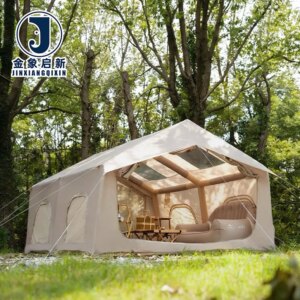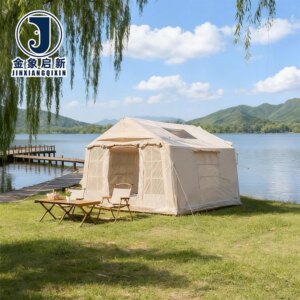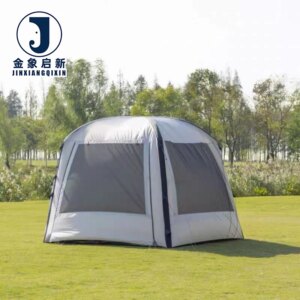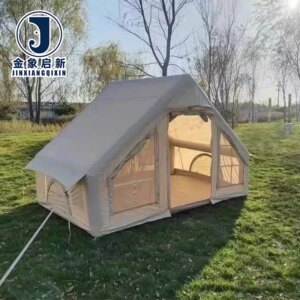
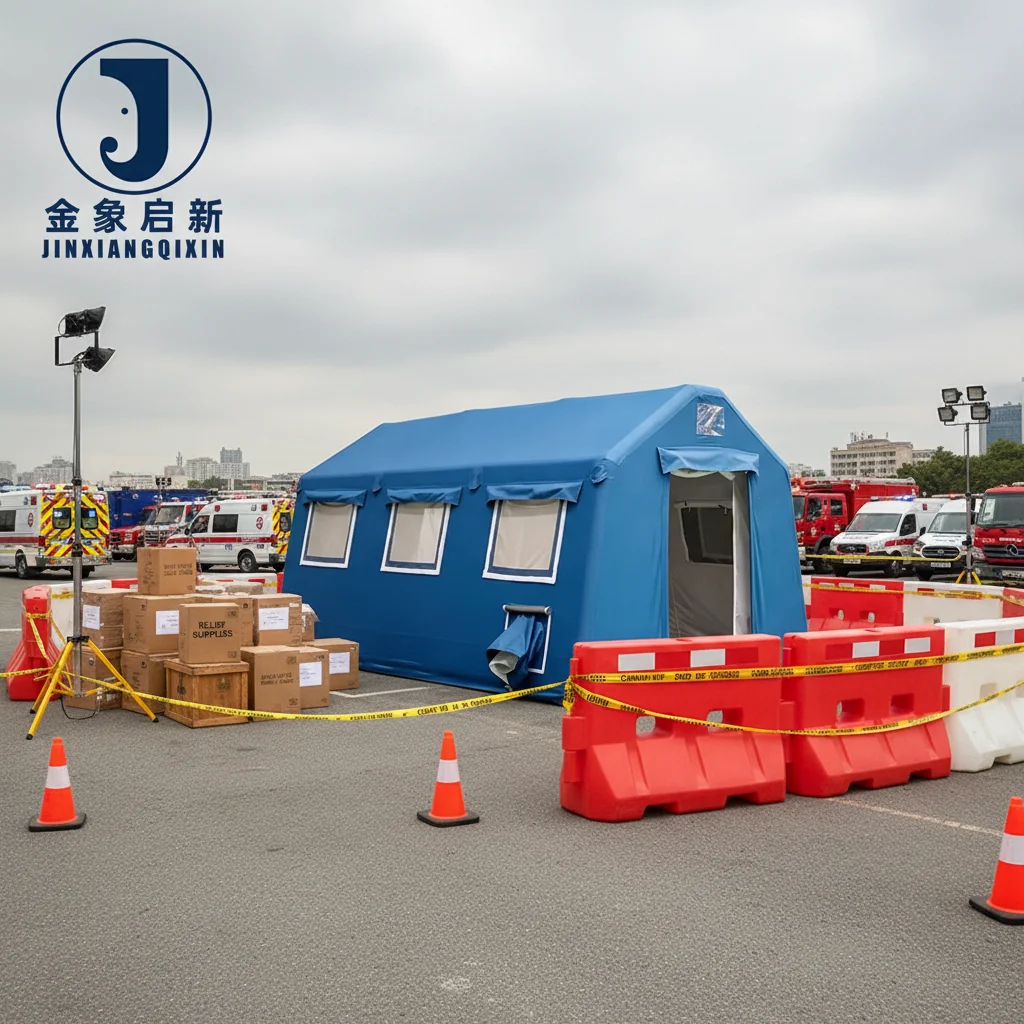
Deep Coating Process Control — nearly three decades refining PVC adhesion and weight consistency, applied to inflatable tent membrane structures where airtight integrity defines performance.
Technical Specifications
| Parameter | Value |
|---|---|
| Product Type | Inflatable Tent |
| Core Material | PVC tarpaulin |
| Waterproof Rating | >3000mm |
| Design Configuration | 4-season, quick automatic opening |
| Construction | Single layer |
| UV Resistance | UV-resistant PVC material (test basis not stated in source — confirm with supplier) |
| Flame Retardant | Available in flame retardant grades — confirm the grade required for your market |
| Anti-Static | Available on request — confirm certification needed for your application |
| Customization | OEM & ODM: sample customization, pattern printing, size and colour options |
| Production Facility | 9,180 m², 3 production lines, 36 sets of professional equipment |
| R&D Team | 10 technicians |
| Standards | ISO9001, ISO14001, ISO45001, CE |
Application Suitability
| Application | Exposure & Requirement |
|---|---|
| Temporary site offices at construction projects | Wind loading, dust ingress, repeated inflation cycles, ground abrasion at base |
| Mobile equipment shelters for outdoor events | Rapid deployment and teardown, UV exposure, variable weather between seasons |
| Auxiliary storage facilities for logistics operations | Continuous inflation pressure retention, forklift proximity, moisture barrier |
| Rapid deployment commercial shelters | Airtight seam integrity across temperature swings, transport folding stress |
Why Inflatable Tent Fabric Fails at the Weld Line Before the Membrane Does
Seam failure in inflatable structures is almost always a coating adhesion problem, not a fabric strength problem.
When PVC inflatable tent material is heat-welded, the coating must melt and fuse uniformly across the joint. If the base coating weight is inconsistent or the plasticiser migration is uneven, the weld peels apart under inflation pressure while the surrounding fabric remains intact. I have seen heavy-grade coated rolls fail at the weld line on site, leaving contractors patching seams instead of working. The specification sheet rarely captures this because standard tensile tests pull the fabric body, not the joint [NEED_CITE: tensile and tear test methods for coated fabrics per ISO 1421]. An inflatable tent fabric manufacturer that controls coating weight at the application stage — not just at final inspection — delivers material that welds predictably across an entire production run.
Coating Weight Consistency and Air Retention
The airtight performance of any inflatable camping tent depends on uniform PVC coating across the full roll width. Variations in coating thickness create weak zones where micro-leaks develop under sustained inflation pressure. Our PVC inflatable tent material production uses process-controlled coating application across three dedicated lines, with in-line weight checks that catch deviation before the roll reaches the welding stage. This matters especially for 4-season tents deployed in temperature-variable conditions where the membrane contracts and expands with each cycle.
Temperature Resilience Across Deployment Seasons
A 4-season inflatable structure must retain flexibility in cold conditions without softening excessively in direct heat. The PVC formulation used in this tent fabric balances plasticiser content to maintain structural integrity across the temperature range encountered in field deployment. UV-resistant PVC material slows surface degradation from prolonged sun exposure, though buyers should confirm the specific UV test basis relevant to their regional climate before committing to volume orders [NEED_CITE: UV degradation test protocols for PVC coated textiles].
Reading the Specification Sheet Beyond Waterproof Numbers
The >3000mm waterproof rating describes hydrostatic head resistance — the pressure of water column the coated fabric can withstand before leakage occurs. For inflatable tent applications, this rating also signals coating density and continuity, since pinholes or thin spots would register as failures during testing. However, waterproof rating alone does not predict tear propagation resistance or weld strength. Base fabric denier and weave density determine how a puncture spreads, while coating adhesion governs whether heat-welded seams hold under inflation load. Buyers sourcing PVC inflatable tent material custom to their structure design should request the full material specification sheet covering base fabric construction, coating weight, and batch-specific waterproof test results rather than relying on a single headline number.
What Specification Gaps Cost You in the Field
When an inflatable tent membrane fails mid-deployment, the root cause often traces back to a specification that was never verified before production. Coating weight stated on the quotation but lighter on arrival means the welder must adjust parameters mid-run, producing inconsistent seams. Colour variation between rolls in the same order becomes visible once panels are welded side by side on a commercial structure. UV treatment claimed without supporting test data leaves the membrane degrading faster than the project timeline [NEED_CITE: field failure analysis of PVC coated fabric structures]. These are not material defects — they are specification verification failures that a disciplined pre-shipment inspection process prevents.
Why Procurement Teams Source Inflatable Structures Here
Process control over PVC coating weight and adhesion has been refined across nearly 30 years of focused coated fabric production, giving buyers material that welds consistently roll after roll. The 10-person R&D team develops custom samples — including size adjustment, colour matching, and pattern printing — within days rather than weeks. Three full production lines with 36 sets of professional equipment support bulk capacity while maintaining batch-to-batch colour and weight consistency that inflatable tent and membrane structure manufacturers depend on. Every roll undergoes dedicated QA/QC inspection at each production stage, with 100% pre-shipment verification covering waterproof testing and seam integrity. ISO9001, ISO14001, ISO45001, and CE certifications accompany commercial orders as standard documentation.
Documentation & Verification
- Material specification sheet stating base fabric, coating weight, and colour reference per roll
- Batch-specific waterproof test report confirming >3000mm rating before dispatch
- Pre-shipment inspection record covering seam integrity and surface consistency
- ISO9001, ISO14001, ISO45001, and CE certificates with every commercial order
- Certificate of origin and customs documentation for cross-border shipment
Fabrication, Handling & Storage
- Heat-weld seams using temperature and dwell settings matched to the PVC coating weight for consistent fusion
- Store rolls upright on padded racks to prevent permanent creasing in the coated surface
- Avoid dragging single-layer PVC membrane across abrasive ground during site deployment
- Use PVC-compatible cleaners only — solvent-based products degrade the plasticiser in the coating
- Allow material to reach ambient temperature before unrolling in cold conditions to prevent cracking
- Plan panel cutting layout to maximise roll width utilisation and minimise welded joint count
What We Need to Quote Your Project
Provide the intended deployment environment, expected inflation pressure range, and any fire-retardant or anti-static certification required by your local regulations. Specify target panel dimensions, colour or pattern requirements, and whether you need rolls or finished cut-and-welded panels. Confirm your annual volume so we can align production scheduling and batch consistency across your order cycle. Sample development is available for material and colour approval before volume commitment.
Frequently Asked Questions
Q: How do I verify the waterproof rating when the rolls arrive?
A: Each batch ships with a test report documenting the >3000mm hydrostatic head result from pre-shipment testing. You can conduct independent hydrostatic testing on receipt using standard column methods to confirm the coating integrity matches the stated specification before cutting or welding begins.
Q: What UV exposure data is available for this PVC grade?
A: The material carries UV-resistant PVC formulation, but the specific test basis and exposure duration data should be confirmed with our R&D team for your regional climate conditions. We can arrange third-party UV degradation testing at accredited laboratories prior to production if your project specification requires it.
Q: Should inflatable tent seams be welded or stitched?
A: Heat welding is the standard for inflatable tent structures because stitched needle holes create permanent air-leak paths through the membrane. Welded seams fuse the PVC coating layers together, maintaining airtight integrity. Our QA process inspects every weld point during pre-shipment verification to catch adhesion failures before dispatch.
Q: What OEM customization options are available for inflatable tent fabric?
A: We offer size adjustment, colour matching, pattern printing, and logo application through our OEM and ODM process. Sample development typically requires 7–10 business days, with production lead times of 15–20 business days after approval. The 10-person R&D team handles material selection and prototype development for custom requirements.
Q: How is colour consistency controlled across multiple rolls in one order?
A: All rolls within a single production batch are coated from the same compounded PVC mixture under controlled conditions. Our pre-shipment inspection compares colour across rolls side by side before packing. For large orders spanning multiple production runs, we retain colour reference samples to maintain continuity between batches.