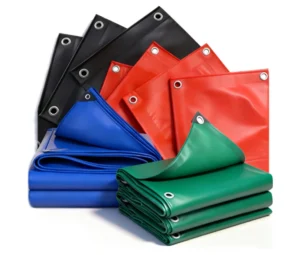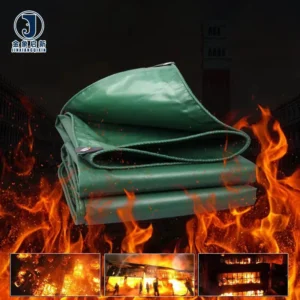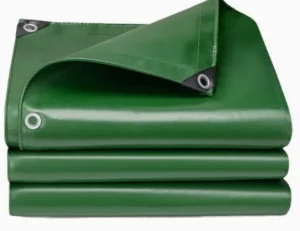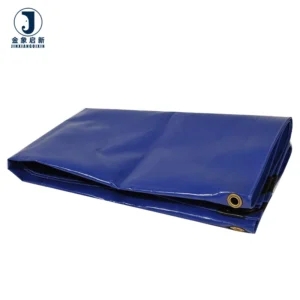
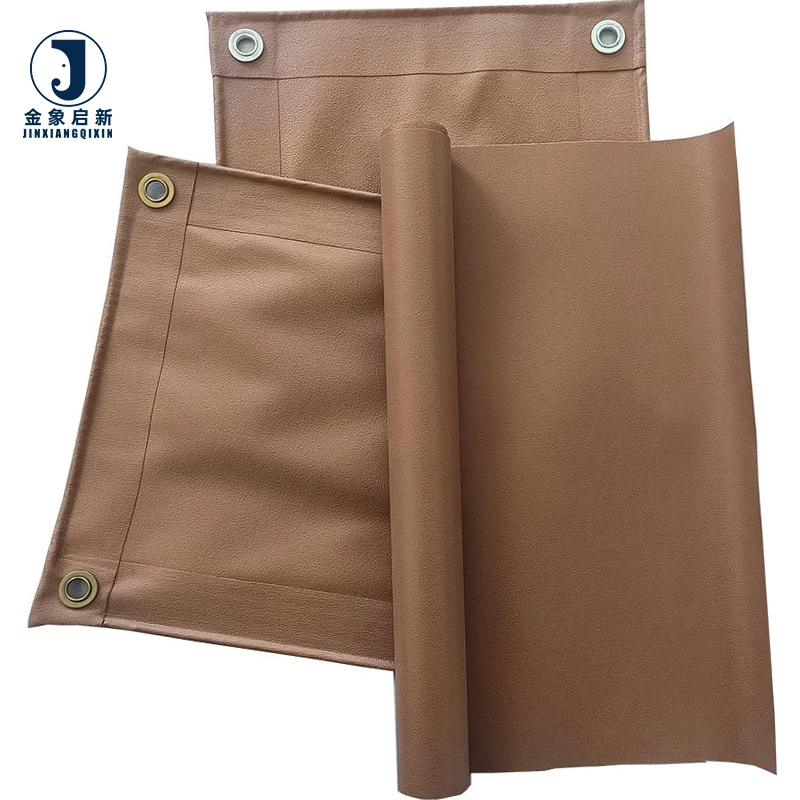
Precision Coating Control — Every roll of 1000D PVC Coated Tarpaulin 550GSM/900GSM is produced on calibrated knife coating lines where coating weight is measured and documented per batch, ensuring the GSM you quote is the GSM you receive.
Technical Specifications
| Parameter | Value |
|---|---|
| Product Type | PVC Coated Tarpaulin |
| Base Fabric | 1000D Polyester |
| Coating Method | PVC Knife Coated |
| Weight Options | 550GSM / 900GSM |
| Waterproof Rating | Fully Waterproof |
| Surface Finish | Self Clean |
| Flame Retardant | Available in flame retardant grades — confirm the grade required for your market |
| Anti-Static | Available — confirm the standard required for your application |
| Anti-Mildew | Available |
| UV Treatment | Anti-UV coated — confirm test basis for your specification |
| Cold Resistance | Anti-cold treatment available |
| Key Features | Waterproof, Tear-Resistant, Oilproof, Soundproof |
Application Suitability
| Application | Exposure & Requirement |
|---|---|
| Truck & Trailer Cover | Road abrasion, constant flexing at load points, UV and weather exposure |
| Side Curtain | Repeated rolling and tension cycles, weld seam integrity under dynamic load |
| Outdoor Tent & Awning | Prolonged UV exposure, wind load, rain ingress prevention |
| Roof Cover | Standing water, thermal cycling, puncture from maintenance traffic |
| Flood Barrier | Continuous water contact, hydrostatic pressure, deployment abrasion |
| Inflatable Structure | Air retention, seam welding under internal pressure, UV degradation |
Why "Waterproof" Does Not Guarantee Long-Term Coating Adhesion
The coating process determines whether waterproofing survives the first season or the third.
Many PVC coated fabrics pass an initial water column test but delaminate once the bond between the base fabric and the coating layer is stressed by thermal cycling or mechanical flex. [NEED_CITE: coating adhesion test methods per ISO 2411 for coated fabrics] With this PVC Coated Tarpaulin 1000D 550GSM 900GSM, the knife coating method forces PVC paste into the interstices of the 1000D woven base, creating a mechanical lock rather than a surface bond. When a buyer specifies material for a truck cover that flexes with every load shift, it is this adhesion — not the surface waterproofing — that dictates service life. Technical specifiers should request the adhesion value alongside the hydrostatic head figure to understand real field behavior.
How Knife Coating Differs From Lamination and Calendering
The PVC Coated Tarpaulin 1000D 550GSM 900GSM uses knife coating, where liquid PVC paste is drawn across the base fabric under a precision blade. This forces the compound through the weave structure, producing a bond that holds during high-frequency welding and resists peeling at stress points. Lamination, by contrast, bonds pre-formed PVC film to fabric with adhesive, creating a layered structure that can separate when exposed to heat at weld lines. [NEED_CITE: comparison of coating methods for industrial textile applications] Calendering presses PVC between rollers onto the fabric but achieves lower penetration into dense weaves like 1000D, making it more suited to lighter base fabrics.
What Self Clean Finish Means for Outdoor Maintenance Cycles
The self-clean surface treatment on this fabric reduces the adhesion of dust, pollen, and road film that accumulate on PVC coated tarpaulin deployed outdoors. Instead of bonding to the coating surface, particulate matter is more easily washed away by rainfall, which reduces the frequency of manual cleaning for truck fleets and tent operators. This treatment is applied at the coating stage and is integrated into the top layer rather than sprayed on post-production, meaning it does not wash off during routine pressure cleaning. For fabricators producing side curtains or large-format tent panels, this translates to fewer warranty callbacks related to staining and surface degradation in the first years of service.
Reading the Relationship Between 1000D Denier, GSM, and Mechanical Performance
The 1000D base fabric denier defines the thickness of individual yarns in the woven scrim, which directly governs tear propagation resistance — once a tear starts, thicker yarns arrest it more effectively. The 550GSM and 900GSM coating weights add mass and stiffness but do not proportionally increase tear strength; their primary contribution is to abrasion resistance, weld seam bulk, and barrier properties. A 900GSM grade will feel substantially stiffer than 550GSM at the same denier, which affects how the fabric handles during fabrication and how it drapes over irregular loads. For high-frequency welding, the 900GSM grade provides a thicker PVC layer at the weld zone, allowing wider weld parameters and stronger seam formation. The choice between the two grades should be driven by the mechanical demand at the weld line and the flexibility required in the finished product, not by weight alone.
What Happens When Coating Weight Is Lower Than Quoted
When PVC coated tarpaulin arrives lighter than the specified GSM, the shortfall is not merely a question of missing material — it typically indicates reduced coating penetration into the base fabric. [NEED_CITE: impact of coating weight deviation on tensile performance in PVC coated textiles] This leaves yarns partially exposed within the weave, creating pathways for moisture ingress and reducing the bulk available at weld seams. Fabricators who set their high-frequency welding parameters for the quoted GSM will find seams that peel apart because the PVC layer is too thin to form a proper fused joint. For truck cover and side curtain applications, this failure appears first at the flex points where the load shifts, long before the body of the fabric shows any sign of wear.
Why Technical Buyers Source From Process-Controlled Coating Lines
Jinxiang operates three full production lines with 36 sets of professional coating and finishing equipment, supporting consistent output across the 550GSM and 900GSM grades without cross-contamination between runs. The 10-person R&D team develops custom formulations and sample rolls within days, allowing technical buyers to validate weld parameters and color matches before committing to bulk orders. Every production stage has dedicated QA checkpoints, and a 100% pre-shipment inspection verifies GSM, color consistency, and coating integrity against the purchase specification. [NEED_CITE: ISO 9001 quality management in coated fabric manufacturing] For buyers ordering multiple rolls of the same PVC Coated Tarpaulin 1000D 550GSM 900GSM, roll-to-roll consistency is verified before dispatch, not assumed from the production batch number.
Documentation & Verification
- Material specification sheet stating base denier, coating method, and confirmed GSM per roll
- Test reports for flame retardant and anti-UV grades matched to the order specification
- Pre-shipment inspection record documenting GSM measurement and visual QA findings
- Roll packing list with individual roll weights and batch traceability codes
- ISO and CE certificates provided with each shipment for compliance verification
- Certificate of origin and customs documentation for international consignments
Fabrication, Handling & Storage
- Set high-frequency weld parameters for the specific 550GSM or 900GSM grade, as thicker coatings require longer dwell times
- Store rolls upright on pallets to prevent flat-spot deformation of the 1000D base fabric under its own weight
- Allow cold-stored rolls to reach ambient temperature before unrolling to avoid cracking the anti-cold treated PVC surface
- Use compatible PVC-based adhesives for repair patches, testing adhesion on the self-clean finish before full application
- Plan cutting layouts to minimize cross-grain panels, as 1000D woven fabric tears more easily along the bias
- Protect cut edges with heat-sealed hems or PVC tape to prevent yarn fraying at the base fabric interface
What We Need To Quote Accurately
Provide your end-use application, the environmental exposure conditions your finished product will face, and any fire classification or anti-static standard required by your local regulations. Specify whether you need rolls at standard widths or custom slit widths, and confirm your annual volume so we can align production scheduling. If your project requires a specific color match or printed branding, share the Pantone reference and we will develop a sample roll for your approval before bulk production.
Frequently Asked Questions
Q: How do I verify the GSM of 550GSM or 900GSM rolls on arrival?
A: Cut a measured sample from each roll and weigh it on a calibrated scale, then calculate GSM from the sample area. Compare the result against the pre-shipment inspection record that accompanies your order. Any deviation beyond standard tolerance should be flagged immediately before fabrication begins, as welding parameters depend on accurate coating weight.
Q: What flame retardant test standard applies to this PVC coated tarpaulin?
A: Flame retardant grades are available, but the specific test standard depends on your market and application — common frameworks include DIN 4102, NFPA 701, and local building code classifications. Confirm the grade and test method required for your project before ordering, and the corresponding test report will be supplied with your shipment documentation.
Q: How does 1000D base fabric affect tear strength compared to lower denier options?
A: The 1000D denier means each yarn in the woven scrim is substantially thicker, which arrests tear propagation more effectively once a cut or puncture initiates. Combined with the 550GSM or 900GSM PVC coating that locks the weave structure, this base fabric provides the mechanical backbone that technical specifiers require for truck covers and structural tent applications.
Q: How is batch-to-batch color consistency controlled across multiple rolls?
A: Each production run uses matched pigment batches, and color is verified against the approved reference during the in-process QA stage and again at pre-shipment inspection. For orders spanning multiple rolls of the same PVC Coated Tarpaulin 1000D 550GSM 900GSM specification, rolls are grouped by production batch on the packing list to support consistent visual appearance when installed side by side.
Q: Can the self-clean finish withstand repeated pressure washing?
A: The self-clean treatment is integrated into the top coating layer during the knife coating process rather than applied as a surface spray, so it does not wash away during routine cleaning. However, aggressive pressure washing at close range can damage the PVC surface over time — we recommend maintaining a moderate distance and testing a small area first to confirm compatibility with your cleaning equipment.