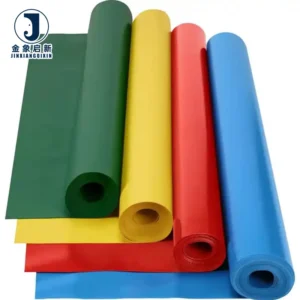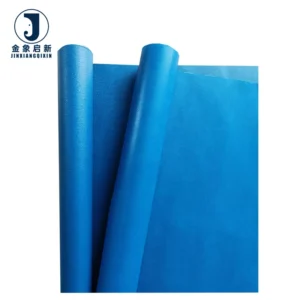
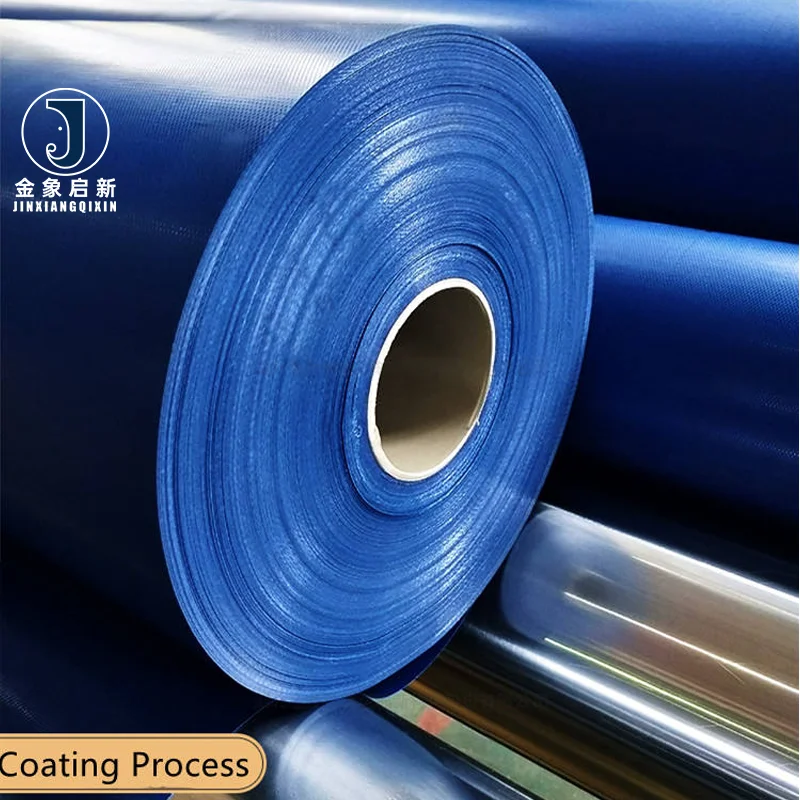
Coated Fabric Control — 650 gsm PVC coated tarpaulin roll built on verified base fabric denier, coating weight and tensile values, with pre-shipment inspection backing every dispatch.
Technical Specifications
| Parameter | Value |
|---|---|
| Specification | 650gsm 1000D1300D 2020 |
| Product Type | PVC Coated Tarpaulin Roll |
| Base Fabric | Polyester |
| Yarn Count | 1000D×1300D |
| Mesh Density | 20×20 |
| Weight | 650 g/m² |
| Total Thickness | 0.46 mm |
| Coating Material | PVC (double-sided) |
| Tensile Strength (Warp) | 2550 N (test basis not stated) |
| Tensile Strength (Weft) | 2250 N (test basis not stated) |
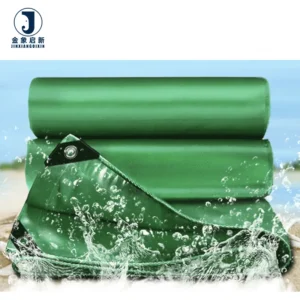
| Waterproof | Yes |
| Flame Retardant | Available — confirm grade required for your market |
| Anti-UV | Available — confirm test basis required for your market |
| Color | Customizable |
| Printing Option | Custom branding available |
| Package | Roll packing, bale packing, carton |
Application Suitability
| Application | Exposure & Requirement |
|---|---|
| Truck and trailer side curtain | Constant flexing at load points, road abrasion, UV and weather exposure, weld seam integrity under dynamic stress |
| Outdoor awning and tent structure | Prolonged sun exposure, wind loading, rain ingress prevention, structural tension holding |
| Industrial machine and equipment cover | Contact with oils and dust, repeated handling, abrasion from loading and unloading, water ingress protection |
| Wood and timber stack cover | Moisture barrier requirement, UV degradation resistance, wind uplift on large surface areas |
Why 650 gsm PVC Coated Tarpaulin Can Still Fail at the Weld Line
Coating adhesion and base fabric stability determine weld performance, not weight alone.
Technical buyers often specify by GSM and assume the welded seam will hold as long as the fabric itself. In practice, PVC coated tarpaulin 650 gsm failures frequently originate at the heat-welded joint where the coating softens and re-bonds. If the coating thickness is uneven or the base fabric shifts during welding, the seam becomes the weakest point. I have seen heavy-grade coated rolls fail at the weld line while the surrounding fabric remained intact — the seam peeled under flex load that the body of the material handled without issue. [NEED_CITE: tensile and tear test methods for coated fabrics per ISO 1421]
The gap between quoted specification and actual weld behaviour is where most field failures occur. A 650 gsm roll with consistent double-sided coating and stable base fabric weaves predictably under hot air or wedge welding. One with coating weight variance across the roll width will weld unevenly: some sections bond fully, others delaminate on the first flex cycle.
How Base Fabric Architecture Shapes Tensile Behaviour
The 1000D×1300D yarn count paired with a 20×20 mesh density creates a base fabric where warp and weft carry load in a defined ratio. The higher denier in the weft direction (1300D) gives the PVC coated tarpaulin 650 gsm a directional strength bias that matters when the fabric is tensioned in a specific orientation — such as a side curtain pulled along its length. Specifiers who ignore yarn direction and cut panels arbitrarily may find the material performs differently depending on which axis takes the primary load.
Coating Method and Its Effect on Seam Integrity
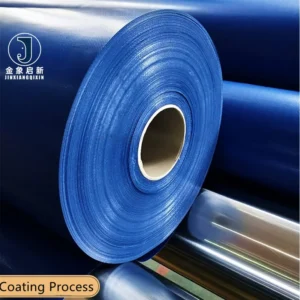
Double-sided PVC coating applied to a 0.46 mm total thickness means the coating layer on each face must bond firmly to the polyester base. The coating weight on each side influences how the material responds to hot air welding: too thin a coat and the weld lacks fusion depth; too thick and the excess PVC flows out of the joint before bonding. For fabricators running automated weld lines, consistent coating thickness across the roll width is more important than the total GSM figure alone. [NEED_CITE: coating adhesion test standards for PVC tarpaulin]
Reading the Specification Sheet Beyond the Headline Number
The 650 gsm weight is the sum of base fabric mass plus coating on both sides. Two rolls can share the same GSM yet differ substantially in how that weight is distributed. A heavier base fabric with thinner coating will tear differently than a lighter base with thicker coating — the first resists tear propagation through yarn density, the second through coating rigidity. The 1000D×1300D base at 20×20 density indicates a fabric that relies on yarn strength for structural performance, with the PVC coating providing waterproofing and surface protection rather than carrying the primary load. Thickness at 0.46 mm places this material in a range where flexibility and handle remain practical for fabrication while maintaining sufficient body for tensioned applications. The warp tensile value of 2550 N and weft value of 2250 N reflect the directional yarn architecture — a difference that should inform panel orientation during cutting and welding. [NEED_CITE: relationship between GSM distribution and tear strength in coated polyester fabrics]
The Cost of Ignoring Coating Consistency Across the Roll
When coating weight varies from one edge to the other, fabricators cut panels that weld cleanly on one side and delaminate on the other. The defect may not appear until the finished cover is installed and subjected to wind load or flex stress. Batch-to-batch colour variation across rolls in the same order becomes visible once panels are installed side by side on a truck or structure. These are not material failures in the conventional sense — the fabric itself meets specification — but they result in rejected deliveries, re-fabrication costs and project delays that fall on the buyer. [NEED_CITE: common causes of coating weight variation in PVC tarpaulin production]
Flame retardant and anti-UV treatments, when specified without a confirmed grade or test report, create a different category of risk: the material passes incoming inspection but fails the compliance audit on site, leaving the contractor exposed.
Why Technical Buyers Source This Grade Here
The 10-person R&D team handles material selection and sample development for custom specifications, allowing fabricators to validate weld parameters and colour match before committing to a production run. Three full production lines and 36 sets of professional equipment support bulk roll output with consistent coating application across the width. Dedicated QA/QC at every production stage with 100% inspection before shipment catches coating weight variance and colour drift before rolls leave the facility. Material specification sheets state GSM, base fabric denier and coating weight for every order, giving receiving teams the data needed for incoming verification. Nearly 30 years of focused coated fabric production provides the process control depth that keeps roll-to-roll consistency within tolerance for high-volume fabricators.
Documentation & Verification
- Material specification sheet stating 650 gsm weight, 1000D×1300D base fabric and coating type per roll
- Flame retardant and anti-UV test reports provided where grade is confirmed at order stage
- Pre-shipment inspection record covering roll weight, width and surface quality
- Roll packing list with net and gross weight for container loading verification
- Certificate of origin and customs documentation for international dispatch
- ISO and CE certificates available with shipment documentation package
Fabrication, Handling & Storage
- Hot air weld temperature and speed should be set against the 0.46 mm thickness and double-sided PVC coating to achieve full fusion
- Panel cutting orientation must account for the 1000D×1300D directional yarn layout to align the stronger axis with primary load
- Rolls stored upright on pallets to prevent flat-spot deformation of the 650 gsm coated surface
- Low-temperature transport requires acclimatisation before unrolling to avoid PVC coating cracking at the fold
- Surface cleaning with mild detergent only — aggressive solvents may degrade the PVC coating layer
- Field repairs using compatible PVC hot air weld patches matching the base coating chemistry
What to Include in Your Enquiry
Provide the end-use application and the environmental conditions the fabric will face — UV exposure duration, wind load expectations, and any fire classification required by your local building or transport code. Specify whether you need rolls at standard width or a custom dimension, and whether colour matching across multiple rolls in a single order is critical. If you require finished panels rather than roll stock, share the cut sizes and any reinforcement or eyelet requirements so the fabrication team can advise on seam placement and edge treatment.
Frequently Asked Questions
Q: How is the 650 gsm weight verified on each roll before shipment?
A: Each roll is weighed and measured during the pre-shipment inspection to calculate actual GSM. The inspection record states the measured weight against the specified 650 gsm value. Buyers can request the inspection data before dispatch to confirm compliance, and third-party inspection at the receiving dock is supported.
Q: What flame retardant grades are available for this PVC coated tarpaulin?
A: Flame retardant treatment is available in multiple grades depending on the target market requirement — such as B1, M2 or NFPA 701. The specific grade must be confirmed at the enquiry stage so the correct formulation is applied and a matching test report is issued with the shipment.
Q: How is roll-to-roll colour consistency controlled within a single order?
A: Colour reference is set at the sample approval stage and used as the production benchmark. In-process QA checks colour against the reference at multiple points during coating. The 100% pre-shipment inspection compares rolls side by side to flag any visible deviation before packing.
Q: What are the key welding considerations for this 0.46 mm material?
A: The double-sided PVC coating requires hot air or wedge welding parameters matched to the total thickness. Weld speed and temperature must allow full coating fusion without burn-through. Fabricators should run test welds on sample pieces to dial in settings before processing full panels.
Q: Can the anti-UV treatment be verified with a test report?
A: Anti-UV treatment is available and can be supplied with a test report when the required test standard is specified at the order stage. Buyers should state the UV stability standard their market demands so the appropriate treatment level is applied and documented.